
May 12, 2026
Foreigners welcome? Categorizing change in German mass media discourse
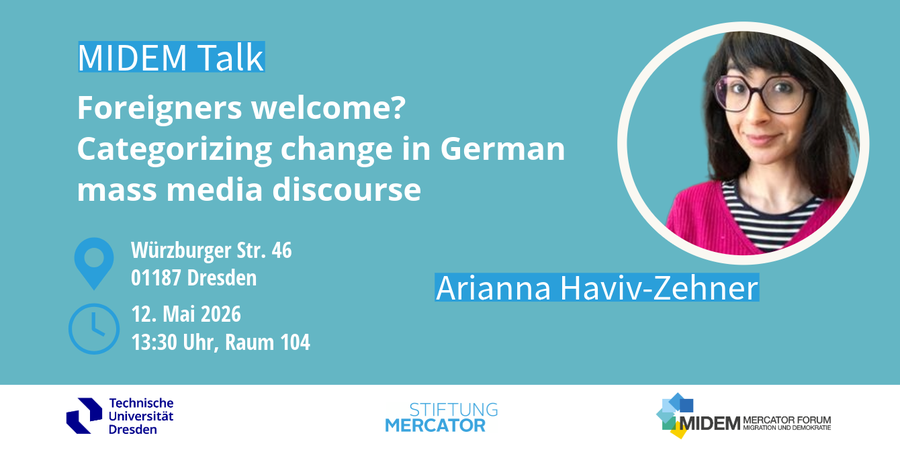
We are pleased to welcome Arianna Haviv-Zehner to give a lecture in which she will present her latest research findings on media discourse and its role in shaping public debates.
The mass media are frequently studied for their influence on public opinion. However, media analysis often relies on measuring the frequency of certain terms, on framing elements, and on identifying bias. In this lecture, Arianna Haviv-Zehner will present new approaches to media analysis that are beneficial to the social sciences.
Using the German General Social Survey (GGSS), she applies Latent Semantic Analysis (LSA) to categorize and compare discourse at key points in time (2006, 2010, 2012, 2016, 2021), drawing on over 10,000 media articles from various German media outlets. The focus is on migration and the integration of foreigners in Germany, as well as on the competing discursive narratives surrounding these developments.
The study examines the term “foreigner” in media texts; German compound terms such as “foreigner problem” and “foreigner integration” play a central role in the discourse analysis. Based on their semantic meaning and co-occurrence, these compound terms are classified into four categories: administration and politics, social integration, xenophobia, and migration restriction.
The results show that the discourse on social integration has gained in importance over time. A subsequent sentiment analysis reveals that this discourse is not positive but neutral, while other categories exhibit a negative trend. The presentation also addresses computer-aided applications for improving media analysis as well as the challenges involved in contextualizing survey data.