
26.06.2026
Check Out our Recent and Forthcoming Publications on Environmental Humanities Teaching and Pedagogy
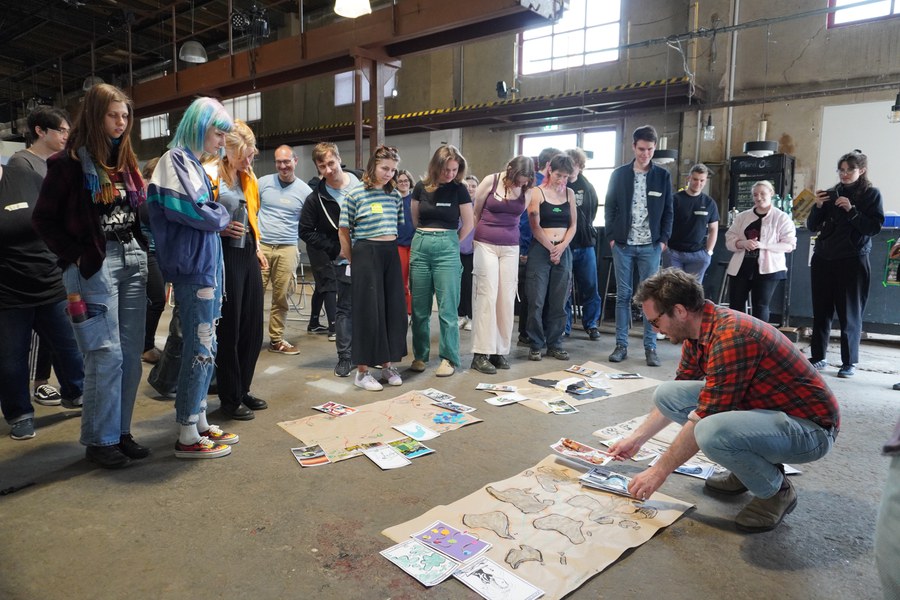
Critical Worldbuilding Seminar. Student Workshop with Orangotango Collective at Geh8 in Dresden.
We regularly collaborate with artists and experiment with interdisciplinary co-teaching formats to foster affective, creative, situated, and embodied learning strategies in the environmental humanities classroom. We frequently publish on our course concepts, theoretical considerations on pedagogy, and reflections of specific seminars.
RECENT SEMINARS
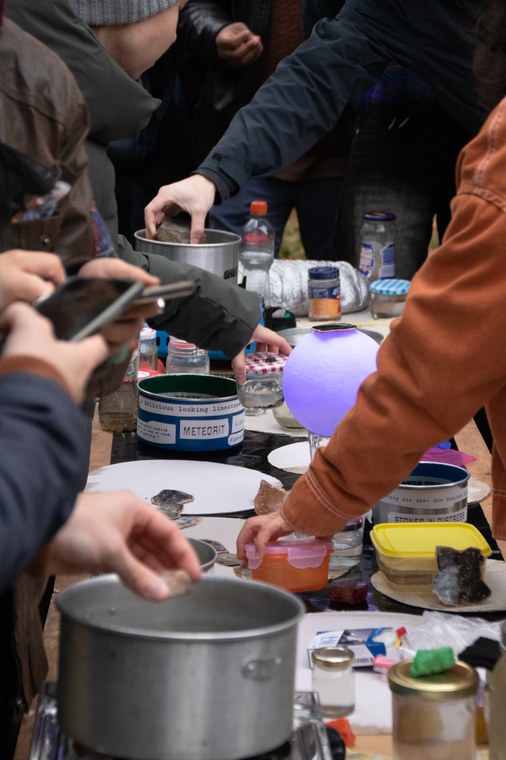
The Stone that Carries You. Artistic Workshop with Sophie Lindner. Großer Garten Dresden. Geostories Seminar
- After Petrocultures (Summer 2026) |Interdisciplinary seminar with English and Sociology students. Co-taught with Prof. Dr. Susann Wagenknecht (Sociology, TUD). Curation of Carbon Ruins Dresden Exhibit for Petrocultures 2026.
- Atmospheric ImaginAiries: Literature and Air (Summer 2025) | Seminar in collaboration with German Hygiene Museum Dresden. Co-teachers included artistic researcher Karolina Sobecka and SF scholar Chris Pak.
- Geostories: Literature and Earth (Winter 2024/25) | Seminar co-taught with artistic researcher Sophie Lindner. See publication "The Carrier Bag of Geostories."
- Critical Worldbuilding | Kritische Weltbildung (Summer 2023) | Seminar co-taught with Prof. Dr. Nicole Raschke (Geography Education), Dr. Anke Schwarz (Human Geography), and Pauline Mai (Geography Education). See publications on "Critical Worldbuilding."
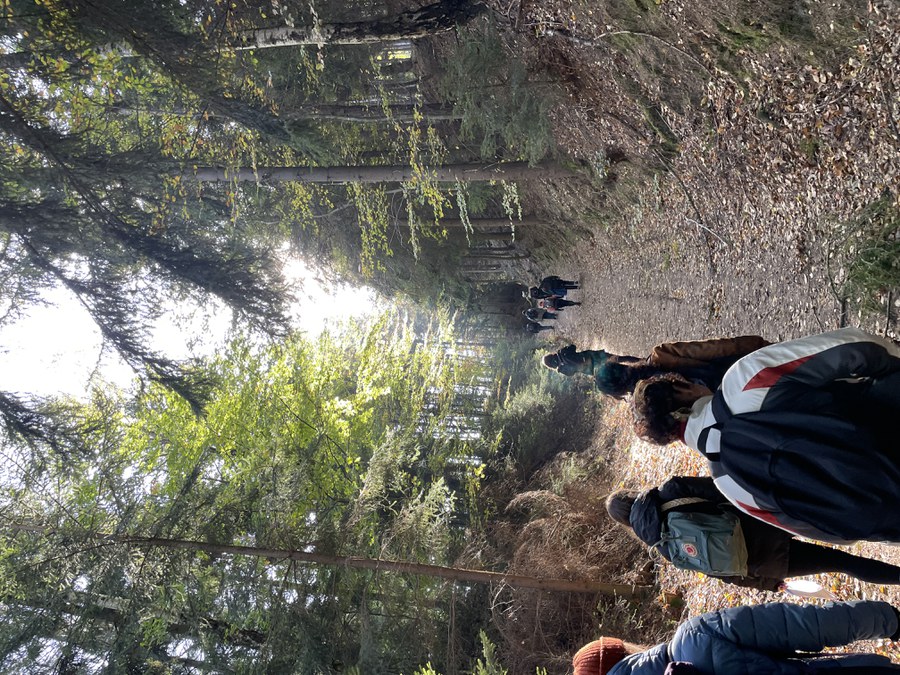
Field Trip to Volcanic Mountain Lausche. With geologist Dr. Jörg Büchner. Geostories Seminar
RECENT PUBLICATIONS:
- Ingwersen, Moritz and Sophie Lindner. "The Carrier Bag of Geostories: Transformative Pedagogy for Human-Lithic Enmeshment." Lagoonscapes 5.2. 2025. 287-310. Blind Peer Reviewed. Open Access. http://doi.org/10.30687/LGSP/2785-2709/2025/02/001
Abstract: This article presents the conceptual framing and course design of a literary and cultural studies seminar that brings arts- and place-based methodologies into dialogue with elemental ecocriticism, feminist materialisms, speculative geology, geopoetics, and inhuman geography. Introducing a process-oriented assignment titled ‘The Carrier Bag of Geostories’, we reflect on the course as an occasion for transformative learning and advocate pedagogical strategies of generative estrangement and the cultivation of familiarity with the inhuman to foster eco-systemic literacy and expand students’ capacities for environmental affect and agency.
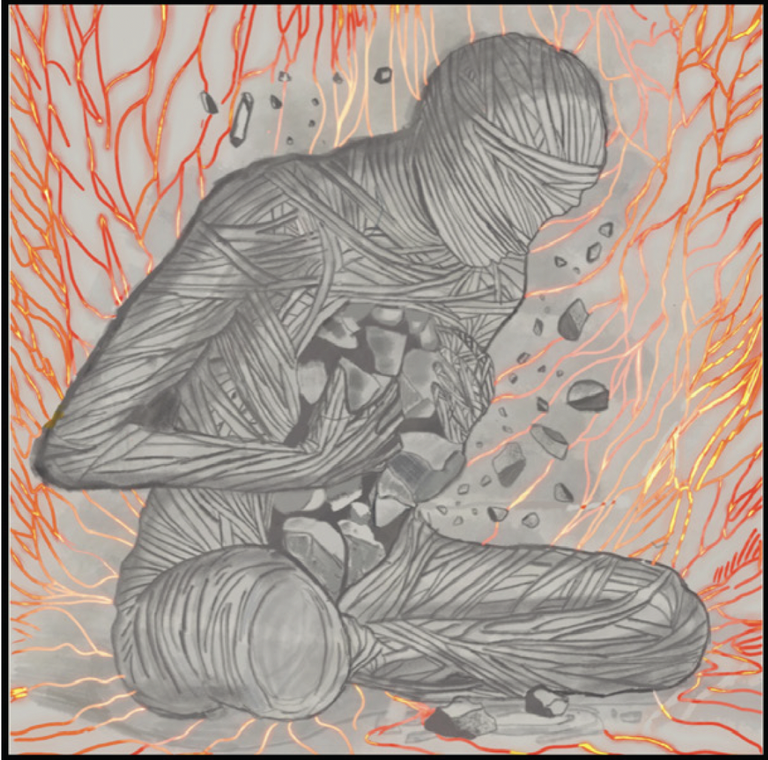
"The land that holds us." Acsah Kulasingham.Student Artwork submitted as part of Carrier Bag of Geostories Assignment.
- Lucio de Capitani, Christina Brito and Moritz Ingwersen (eds). Teaching the Environmental Humanities in Europe. Special Issue of Lagoonscapes. 2025. Open Access. http://doi.org/10.30687/LGSP/2785-2709/2025/02
Abstract: This special issue of Lagoonscapes gathers pedagogical reflections, teaching concepts, and experiments developed by university teachers across Europe who work in conversation with the field of the Environmental Humanities. Amidst the escalating climate crisis, accelerated by a resurgence of right-wing nationalisms and ongoing systems of environmental injustice, learning how to teach (and learn) with, through, and about socio-ecological precarity, interdependencies, and enmeshment is a crucial and increasingly urgent task that requires an expansion of traditional methodologies and subject matters. With an emphasis on place-based, creative, and collaborative approaches to pedagogy, this collection features contributions from the UK, Ireland, Portugal, Germany, Austria, Italy, Poland, Sweden, and Belgium that foreground interdisciplinary dialogues – from literary and cultural studies, to visual and conceptual art, maritime history, ethnography, and (coastal) archaeology. Committed to an understanding of Environmental Humanities teaching as education for change, many contributions take the learning process beyond customary classroom settings and foster conversations between critical EH theory and embodied, situated experience. - Ingwersen, Moritz, Nicole Raschke and Pauline Mai. "Critical Worldbuilding | Kritische Weltbildung: Überlegungen zu einem interdisziplinären Seminarkonzept als Möglichkeit des (Auf-)Bruchs." GW-Unterricht 174 (2/2024). 15-27. Blind Peer Reviewed. Open Access. https://doi.org/10.1553/gw-unterricht174s15
Abstract: Der Beitrag diskutiert theoretische und konzeptionelle Überlegungen zur Gestaltung des interdisziplinären Projektseminars Critical Worldbuilding | Kritische Weltbildung. Spekulative und kreative methodische Zugänge der experimentellen Lehrveranstaltung schaffen Irritationsanlässe, die seminarbegleitend reflektiert werden. Auf Grundlage der Ergebnisdarstellung werden anhand von Thesen Erfahrungen und Prozesse im Seminarverlauf rekonstruiert, in denen Selbst- und Weltvorstellungen im Sinne transformativer Bildungsprozesse hinterfragt und verändert werden.
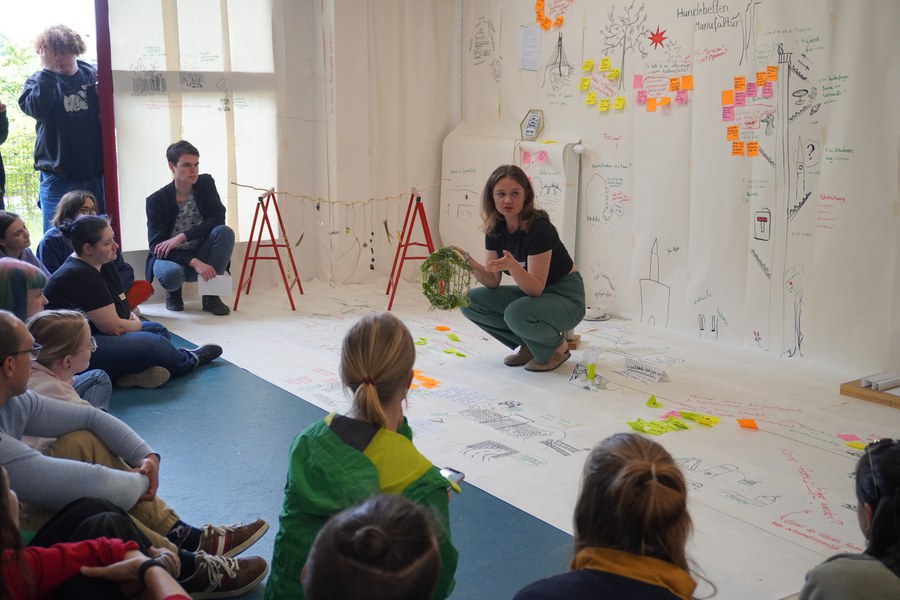
Critical Worldbuilding. Student Workshop on Critical Mapping.
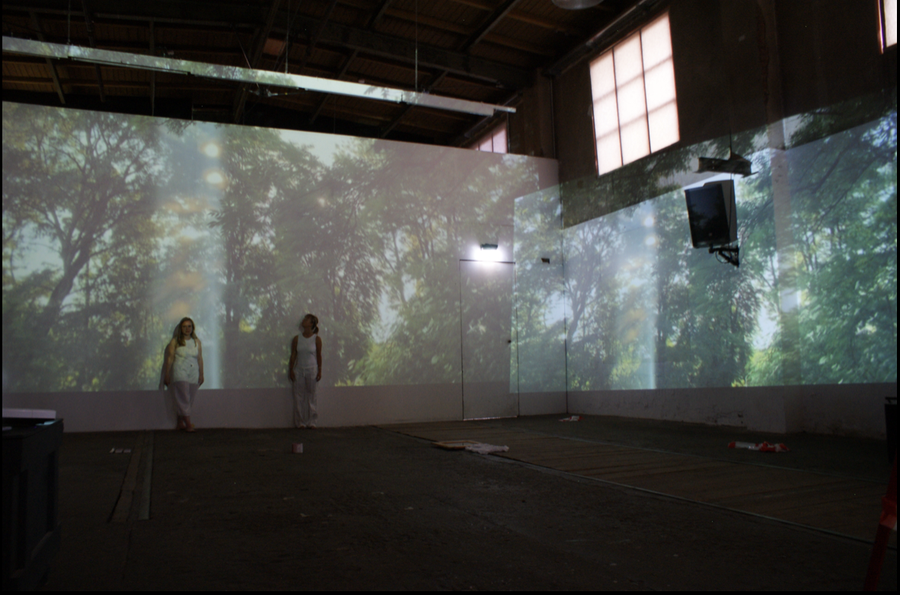
Give-Take. Multisensory Interactive Student Performance. Critical Worldbuilding.
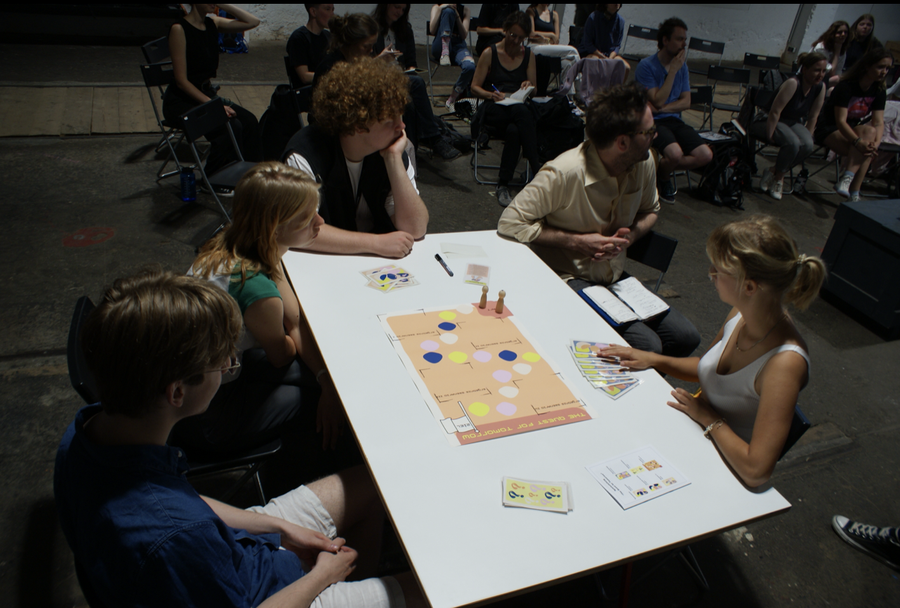
The Quest For Tomorrow. Student-Designed Board Game. Critical Worldbuilding
FORTHCOMING PUBLICATIONS:
- Ingwersen, Moritz and Nicole Raschke. “Critical Worldbuilding: From Energy Literacy to Solar Education.” Teaching Energy Humanities, eds. Debra J. Rosenthal and Jason de Lara Molesky. MLA Teaching Series. Blind Peer Reviewed. Forthcoming, Fall 2026.
In lieu of abstract: The challenges of a just and culturally-anchored transition away from fossil fuels and its corresponding structures of feeling and power must also pertain to environmental education and translate into a necessary reconfiguration of not only what but also how we learn and teach. Building on the insistence within the energy humanities that energy transition is inextricable from a wholescale cultural transformation, we see energy humanities education as essentially education for radical change. -
Mai, Pauline, Nicole Raschke, Moritz Ingwersen, and Antonia Hahn. "Zukunftswelten Bilden." Handbuch Transformative Bildung. Edited by Verena Schreiber and Eva Nöthen. Forthcoming 2027.
In lieu of an abstract: Zukunftswelten Bilden als methodischer Zugang bietet die Möglichkeit, gegenwärtige Verhältnisse durch einen disruptiven Perspektivwechsel zu reflektieren. Angelehnt an den Utopia-Generator (Geoff Manaugh 2011) regt die spielerisch-kreative Auseinandersetzung mit Imaginationen zufälliger und auszuhandelnder Zukunftszenarien die Lernenden dazu an, sich den Vorstellungen von und Beziehungen in und mit der Welt bewusst zu werden. Konkrete Denkanlässe erwürfelter Kategorien schaffen nicht nur einen Ausgangspunkt für kollektive Aushandlungen, sondern bilden eine Grundlage, um die individuellen und kollektiven, oft normativen, Ansichten durch Irritation, Verfremdung und Verwunderung aufzubrechen und kritisch zu reflektieren.