
Aug 31, 2026
Dr. Kapteina at the workshop "Business Ethics and Democracy" in Philadelphia
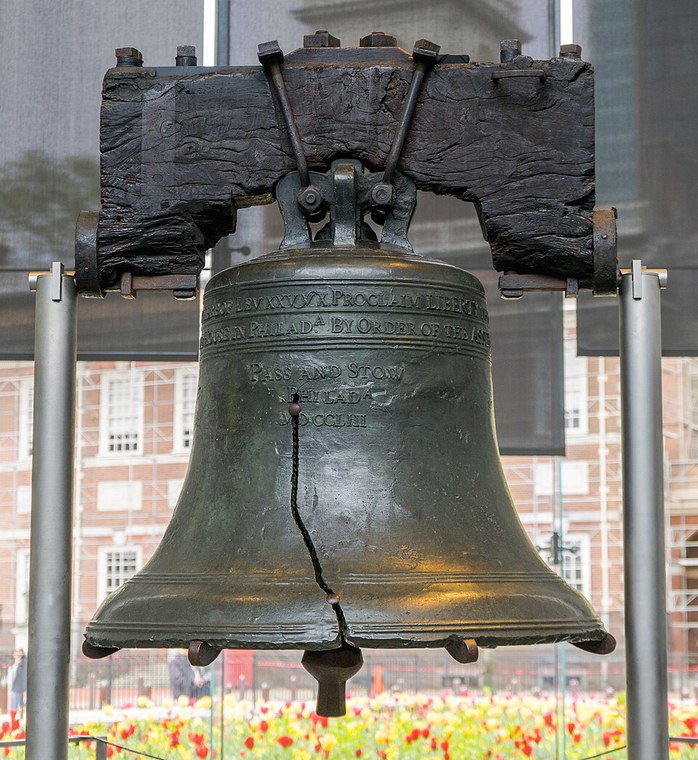
Liberty Bell Philadelphia
On 28 and 29 July 2026, Dr. Benedikt D. S. Kapteina, Postdoctoral Fellow at the Chair of Business Administration, esp. Responsible Management, at TU Dresden's International Institute (IHI) Zittau, took part in the workshop "Business Ethics and Democracy: Illiberalism as a Challenge for Business and Society" in Philadelphia. The workshop was by invitation only and was convened by Andreas Georg Scherer (University of Zurich), Peter Bloom (University of Essex), Cristina Neesham (Newcastle University and Swinburne University) and Yuan Li (Saint Mary’s College of California). It was held at the Sonesta Rittenhouse Square.
Theme and rationale
The workshop starts from the observation that liberal democracy, the normative foundation of the postwar order, has come under considerable pressure through polarisation, the expansion of executive power, disinformation and the instrumentalisation of media. Its call states that this transformation is not only political but also economic and organisational, and singles out the concentration of corporate power in the technology and financial sectors as a driver of authoritarian drift in its own right. The guiding question is therefore how the moral and political responsibilities of business must be redefined amid democratic backsliding, as exclusionary practices, the erosion of deliberative norms and the refusal to recognise legitimate opponents increase while the outward form of democratic legitimacy is preserved.
Format and significance
The workshop is a development format rather than a presentation format. Papers are circulated among all participants ten days in advance, and everyone is expected to have read all papers in their session and to have prepared comments. Each paper is allotted thirty minutes: twelve for the author, five for the discussant, and around ten for plenary discussion. The convenors explicitly adopt an appreciative mode of feedback that names strengths and opportunities as well as limitations, and they encourage authors to ask for help on one or two specific problems. Contributions serve to prepare submissions to a Business Ethics Quarterly special issue on business ethics, illiberalism and the democratic order in the digital age; the journal’s chief editors, Danielle Warren (Rutgers Business School) and Jeffrey Moriarty (Bentley University), attended and presented the call for papers. An invitation therefore means access to a small circle that currently shapes this debate.
The nine sessions across the two days were organised by theme, from the agents of illiberalism through the role of corporations in democracy and empirical cases to complicity and governance. Keynotes were given by Eric Orts (University of Pennsylvania) on "Business and the New Totalitarianism", Joanne Ciulla (Rutgers University) on academic freedom and the obligations of educators when democracy is under threat, and Abraham Singer (Loyola University Chicago) on two corporate political pathologies, institutional capture and the corporation as a vehicle of undemocratic state activity.
Thematically, the sessions ranged from the agents of illiberalism, including the role of expertise and the question of a corporate duty to warn about illiberal government action, through the role of corporations in democracy and empirical cases to complicity, cryptocurrency and corporate governance. This range is characteristic of the field: the normative debate about corporate responsibility and empirical research on actual corporate behaviour have largely run separately, and the workshop brings them into one room. For the papers involved, that is the decisive benefit, because the feedback comes from both traditions.
Contributions by Dr. Kapteina
Dr. Kapteina contributed three papers. In the session on the role of corporations in democracy he presented "Constructed Under Constraint: Agency Without Actorhood and the Limits of Corporate Resistance Under Democratic Backsliding" with Markus Scholz and Daniel Schwake (University of Notre Dame). The second part of the same theme included "Three Moral Grounds for Corporate Democratic Responsibility", written with Iwan Alijew (University of St. Gallen). In the closing session on corporations and governance he presented "Corporate Political Engagement to Protect Democracy: If, When, and How" with Markus Scholz and N. Craig Smith (INSEAD).
Beyond his own papers he acted as discussant for Miguel Alzola (Fordham University) on where democratic erosion begins inside the firm. He was thus involved in three of the nine sessions, in alternating roles as author and as commentator.
What the research shows
Dr. Kapteina studies how companies act politically when democratic institutions come under pressure, and when such action has an effect. The concept of Corporate Democratic Action sets out the conditions under which companies act as democratic actors: what matters is less the visibility of a commitment than its anchoring in structures, responsibilities and routines. The policy paper on CEO activism, written with the German Economic Institute (IW) in Cologne, accordingly shows that publicly visible positioning by senior executives is limited in its effect. Earlier stages appeared in the Academy of Management Proceedings 2024 as "Decoding Corporate Support for Democracy: A Study in Eastern Germany" and in 2025 as "Redefining Corporate Responsibility: The Role of Companies in Supporting Democracy"; an early version of the argument appeared in the LSE Business Review. Further work, including a review article on the creation of private governance in the Journal of Business Ethics, is listed in the publication list. The line of research was most recently translated into practice at the Schmalenbach workshop on Corporate Democratic Action.
This field is studied at the Chair of Business Administration, esp. Responsible Management at TU Dresden's International Institute (IHI) Zittau as a team, together with, among others, Prof. Dr. Markus Scholz and PD Dr. Eckhard Burkatzki.