
Jan 13, 2026
Teaching Award for Service Learning: Democracy as a Management Challenge
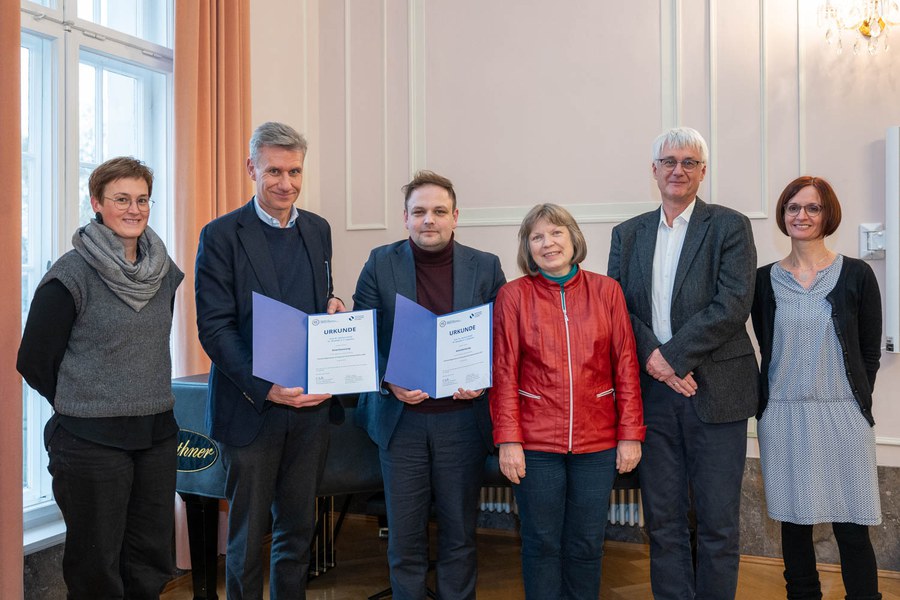
From left to right: Nina Frances Gbur (NDC), Markus Scholz (TU Dresden), Benedikt D. S. Kapteina (TU Dresden), Undine Krätzig (GFF), Thorsten Claus (TU Dresden), and Sylke Fritzsche (NDC).
As companies are increasingly expected to act as social and political actors, robust concepts and organizational frameworks are often missing to support this role in a democratically responsible way. It is precisely at this intersection that the course “Practical Applications of CSR”, offered by the Chair of Business Administration, particularly Responsible Management, at TU Dresden, is positioned. For this teaching format, the Chair received the Teaching Award of the Society of Friends and Sponsors of TU Dresden (GFF) on 8 January 2026 for the 2024/2025 academic year.
The course was taught by Prof. Dr. Markus Scholz and Dr. Benedikt D. S. Kapteina at the International University Institute Zittau (IHI). The award was granted on the nomination of students and explicitly recognizes not only the format itself, but also the exceptional commitment and innovative didactic design of the course.
When students first entered into dialogue with the trainers of the Network for Democracy and Courage (NDC) Saxony, it quickly became clear that this course was not a conventional consulting project. Instead, it centered on how corporate responsibility can be conceptualized and practiced in politically sensitive and socially polarized contexts.
Research Framework: Corporate Democratic Responsibility
The course is embedded in the Chair’s broader research agenda on Corporate Democratic Responsibility (CDR) and contributes to the strategic profile development of TU Dresden in the field of responsible management and societal transformation. This agenda examines how companies can assume responsibility under conditions of democratic erosion and social polarization, and where the normative, political, and power-related boundaries of such responsibility must be drawn. At its core, it conceptualizes firms not merely as market actors, but as democratically relevant organizations, and corporate responsibility as a question of legitimacy, power, and democratic accountability.
Corporate Democratic Responsibility (CDR) refers to a research perspective that deliberately moves beyond efficiency- or sustainability-oriented approaches to corporate responsibility and systematically investigates how organizations contribute to the stabilization or erosion of democratic structures, discourses, and institutions.
A central component of this agenda is the continuous exchange with corporate and civil society partners. The Chair collaborates with partners from various industries to empirically examine democracy-related challenges and further develop conceptual approaches. In this context, the course serves as a real-world laboratory and a strategic bridge between university, business, and civil society. Concepts and case analyses developed in the course feed directly into ongoing research projects, sharpening theoretical assumptions and generating new research questions.
The course exemplifies TU Dresden’s understanding of modern management education as not only analyzing societal challenges, but actively engaging with them through research, teaching, and knowledge transfer. This approach becomes particularly visible at the International University Institute Zittau (IHI), where business education, democratic reflection, and regionally anchored cooperation are systematically integrated.
Service Learning at the Intersection of Business, Ethics, and Democracy
Didactically, the course is designed as a service-learning format. Service learning combines academic instruction with civic engagement by enabling students to apply scholarly concepts to real-world challenges faced by external partners and to reflect on these experiences in a structured theoretical and ethical manner.
At the core of the course was a collaboration with the Network for Democracy and Courage (NDC) Saxony, a nationwide initiative committed to democratic culture and to countering discriminatory and anti-democratic ideologies. Acting as an external advisory team, students developed strategic and organizational concepts aimed at making NDC’s educational programs accessible to companies, while safeguarding the organization’s civil society independence.
An on-site visit to NDC in Dresden, collaborative concept development, and a final presentation of results provided students with in-depth insights into the practice of political education as well as into the organizational challenges of corporate engagement. Several concepts and analytical approaches developed in the course are currently being further refined together with NDC and corporate partners. At the same time, the course has generated master’s theses and empirical case studies that feed directly into the Chair’s ongoing research projects.
Teaching as a Space for Experiencing Responsibility
The award also holds personal significance: “That the nomination came from students is a very special recognition. It shows that the openness of the format, the close collaboration with practice partners, and the collective engagement with difficult questions are experienced as meaningful. It encourages me to conceive of teaching as a shared space for reflection and experience, in which students learn to engage with societal conflicts in a scientifically grounded, ethically reflective, and practically capable way.”
International Relevance and Active Expertise
With its research-driven service-learning architecture, the course is embedded in a dynamic international development in management and business ethics education. Comparable formats are currently gaining importance at leading North American business schools, including the Wharton School, the University of Michigan, and Rutgers University.
Against this backdrop, TU Dresden and the International University Institute Zittau (IHI) have positioned themselves early as a profile-shaping academic hub in this emerging field. The Chair contributes its scientific and didactic expertise not only to its own teaching, but also to the development of comparable teaching and research formats beyond the local context, aiming to conceptually strengthen democratic corporate responsibility and to generate tangible societal impact. In doing so, it enhances both the international visibility and the societal transfer mission of TU Dresden and the International University Institute Zittau (IHI).
Outlook
Looking ahead, the course will be further developed and institutionally anchored as a permanent component of Responsible Management and Corporate Democratic Responsibility (CDR) teaching at the International University Institute Zittau (IHI). The objective is to expand the format into an experimental teaching and transfer platform in which research, education, corporate dialogue, and civil society cooperation are systematically interconnected.
In this way, the initiative aims to strengthen organizational capacities for responsibility and to embed democratic competencies in economic practice over the long term. At the same time, it further sharpens the profile of TU Dresden and the International University Institute Zittau (IHI) as a location for research-driven, societally engaged management education.
The Chair extends its sincere thanks to the Society of Friends and Sponsors of TU Dresden for this recognition of innovative teaching. Special thanks go to the students for the nomination and to the Network for Democracy and Courage (NDC) Saxony for the committed and trusting collaboration.