
Apr 28, 2026
Between Conviction and Neutrality: When Leadership Becomes Political
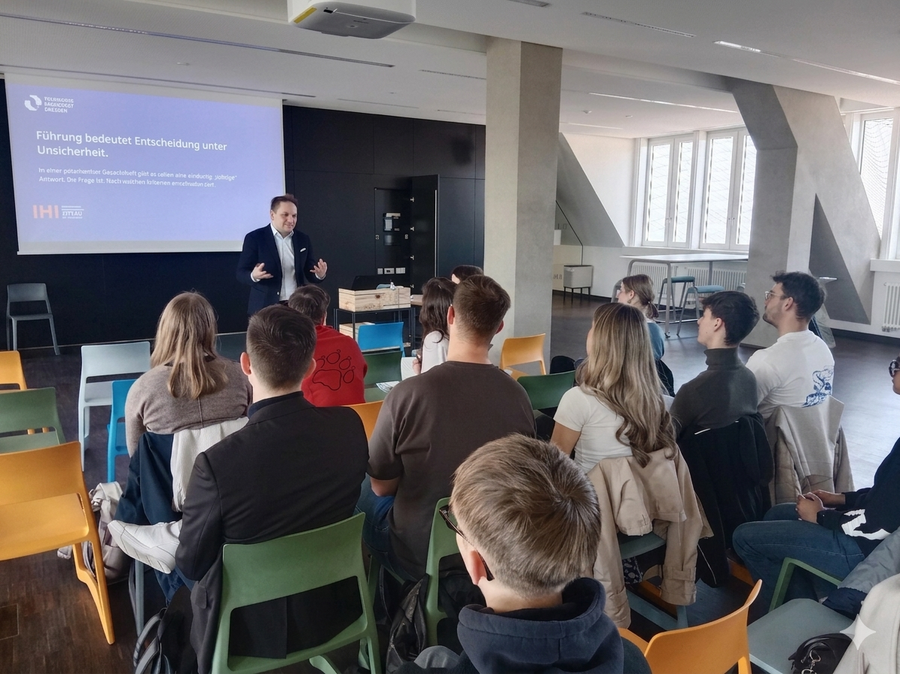
How can leaders navigate an environment shaped by increasing societal polarization and normative uncertainty? This question was at the center of the event “Future Leaders – Democratic Responsibility in Polarized Times”, hosted by the Society of Friends and Sponsors of TU Dresden e.V. at the Fritz-Foerster-Bau.
The first part was led by Dr. Benedikt Kapteina, postdoctoral researcher at the Chair of Business Administration, in particular Responsible Management, at the IHI Zittau of TU Dresden, through an interactive workshop. The IHI Zittau represents an interdisciplinary research environment that situates management questions within the broader tensions of economic, societal, and normative expectations. Kapteina confronted participants with the classical argument of Milton Friedman, according to which the sole social responsibility of business is profit maximization.
Using realistic scenarios, such as how to respond to extremist statements within a team, students developed and discussed different courses of action. A central insight was that organizational silence itself constitutes a form of positioning and generates societal effects. The discussion thus shifted from whether companies act politically to how they inevitably do so. In this context, Kapteina introduced the concept of Corporate Democratic Action, which does not refer to party-political engagement but to the question of how firms can contribute to stabilizing democratic conditions. CDA was discussed as a counterpoint to narrowly economistic interpretations of CSR logics, reframing companies as potential infrastructural actors of democratic order. Kapteina summarized this idea in a concise statement: “Companies cannot escape the political dimension of their actions; they can only decide how consciously they deal with it.”
The subsequent panel discussion in a fishbowl format enabled direct exchange between academia, practice, and students. Sebastian Thielmann, Deputy CEO of the Ostsächsische Sparkasse Dresden, responsible for corporate communications and regional stakeholder relations, contributed a practice-oriented perspective. He highlighted that regionally embedded financial institutions operate within a field of tension shaped by public expectations, internal organizational dynamics, and institutional claims to neutrality. In practice, neutrality appeared less as the absence of positioning than as a continuously negotiated balance between competing stakeholder expectations.
A key point of controversy was the extent to which companies can legitimately act politically, or whether such engagement exceeds their institutional role. While the workshop emphasized the necessity of societal positioning, the panel perspective underscored stronger links to institutional stability and trust.
Overall, the event demonstrated that future leaders require more than technical expertise. What becomes decisive is the ability to exercise reflective judgment in ethically and politically complex situations. Participants were particularly confronted with the insight that leadership in polarized contexts is not about resolving dilemmas, but about making justified decisions under conditions of persistent tension. The event created a valuable space for reflection, made possible by the initiative of the Society of Friends and Sponsors of TU Dresden e.V..