
Mar 27, 2026
New publication: Carbon Fiber Elastomer Film
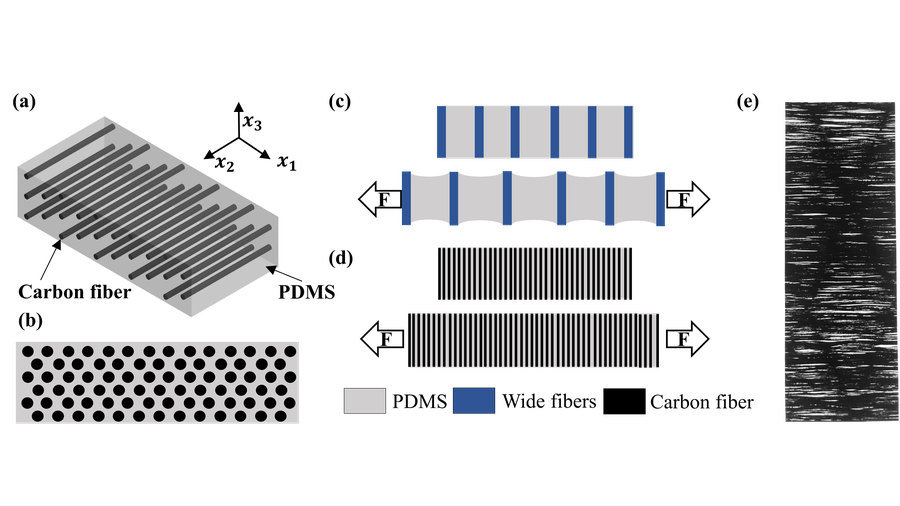
A carbon fiber elastomer film for mechanically anisotropic enhancement of stretchable electronics
Junhao Ni, Carola Böhmer, Markus Koenigsdorff, Andreas Richter, Gerald Gerlach, E.-F. Markus Vorrath
A new scientific publication, recently published in Composites Part B: Engineering, a leading journal in the field of composite materials. It presents a low-cost and easy-to-fabricate approach for introducing controlled mechanical anisotropy into thin, stretchable electronic systems.
Stretchable electronic devices with micro-to sub-millimeter thickness are increasingly used in soft robotics, wearable healthcare, and human-machine interfaces. However, the mechanical isotropy of commonly used elastomers leads to undesirable deformation in transverse directions, reducing actuation efficiency, sensing precision, and geometric stability. Here, we present a low-cost, easy-to-produce and readily applicable carbon fiber elastomer film (CFEF) that imparts pronounced mechanical anisotropy when laminated onto isotropic elastomers. The CFEF is fabricated by embedding unidirectionally aligned carbon fiber monofilaments within a polydimethylsiloxane (PDMS) matrix. The composite exhibits high stiffness along the carbon fiber axis, while remaining highly compliant in the direction perpendicular to the fibers. Fabrication requires only commercially available materials and standard processes, ensuring compatibility with existing devices. For a 200 μm thick PDMS film, it suppresses transverse strain by 95%. Applied to strip-type multilayer dielectric elastomer actuators, the CFEF increases actuation strain by 22%. In dielectric elastomer sensors, an anisotropy ratio of 80.6:1 is achieved. This approach offers an effective and manufacturing-friendly solution for tailoring directional mechanical properties in thin, soft electronic systems without compromising flexibility.
This work was carried out within the DFG Research Training Group GRK 2430 and is a collaboration between the Institute of Solid-State Electronics (IFE) and the Institute of Semiconductors and Microsystems (IHM) at Technische Universität Dresden.
Full article: https://doi.org/10.1016/j.compositesb.2026.113417