
Aug 19, 2026
Lasers give 3D-Printed Metal Components New Functions – European CLASCO Project Successfully Completed
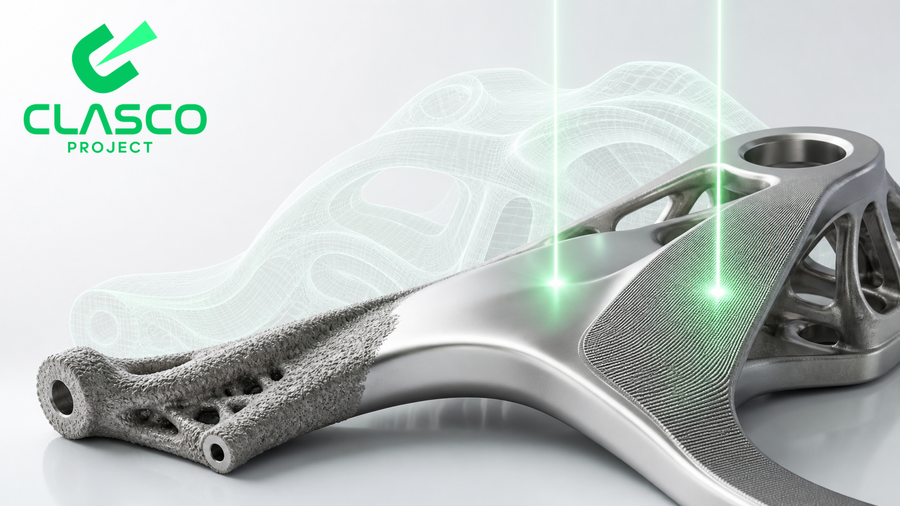
European research consortium coordinated by TU Dresden develops new methods for post-processing complex 3D-printed metal components
As part of the Horizon Europe project CLASCO – Climate Neutral and Digitalized Laser-Based Surface Functionalization of Parts with Complex Geometry – researchers led by TU Dresden (TUD) have developed a new approach for post-processing complex 3D-printed metal components. The three-and-a-half-year project focused on developing a process chain: The researchers combined laser polishing, laser microstructuring, process monitoring, digital twins, and artificial intelligence into an integrated manufacturing concept. They tested the developed technologies on components for the aerospace industry and for medical applications.
Additive manufacturing of metals enables the production of lightweight components with geometries that are difficult or impossible to produce using conventional methods. However, 3D-printed metal components often have comparatively rough surfaces. For demanding applications, manufacturers must therefore first perform surface finishing in a targeted manner on these components.
The researchers combined two complementary laser processes into a single manufacturing system. First, laser polishing smoothed the rough surface without making contact. Subsequently, the Direct Laser Interference Patterning (DLIP) process created precisely defined microstructures on selected areas of the component. Using these structures, the researchers were able to tailor the surface properties in a targeted manner to the respective application.
“With CLASCO, we have demonstrated that we can tailor the surface of complex 3D-printed metal components to specific requirements while simultaneously digitally monitoring the processing,” This lays an important foundation for making such components more efficiently usable for demanding industrial applications in the future,” says Prof. Andrés Fabián Lasagni, holder of the Chair of Laser-based Manufacturing at TUD and coordinator of the CLASCO project.
The project also focused on the possibilities of lightweight construction. The researchers took advantage of the design freedom offered by additive manufacturing right from the component design stage to save on material and weight. For two demonstrators intended for the aerospace industry, they achieved significant weight savings through topology optimization. They reduced the weight of an A350 mounting bracket by approximately 53 percent and were able to design a corresponding lever to be about 38 percent lighter.
After additive manufacturing, the researchers processed the surfaces using the newly developed laser-based process chain. Laser polishing reduced the typical surface roughness immediately after 3D printing from about 10 to 30 micrometers to less than one micrometer. In a second processing step, DLIP generated regular structures in the micrometer range. This enabled the scientists to modify properties such as wettability, corrosion behavior, or the interaction of implant surfaces with biological materials in a targeted manner.
CLASCO also focused on the sustainability of the developed manufacturing process. The investigations made it clear that additive manufacturing is not automatically more sustainable simply because it can save material during the production of a component. Rather, a thorough assessment must take all steps in the process chain into account.
Among other factors, the production of the metal powder, its recovery and reuse, processing time, energy requirements, and the consumption of inert gases all influence the overall environmental impact.
The project demonstrated that, in particular, the reuse of metal powder and efficient post-processing are key factors for more sustainable additive metal manufacturing. The results thus not only provide new manufacturing technologies but also insights into the conditions under which these technologies can be used in a particularly resource-efficient manner.
With the formal conclusion of CLASCO, work on the developed technologies does not end. The project partners intend to further implement the results in practice and utilize them for industrial systems, machining services, technology licensing, contract research, and follow-up projects.
The next steps aim to make the processes more robust and efficient and to transfer the developed methods to other industrial applications. In addition to aerospace and medical technology, the approach could be used wherever complex, high-quality metal components require surfaces with precisely defined properties.
About CLASCO
CLASCO ran from January 1, 2023, to June 30, 2026, and had a total budget of approximately 4.83 million euros under the Horizon Europe program. The consortium brought together 13 partners from six European countries and was coordinated by TU Dresden under the leadership of Prof. Andrés Lasagni.
The consortium included TU Dresden, CATEC, SYLAS, New Infrared Technologies, Z Prime, ABCircular, Airbus Defence and Space, CT Ingenieros, the German Society for Materials Science, SurFunction, DePuy Ireland, Steinbeis 2i, and nLIGHT.
More Information: https://clasco-project.eu/
Contact
 © Andrés Lasagni
Inhaber
NameProf. Dr. Eng. Andrés Fabián Lasagni
Chair Keeper
Send encrypted email via the SecureMail portal (for TUD external users only).