
AMHaWer
Experimental analysis and numerical modeling of the influence of adhesive threads on the material and damage behavior of FRP laminates under quasi-static and cyclic mechanical loading
The AMHaWer project investigates the effects of adhesive threads on the mechanical properties and damage behavior of fiber-reinforced polymers (FRP). These thermoplastic threads are incorporated during the production of semi-finished fiber products to facilitate transport and processing. Remaining embedded in the FRP after resin infiltration, they act as defects that may initiate inter-fiber fractures under mechanical load. These fractures promote further damage mechanisms, such as delamination, ultimately compromising the structural integrity of the material.
To account for such defects, further development of existing material models is required. For this purpose, the project combines experimental investigations with numerical simulations. Quasi-static and cyclic tests on specimens with defined thread configurations are conducted, while FEM models with cohesive zone elements (CZE) are used to analyze stress distributions and crack initiation around the threads.
The findings obtained in this project are incorporated into advanced material modeling. This allows for more precise design of FRP and supports the development of reliable and efficient lightweight structures.
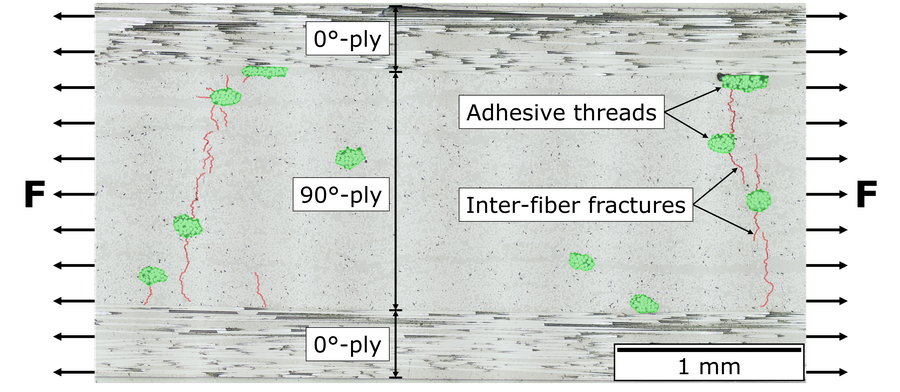
Schliffbild eines glasfaserverstärkten Kreuzlaminats mit Haftfäden (grün) und Zwischenfaserbrüchen (rot).
01.01.2025–30.06.2027

 © Saskia Trute
Chair of Lightweight Systems Engineering and MultiMaterial Design
NameProf. Dr.-Ing. habil. Maik Gude
Send encrypted email via the SecureMail portal (for TUD external users only).
Institute of Lightweight Engineering and Polymer Technology
Visitors Address:
DÜR, Floor 0, Room 71 Holbeinstr. 3
01307 Dresden
Deutschland
- Prof. Holger Ruckdäschel
Chair of Polymer Engineering, University of Bayreuth
- Jan Walter (Calculation Methods and Simulation)
- Dr.-Ing. Richard Protz (Calculation Methods and Simulation)
Publications Richard Protz | TU Dresden