
Promotion of early-career researchers 2025
Supporting the next generation of researchers and introducing young people to engineering at an early stage are key priorities of the Institute of Lightweight Engineering and Polymer Technology (ILK) at TU Dresden. Through a wide range of programs for children, teenagers, and university students, the institute provides access to STEM fields, fosters interest in research and technology, and offers insights into engineering. A particular focus is placed on encouraging girls and young women to pursue STEM disciplines.
These activities range from school projects and hands-on programs to opportunities for university students and support throughout academic qualification pathways. In this way, ILK helps young people explore and pursue their individual paths in engineering and research.
The following pages present a selection of ILK's outreach and educational initiatives in 2025 and highlight only a portion of the institute's broad range of activities.
For current updates on ILK's activities for young people, follow ilk.dresden on Instagram.
How can a new product be created from plastic waste? Which materials are contained in everyday objects? And how can an idea be transformed into a functional prototype? Children explored these and other questions during a holiday programme at the Institute of Lightweight Engineering and Polymer Technology (ILK) at TU Dresden in a playful and hands-on way.
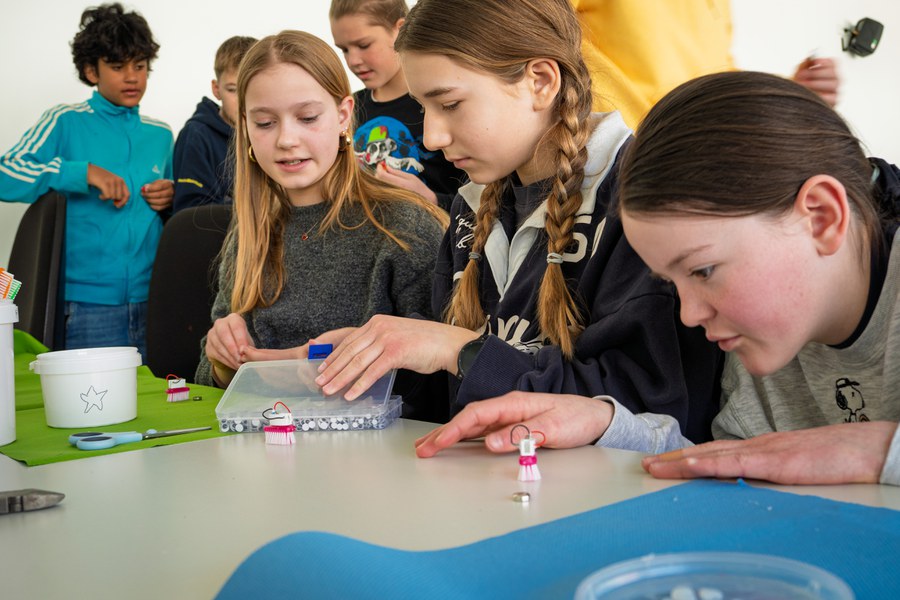
Children's Holiday Program at the Institute of Lightweight Engineering and Polymer Technology (ILK) at TU Dresden.
The programme began with a tour of the Lightweight Innovation Centre (LIZ), where the children were introduced to the ILK and its research fields. Afterwards, they were able to actively participate in various hands-on activities. When building and individually designing their own small robots made from toothbrush heads, creativity and personal ideas were encouraged. At the same time, the children gained first insights into technical principles and mechanics in a playful way. During the subsequent robot race, the children competed their self-developed robots against each other and were able to directly experience how they worked.
Another focus of the programme was the circular economy. Using the HoliMaker system, a manual device for processing recycled plastic material, the children produced their own keychains from recycled plastic waste and experienced how new products can be created from discarded materials. In this way, they gained insights into the importance of recycling processes and the challenges associated with sustainable use of plastics.
In addition to learning about technical principles, the joy of experimenting and trying things out together was also a central element. Through designing, experimenting and developing their own solutions, the children experienced technology and research first-hand and discovered the diversity of engineering-related questions and challenges.
Societal challenges such as climate protection, resource efficiency, and digitalization do not stop at national borders. This makes it all the more important to inspire young people to engage with STEM (Science, Technology, Engineering, and Mathematics) topics early on. X-Garden brings together students from Saxony and Poland to explore science and technology, learn from one another, and discover new perspectives. At the same time, the project provides teachers with up-to-date expertise and practical approaches for their classrooms.
X-Garden connects universities, research institutions, schools, and partners from the innovation and education landscapes in Saxony and Poland. Workshops, excursions, summer schools, science picnics, and other interactive formats complement traditional lessons by offering hands-on experiences and fostering cross-border exchange.
As a project partner, the ILK contributes its expertise in lightweight engineering and polymer technology. The focus is on topics such as sustainable materials, innovative lightweight processes, recycling technologies, and modern lightweight engineering. These subjects are integrated into the educational offerings, making the latest developments in science and research accessible and tangible for students and teachers alike.
In this way, X-Garden creates a space where curiosity is sparked, knowledge is shared, and new connections are formed. The project not only strengthens interest in STEM subjects but also promotes openness, collaboration, and a broader perspective that transcends borders.
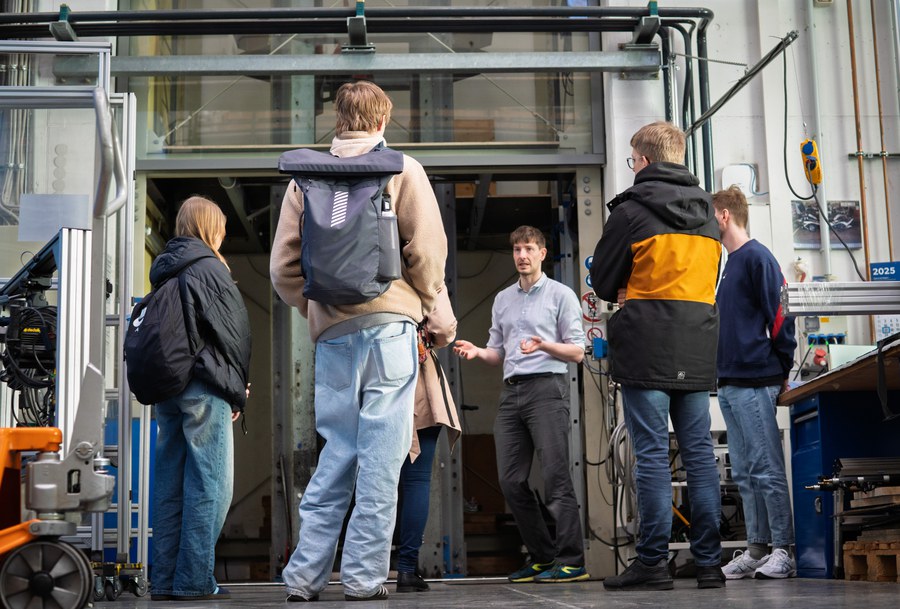
A tour of the ILK's Lightweight Innovation Center (LIZ).
SCHAU REIN! is Saxony's largest initiative for career and study orientation. Every year, companies, universities, and research institutions open their doors to give students from the 7th grade onward practical insights into various career fields and study opportunities. The ILK once again participated in the initiative with an interactive offering.
During a tour of the institute, participants were introduced to the extensive machinery in the Process Development Center (PEZ) and the Lightweight Innovation Center (LIZ), gaining insight into the ILK’s various research and work areas. In the subsequent lightweight engineering course, they were able to get hands-on experience at several stations, solving tasks related to materials, lightweight engineering, and sustainable material concepts in a playful way. This made engineering concepts tangible and allowed technical questions to be explored in an engaging and interactive manner.
Girls'Day is Germany's largest career orientation day for girls and offers female students the opportunity to explore degree programs and career fields where women are still underrepresented. The ILK regularly participates in this initiative. By taking part in Girls'Day, the ILK supports the goal of introducing girls to engineering topics at an early age and encouraging them to consider STEM-related studies and careers.
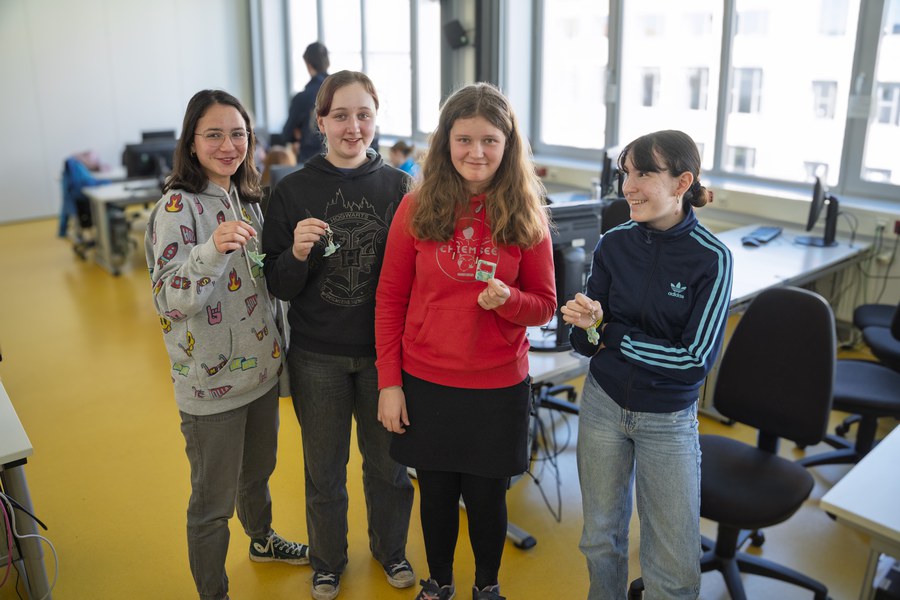
Girls'Day 2025.
As part of a three-hour workshop, participants aged 12 to 17 explored the fundamentals of the circular economy and the 9R strategies for resource-efficient material use. They learned about different types of plastics and their applications in lightweight engineering, examined material sorting and recycling processes, and used a mini injection molding machine to produce their own plastic component from recycled material. A tour of the ILK's Lightweight Innovation Center (LIZ) rounded out the program.
Girls'Day was supported by the DFG-funded projects SFB/TRR 285, SFB/TRR 402, as well as the juniorIng. Sachsen e.V. initiative.
The Girls'Day Academy supports female students throughout an entire school year as they explore career and study opportunities in the STEM field. Through regular visits to universities, research institutions, and companies, participants gain deeper insights into scientific and technical topics and learn about various academic disciplines and career paths. The ILK participates as a program partner with several hands-on workshops.
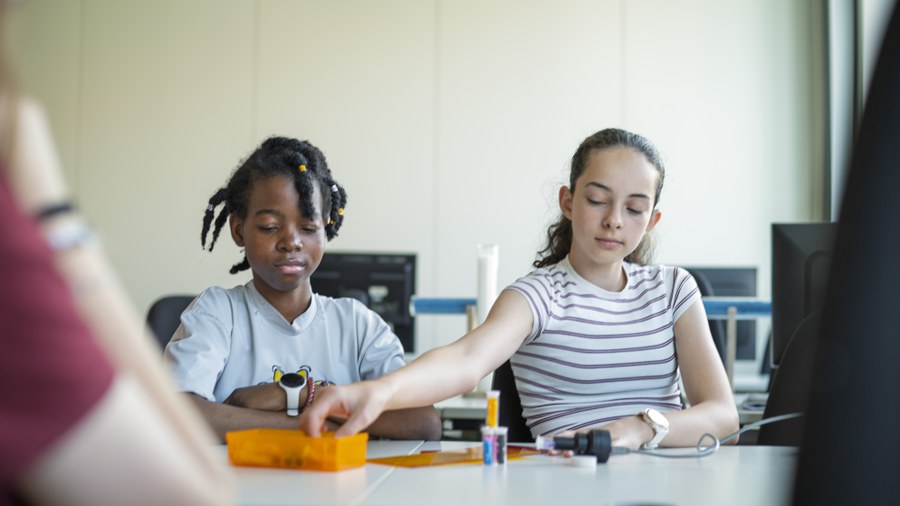
Girls'Day Academy 2025.
During the workshops, the students explored the fundamentals of the circular economy and sustainable polymer engineering. Examining the properties of different plastics, identifying and sorting materials, and conducting a float-sink test to separate various materials were central components of the ILK program. These activities provided the participants with essential insights into the plastic recycling process. Additionally, the students processed recycled plastics using a HoliMaker mini injection molding machine, gaining practical experience with material cycles and the production of plastic components.
Through the Girls' Day Academy, the ILK contributes to the long-term promotion of young talent in STEM fields and guides female students as they engage with engineering-related topics. The recurring visits provide opportunities to deepen their understanding of these subjects, discuss questions, and foster interest in sustainable technologies as well as study and career prospects in engineering.
Under the motto “The Night That Makes You Smarter,” the 22nd Dresden Long Night of Sciences opened the doors of numerous scientific institutions to visitors of all ages. The ILK also participated with a diverse program, inviting attendees to discover cutting-edge research in lightweight engineering, polymer technology, and sustainable production.
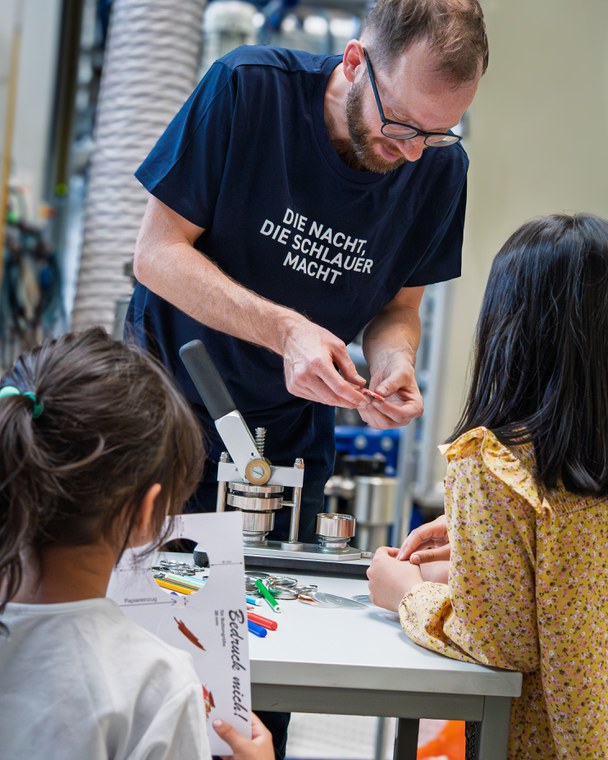
The Long Night of Science at the Process Development Center of the Institute of Lightweight Engineering and Polymer Technology (ILK) at TU Dresden.
At the Process Development Center (PEZ), visitors could experience modern manufacturing technologies up close. Live demonstrations on large-scale systems showcased how complex components are created under high forces and with precise heat application. Interactive stations allowed guests to engage with topics such as recycling, material processing, and robotics, enabling them to understand technical processes through hands-on experiments. For younger attendees, the ILK offered various interactive activities: At the lightweight engineering course, they solved technical challenges and tested their knowledge of materials and constructions. Upon successful completion, the young researchers were awarded a certificate. They could also create their own buttons to take home as a souvenir.
Guided tours through the ILK’s Process Development Center and discussions with researchers provided insights into lightweight engineering and polymer research. The topics presented ranged from the development of new materials and innovative manufacturing processes to sustainable usage concepts. Thanks to the annually changing event location within the ILK, visitors are consistently offered new insights into different areas of the institute’s research infrastructure and its diverse fields of work.

The non-profit association juniorIng. Sachsen e. V. was founded in 2009 by employees of the ILK at TU Dresden to spark and sustainably foster young people’s interest in engineering and natural sciences at an early stage. Through its work, the association aims to provide hands-on technological education and inspire students of all ages to explore lightweight engineering.
In close collaboration with scientific and cultural educational institutions in Dresden and throughout Saxony, juniorIng organizes practice-oriented events for kindergartens, schools, vocational schools, and high schools. The topics range from fundamentals of materials and construction methods to structural design aspects and sustainability strategies in lightweight engineering.
Beyond organizing events, the association supports teachers and educational staff in delivering engaging and practical engineering education—whether through project days, school assignments, or the provision of experimental materials such as material, construction, and processing kits. In cooperation with the ILK, juniorIng also conducts experiments with different target groups, providing a tangible understanding of engineering concepts.
In 2024, the association successfully carried out numerous initiatives, giving young people hands-on insights into the world of lightweight engineering. These included school project days, participation in programs such as Schau Rein! and Girls’ Day, as well as supporting students from Martin-Andersen-Nexö-Gymnasium with their scientific projects (KOLL and BELL).
Additionally, the tryING trial studies program introduced prospective female students to the manufacturing and testing of fiber-reinforced composites. Since 2021, juniorIng has also been a board member of the Saxon Youth Education Network (LJBW), advocating for the statewide coordination of STEM activities and school social work.

TryING 2024.
Through these activities, juniorIng has already reached a large number of children and young people. Beyond imparting knowledge, the program has fostered shared, inspiring, and educational experiences.
Contact
 © Florian Lehmann
Saskia Trute B.A.
Communications
Send encrypted email via the SecureMail portal (for TUD external users only).
Institute of Lightweight Engineering and Polymer Technology
Visitors Address:
DÜR, Institute of Lightweight Engineering and Polymer Technology Holbeinstr. 3
01307 Dresden
Deutschland
Visiting address:
DÜR, Floor 2, Room 259 Holbeinstr. 3
01307 Dresden
Germany