Master's in Aerospace Engineering
Expected to begin in the 2027–2028 winter semester
Develop technologies for the aerospace industry of tomorrow
How are modern aircraft and spacecraft developed, designed, and operated? How can complex technical systems be analyzed, simulated, and further developed?
The Master’s program in Aerospace Engineering provides in-depth engineering knowledge for the development, design, and operation of aircraft and spacecraft. In doing so, you’ll combine various disciplines such as aerodynamics, mechanics, materials science, thermodynamics, propulsion systems, flight control, and space systems.
You will focus on the design of aircraft and spacecraft, the analysis and evaluation of aerospace propulsion systems, the planning and execution of space missions, and flight control. In addition, you’ll acquire skills in modeling, simulating, and analyzing complex technical systems, and you’ll be able to tailor your academic profile to your interests and career goals.
What to Expect During Your Studies

The four-semester master’s program builds upon a first university degree program in mechanical engineering, aerospace engineering, mechatronics, or a comparable degree program. During the program, you will deepen your engineering knowledge and apply it to complex problems in aerospace.
In the first two semesters, you’ll take core required modules and deepen your knowledge in areas such as flight dynamics, aircraft design, fundamentals of aircraft propulsion, as well as satellite technology and communications. In addition, a wide range of required-elective areas is available.
In the subject-specific required elective area, you can specialize, for example, in aircraft development, aircraft flight behavior, space technology, aircraft propulsion, or aircraft systems and operations. In addition, you can acquire interdisciplinary technical skills, such as in artificial intelligence, simulation, or lightweight construction.
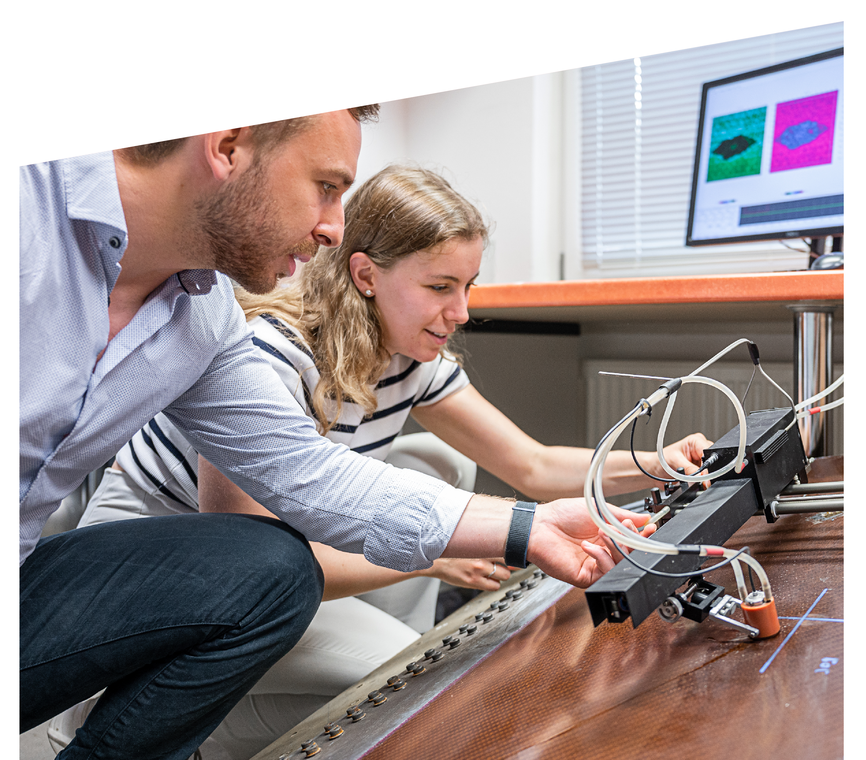
Exercises, lab sessions, project work, and simulations complement the courses. In doing so, you apply theoretical knowledge to specific technical problems and further develop your skills in analysis, modeling, and independent problem-solving.
The third semester is centered around the research internship. During this internship, you will work on specific tasks from research, industry, or space projects and become familiar with typical professional workflows and project structures. The research internship can also be used as a mobility window for a stay at an external research institution or abroad.
In the fourth semester, the focus is on the master’s thesis. You will independently address a scientific research question in the field of aerospace engineering and apply the technical and methodological skills acquired during your studies to a specific problem.
Shape Your Own Academic Profile
The degree program offers extensive opportunities for individual specialization. In the subject-specific elective track, you have 45 credit points at your disposal, which you can use in a targeted manner to tailor your profile to various areas of aerospace engineering.
Possible areas of focus include, for example:
- Aircraft Development
- Aircraft Flight Behavior
- Space technology
- Aviation Propulsion
- Aircraft systems and operations
In addition, you can acquire interdisciplinary technical skills, for example in artificial intelligence, simulation, fuel cell technology, or lightweight structures. Further elective options in the areas of General and Interdisciplinary Qualifications as well as Interdisciplinary Technical Qualifications will round out your academic profile with skills in communication, law, and general education, among other things.
A study abroad program at another university is also possible. In addition to the research internship in the third semester, the second semester is particularly well-suited for a temporary stay at another university.
Your Career Prospects

With a master’s degree, you will be qualified for challenging engineering roles in the aerospace industry. You will possess in-depth knowledge and skills for the development, design, analysis, and evaluation of complex technical systems. Career opportunities are available particularly in the aerospace industry, in companies of various sizes, as well as in public institutions and government agencies. National and international research and development institutions also offer potential fields of work.
Depending on your individual academic focus, you can pursue a career in the following areas, for example:
- Aircraft development and design
- Aerodynamics and flight dynamics
- Aviation Propulsion
- Space technology and space missions
- Aircraft systems and operations
- Simulation and System Analysis
- Flight Control
- Research and Development
Thanks to the international focus of the aerospace field and the opportunity to complete parts of the program abroad, you’ll also prepare yourself for careers in an international work environment.
The master’s degree also serves as a foundation for further academic qualifications, particularly for pursuing a Ph.D.
Application
The master’s program is expected to begin in the 2027/28 winter semester. All information regarding admission requirements, application deadlines, potential admission restrictions, and guidance for international applicants will be published in the Student Information System (SINS) well in advance of the program’s start. Go to the Student Information System (SINS)
Applications are submitted online via the TU Dresden application portal.
Go to the online application
Contact
ServiceCenterStudium (general questions about studying)
℡ +49 351 463-42000
✉ scs@tu-dresden.de
🔗tud.de/scs
Academic Advising (subject-specific questions about the degree program)
✉ Studienberatung.mw@tu-dresden.de
To the Study Information System (SINS):
https://tud.de/sins