
Sep 10, 2026
Award winners for the Dresden DZG-overarching projects 2026
The mission of the German Centres for Health Research (DZGs) is to promote translational research to combat common diseases. There are four DZG centres in Dresden that work on diabetes, neurodegeneration, cancer, and child and adolescent health. By working together and finding common ground, scientists can strengthen medical research across disciplines and translate new findings more quickly to the clinic.
Once a year, the four DZGs at partner site Dresden, jointly host the Joint Dresden DZG-Symposium and announce a seed funding call for DZG-overarching projects to foster collaborations.
The DZG centers in Dresden are:
- the German Center for Diabetes Research (DZD/PLID)
- the German Consortium for Translational Cancer Research (DKTK)
- the German Center for Neurodegenerative Diseases (DZNE)
- and the German Center for Child and Adolescent Health (DZKJ)
The winners of this year’s grants were honoured by the speakers of the DZGs: Prof Michele Solimena (DZD/PLID), PD Dr. Rebecca Bütof (DKTK) and Prof Gerd Kempermann (DZNE). Six people comprising two teams were awarded 10,000 or 5,000 euros in funding.
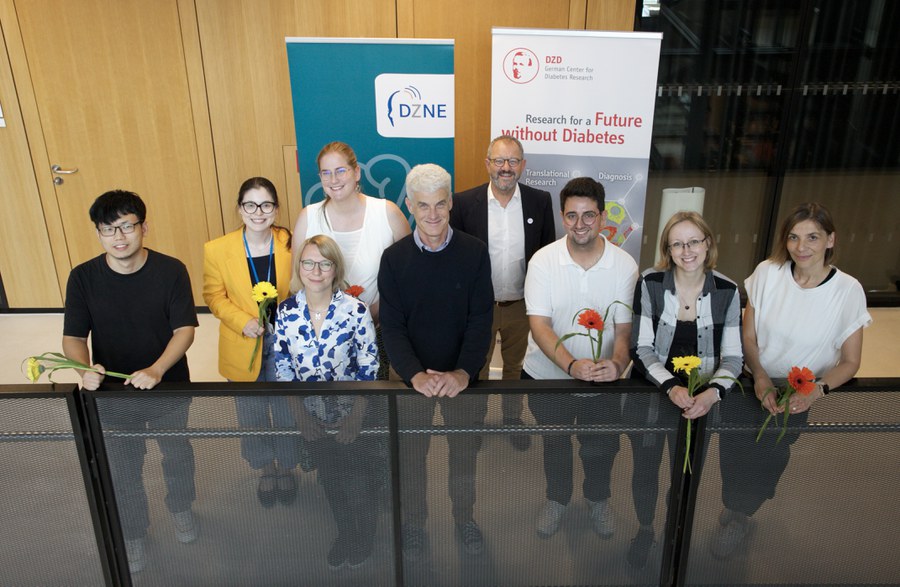
The prisewinners: (l.t.r) Ning Ding, Karina Amineva, Rebecca Bütof, Soňa Michlíková, Gerd Kempermann, Michele Solimena, Rafael Tur Guasch, Natalie Dumler and Franziska Baenke
The IMPACT project “Interdisciplinary and Conceptual Multiorgan Platform for Analysing inflammatory Organ Cross Talk” is made up of Natalie Dumler and Rafael Tur Guasch from the DZNE and Franziska Baenke from the DKTK. This project is a clever use of a microfluidic device to investigate the influence that different organs have on each other via the immune system. This has applications in diseases affecting the brain, eyes and digestive system.
In the CryoGraft project “star-PEG cryogel preservation of tumor and thymic tissue with multiplex readout” Ning Ding and Soňa Michlíková of the DKTK and Karina Amineva of the DZKJ are working together on a polymer-based cryopreservation strategies broadly applicable to biologically distinct human tissues. Such a method would be useful for testing or predicting the efficacy of anticancer drugs.
This year’s projects once again highlight the value of looking beyond the boundaries of individual disease areas. Despite the differences between conditions such as cancer, diabetes, neurodegenerative diseases, and diseases affecting children and adolescents, shared biological mechanisms and research questions can open up new perspectives for understanding disease and developing innovative therapeutic strategies.
Bringing together expertise from different German Centers for Health Research (DZGs) creates an important platform for interdisciplinary exchange and collaboration. In Dresden, this cross-DZG dialogue has become a strong tradition: since 2019, our symposium has connected researchers across disciplines, encouraging new ideas, joint approaches, and collaborations at the Dresden research site.
We congratulate this year’s award winners and wish them every success with their projects and future research!