
May 18, 2026
Michele Solimena awarded the Paul Langerhans Medal by the DDG
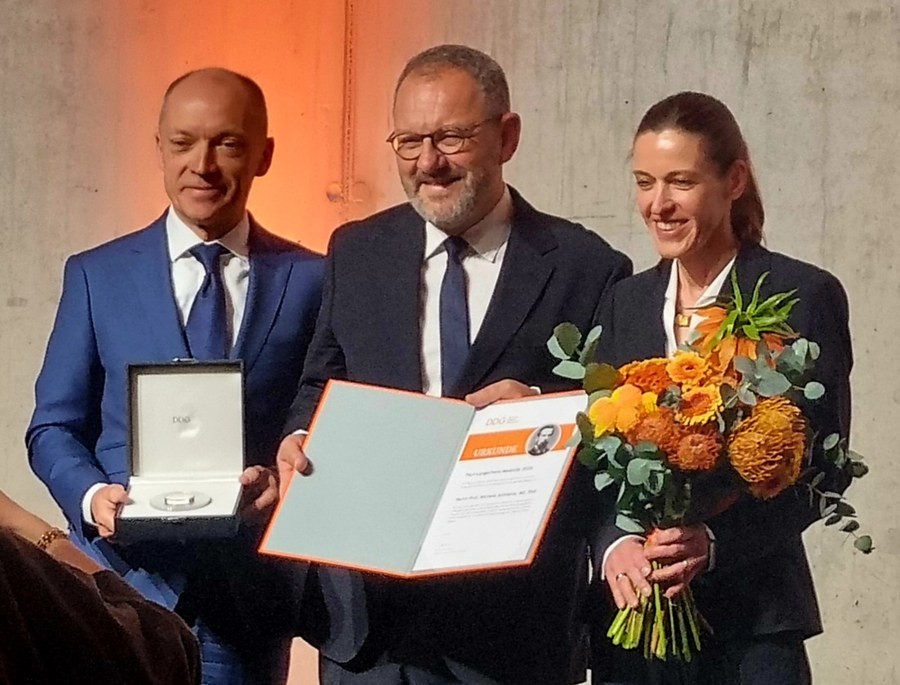
Martin Hrabě de Angelis (DZD) Professor Michele Solimena and Barbara Ludwig (PLID/UKD)
Michele Solimena awarded the Paul Langerhans Medal by the DDG
Prof. Dr. Dr. Michele Solimena of the Paul Langerhans Institute Dresden (PLID) of Helmholtz Munich at the University Hospital and Faculty of Medicine Carl Gustav Carus of TU Dresden was awarded the Paul Langerhans Medal, the highest award of the German Diabetes Association (DDG) on the 15th of May 2026. This award recognizes Prof. Solimena’s outstanding achievements in understanding the cell biology of insulin-producing beta cells of the pancreatic islets and the molecular mechanisms that cause diabetes.
Diabetes arises when the supply of insulin is insufficient to maintain blood glucose levels within healthy ranges. As beta cells are the sole source of insulin, their demise is the key determinant of this disease. How beta cells function, how they adapt to changing metabolic needs, and why they fail in diabetes are the central questions Prof. Solimena has been addressing.
His work relied on a diverse set of model systems, from cell lines and animal models to tissue samples from living donors undergoing pancreatectomy. This integrated approach enabled seminal contributions in elucidating how beta cells regulate insulin production, storage and release in response to hyperglycemia. His pioneering work on surgical specimens from living donors with normoglycemia, prediabetes or type 2 diabetes has further provided unpreceded insights into the molecular alterations of beta cells along the progression to diabetes. This knowledge, in turn, is instrumental to devise novel treatments targeting the cause of beta cell failure and thereby protect and restore insulin production.
While still a postdoc in the De Camilli’s lab, Solimena discovered the occurrence of autoantibodies against glutamic acid decarboxylase 65 (GAD65) in subjects affected by type 1 diabetes and in Stiff Person syndrome, a rare neurological disorder affecting GABAergic neurons in the central nervous system. Today anti-GAD65 autoantibodies are the single most widely used autoantibody biomarker for diabetes classification.
Impacting scientists locally, nationally and internationally
Pamela Toledo of the National University of Quilmes and long-term collaborator described Prof. Solimena’s influence: “during our 12 years working together, Prof. Solimena had many new ideas that changed the way we thought about insulin-producing cells. Prof. Solimena’s continuos input allowed me, as a young scientist, to win fellowships and grants which have supported my career.”
“His collaborative nature has been of immense value to me personally, like the information he shares about autoantibodies implicated in type 1 diabetes” said Prof. Ezio Bonifacio, a faculty member of the PLID and of the Center for Regenerative Therapies Dresden. “He also acts as an ambassador to the Dresden diabetes community leveraging the international reputation he built through his long-term research programs.”
“By awarding the Paul Langerhans Medal, the German Diabetes Association honors Prof. Solimena as a scientist who has decisively shaped our understanding of beta cell biology,” said Prof. Martin Hrabe de Angelis, Executive Board Member of the German Center for Diabetes Research (DZD). “His work has laid the foundations for new strategies in the prevention and treatment of diabetes—and thus has had an impact far beyond the realm of research.”
About the person
Prof. Michele Solimena trained as a medical doctor at the University of Milano, Italy, where he also completed his PhD in pharmacology and toxicology in 1993. He became an Associate professor and the Yale University School of Medicine, USA and thereafter a Group Leader at the Max Planck Institute of Molecular Cell Biology and Genetics in Dresden, Germany. In 2003, he was appointed Professor of Molecular Diabetology at the Faculty of Medicine Carl Gustav Carus of the Technical University of Dresden.
In 2009 he became the founding Director of the PLID and one of five speakers of the German Center for Diabetes Research (DZD e.V.), where he also leads the Beta Cell Academy. In 2015, he became the Director of the Institute for Pancreatic Islet Cell Research (IPI) of Helmholtz Munich.
Contact: Mark Leaver