
Simon Praetorius
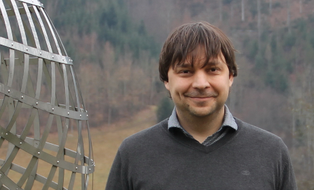 © Bildarchiv des Mathematischen Forschungsinstituts Oberwolfach
Senior research and teaching associate
NameMr Dr. Simon Praetorius
Course coordination · Student supervision · Research
Send encrypted email via the SecureMail portal (for TUD external users only).
Institute of Scientific Computing
Institute of Scientific Computing
Visiting address:
Z21, 235.1 Zellescher Weg 25
01217 Dresden
I am a numerical mathematician working at the intersection of numerical analysis, geometric partial differential equations, and scientific computing. My research focuses on finite element methods for PDEs on surfaces and manifolds, in particular on the approximation of geometric quantities, geometrically constrained vector and tensor fields, and structure-preserving methods for geometric evolution equations. A second focus of my work is the development of reusable scientific software and finite element infrastructure, especially within the DUNE framework.
In teaching, I am particularly involved in programming and scientific computing at both Bachelor’s and Master’s level and supervise student projects and theses in numerical mathematics and scientific computing.
Teaching
My teaching ranges from introductory programming in the Bachelor’s program to advanced scientific computing at Master’s level. A particular focus of my teaching is connecting mathematical and algorithmic concepts with their practical implementation in modern scientific software.
Current courses
- Programmieren – Grundlegende Konzepte — 1st semester Bachelor
WS25/26, WS26/27 - Programmieren – Weiterführende Konzepte — 2nd semester Bachelor
SS26 - Scientific Programming – Advanced Concepts — Master, C++
WS26/27
More about teaching and previous courses
Student projects & theses
I regularly supervise Bachelor’s and Master’s theses as well as student research projects in numerical mathematics and scientific computing. Topics are often connected to current research and may range from mathematical and numerical analysis to computational experiments and the development of scientific software.
Currently available topics
- Curvature of discrete and higher-order curves (Bachelor’s thesis)
Compare different curvature approximations on discrete and higher-order curves and investigate their accuracy and convergence. - Stabilized finite-element approximation of curvature (Master’s thesis)
Implement and investigate stabilized finite-element methods for the approximation of mean curvature and the shape operator. - Lagrange multiplier methods for tangential vector fields (Master’s thesis)
Study finite-element approximations of tangential vector fields on surfaces and investigate the interaction between discretization errors and multiplier parameters. - Characterizing planar shapes with Minkowski tensors (Bachelor’s thesis)
Investigate tensor-valued geometric measures for the characterization of planar shapes, including their invariance, eigenstructure, and numerical approximation.
If you are interested in one of these topics, or in a project related to finite element methods, geometric PDEs, numerical algorithms, or scientific computing, feel free to contact me. Topics can often be adapted to the background and interests of the student.
More information about student projects and supervision


Research
My research lies at the intersection of numerical analysis, geometric partial differential equations, and scientific computing. A central theme is the development and analysis of finite element methods that respect the geometric structure of the domain, the unknown fields, and the underlying evolution equations.
Current research focuses on geometry-aware finite element methods, geometrically constrained vector and tensor fields, and structure-preserving methods for geometric evolution equations. Closely connected to this work is the development of computational abstractions and scientific software for advanced finite element methods.
More information on my Research profile and current research areas.
Recent publications
Selected recent publications are listed below. A Complete publication list and preprints can be found on my personal academic webpage and on google scholar.
2024
-
Active smectics on a sphere, 8 May 2024, In: Journal of Physics: Condensed Matter. 36, 18, 13 p., 185001Electronic (full-text) versionResearch output: Contribution to journal > Research article
-
Diffusion of tangential tensor fields: numerical issues and influence of geometric properties, 1 Mar 2024, In: Journal of Numerical Mathematics. 32, 1, p. 55-75, 21 p.Electronic (full-text) versionResearch output: Contribution to journal > Research article
2023
-
Influence of finite-size particles on fluid velocity and transport through porous media, 5 Jul 2023, In: Physical Review Fluids. 8, 7, 074501Electronic (full-text) versionResearch output: Contribution to journal > Research article
-
Tangential Errors of Tensor Surface Finite Elements, May 2023, In: IMA Journal of Numerical Analysis. 43, 3, p. 1543-1585, 43 p.Electronic (full-text) versionResearch output: Contribution to journal > Research article
2022
-
Finite element discretization methods for velocity-pressure and stream function formulations of surface Stokes equations, 5 Jul 2022, In: SIAM Journal on Scientific Computing. 44, 4, p. A1807-A1832, 4Electronic (full-text) versionResearch output: Contribution to journal > Research article
 This information is provided by the FIS.
Scientific software
The development of reusable scientific software is an integral part of my research. I am a core developer of the DUNE and AMDiS finite element frameworks and contribute to their numerical and software infrastructure.
More about Scientific software and open-source projects.