
Mar 19, 2026
School student Hannah Ferenz wins the 2026 plus-MINT Prize for her research into conductive bacteria
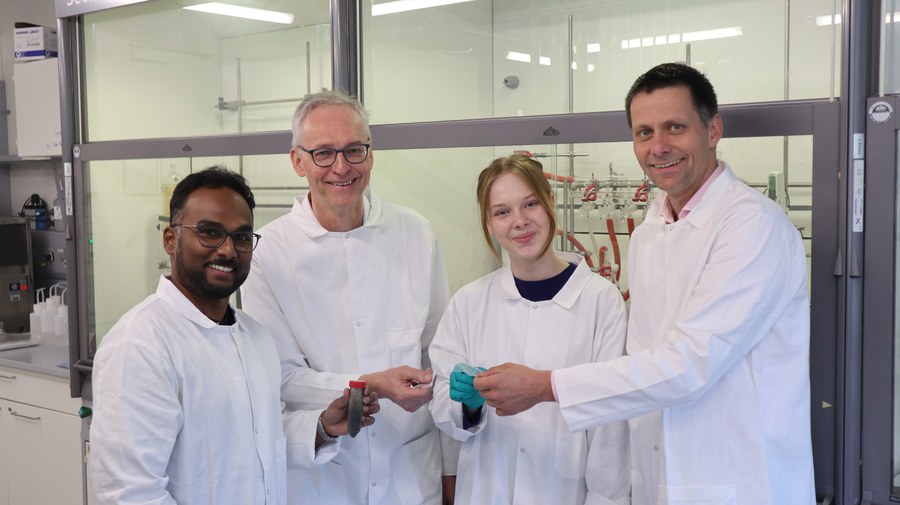
f.l.t.r. Dr. Rakesh Nair, Prof. Karl Leo, Hannah Ferenz, Dr. Hans Kleemann.
Hannah Sophie Ferenz, a 17-year-old student at the Landesgymnasium Sankt Afra in Meissen, has been awarded the 2026 plus-MINT Prize. This makes her one of the most promising young talents in STEM subjects across Germany. She is being honored for her excellent research on decomposable electronics, which she is conducting together with Prof. Karl Leo, Dr Hans Kleemann and Dr Rakesh Nair at the Institute of Applied Physics.
University-level research
Hannah Ferenz has been actively collaborating with university research institutions since 2025 – including the Institute of Applied Physics at TU Dresden. There, as part of the Leaftronics project, she is working alongside Dr Rakesh Nair, Dr Hans Kleemann and Prof. Karl Leo on an innovative approach: the use of so-called cable bacteria as conductive structures for electronic applications.
These microorganisms, which are several centimetres long, can absorb metals from their environment and thereby develop electrical conductivity. At the same time, they help to reduce carbon dioxide and methane emissions. Hannah’s aim is to combine these biological systems with ‘Leaftronics’ technology – that is, decomposable circuit boards made from lignocellulosic structures – to develop fully biological electronics. Her interdisciplinary project combines biology, physics and materials science and is conducted at an excellent level of university research.
“The idea of integrating filamentous bacteria into the Leaftronics approach to develop fully CO₂-neutral electronic circuits originally came from my own doctoral research. At the time, however, I had to abandon it because I could not source suitable filamentous bacteria either at TU Dresden or anywhere in Saxony. It is all the more impressive that Hannah not only successfully found some, but that she even managed to establish stable cultures independently in her school laboratory. On this basis, we are now also beginning to establish new cultures at the institute for further experiments,” explains Dr Rakesh Nair, who himself was recently awarded a prize for his work on Leaftronics.
Award for excellence and independence
Hannah Ferenz particularly impressed the jury with her analytical depth, her exceptional independence in scientific work, and her reflective approach to complex issues. Among other things, the jury assessed her academic achievement, scientific maturity, international connectivity, as well as her personality and social commitment.
Her achievements to date also underscore her talent: among other things, she took first place at state level in the International Biology Olympiad and won awards in the “Jugend forscht” competition.
A role model for young women in science
With this award, Hannah Ferenz exemplifies the aim of the plus-MINT Prize: to integrate young people into scientific networks at an early stage and open up international perspectives for them.
As a young woman in the natural sciences in particular, she can encourage other schoolgirls to consider a career in research and science.
About the plus-MINT Prize
The plus-MINT Prize, awarded by the Association for the Promotion of MINT Talent (Verein zur MINT-Talentförderung e. V.), recognises outstanding achievements in mathematics, computer science, natural sciences and technology, and specifically focuses on the early promotion of scientific excellence, initiative and international perspectives. In addition to the award, the prize includes participation in the renowned London International Youth Science Forum, which takes place annually at universities such as Oxford and Cambridge and enables young talents to engage with researchers from all over the world. More information: https://www.plus-mint.de/blog/plus-mint-preis-2026
Contact:
Dr Rakesh R Nair
Institute of Applied Physics
TU Dresden
Email: