
Feb 25, 2026
Research: Quintuplet Condensation in the Skyrmionic Insulator Cu2OSeO3 at Ultrahigh Magnetic Fields
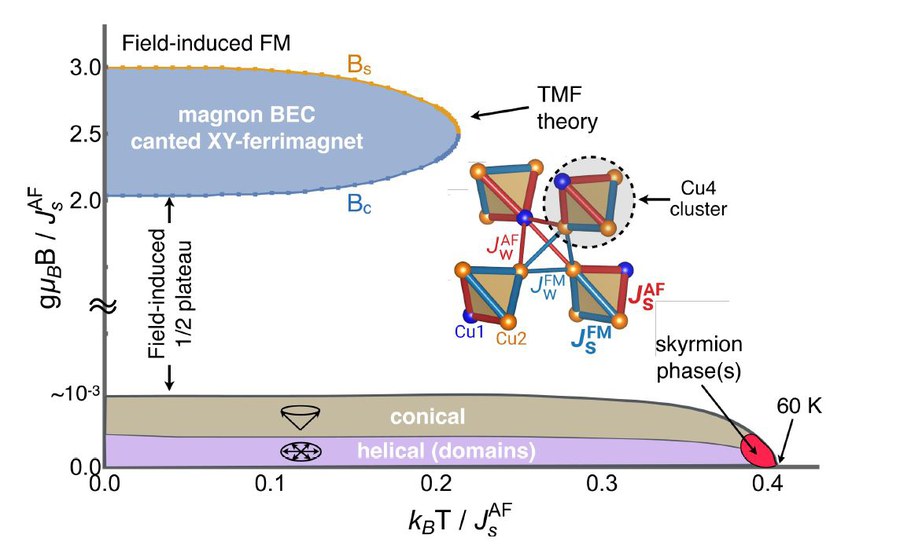
At first sight, Cu2OSeO3 - the material known as the first skyrmionic Mott insulator - does not look like a promising candidate for Bose-Einstein condensation of magnons: its strong S = 1 tetrahedra have a robust triplet state and the wide 1/2-magnetization plateau expected to survive an enormous magnetic field of about 200 Tesla. Here, a team of researchers led by Prof. Toshihiro Nomura from Shizuoka and Tokyo succeeded in measuring the intensity and polarization of light going through Cu2OSeO3, and that
in ultrahigh magnetic fields. The measured quantities were combined into a Faraday rotation angle, which unexpectedly developed a broad maximum between the breakdown of the plateau at 180 Tesla and the full saturation at 300 Tesla.
To understand the origin of this maximum, Prof. Ioannis Rousochatzakis from Loughborough University and Dr. Oleg Janson from IFW Dresden took their earlier developed microscopic model and analyzed its high-field behavior, both analytically (tetrahedral mean-field theory) and numerically (quantum Monte Carlo simulations). This analysis revealed that the nonmonotonic behavior of magnetization correlates with electric polarization; the linear magnetoelectric effect coupling, well-known for Cu2OSeO3 from earlier reports, plays a crucial role here. Most importantly, the phase in-between the
plateau and full saturation was identified as a magnon condensate.
Measuring the full magnetization curve in a quantum magnet with an exceptionally robust 1/2 plateau is a remarkable achievement. Equally remarkable is proof that the strong-tetrahedra model, which describes the formation of skyrmions in low fields, remains valid and provides useful insights even if the magnetic field is extremely high.
T. Nomura, I. Rousochatzakis, O. Janson, M. Gen, X.-G. Zhou, Y. Ishii, S. Seki, Y. Kohama, Y. H. Matsuda,
Quintuplet Condensation in the Skyrmionic Insulator Cu2OSeO3 at Ultrahigh Magnetic Fields,
Phys. Rev. Lett. 136, 076703 (2026) (arXiv)