
Dec 08, 2025
Stay curious and try new things!
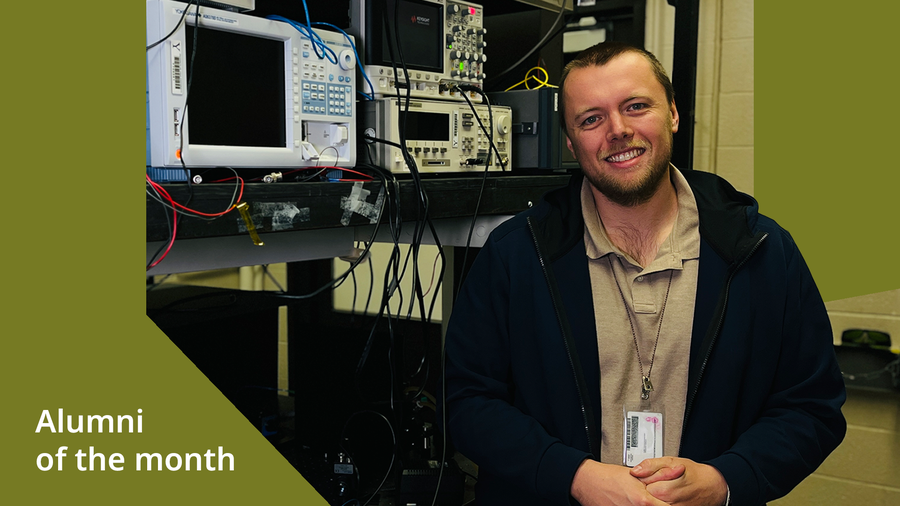
Dr. Stefan Rothe is the graduate of the month for January 2026 – pictured here in front of his multimode fiber amplifier at Yale University.
(interviewed in 2025)
Dr. Stefan Rothe knew early on that he wanted to study engineering – he just didn’t know in which discipline. It wasn’t until later in his electrical engineering studies that he found his specialization – and since then, he has been researching the programming of light waves for the development of secure data communication or high-performance fiber lasers. First at TUD – now at Yale University.
|
Name: |
Dr. Stefan Rothe |
|
Degree program |
Electrical engineering |
|
Faculty |
Faculty of Electrical and Computer Engineering |
|
At the university: |
Diplom degree program (2012 - 2018), doctoral studies (2019 - 2023) |
|
Current work: |
Postdoc at University of Twente , (Netherlands) |
Why did you decide to study at TU Dresden?
I decided to pursue an engineering degree fairly quickly after finishing high school. At that time (and as far as I know, still today) TUD was one of the few institutions in Germany where you could still enroll in the diplom program. Although I believe that, in terms of content, there isn’t much difference compared to the modular Bachelor/Master degree programs at other universities, what I particularly liked back then was that you could still earn the diplom engineer degree at TUD.
What made you choose this degree program?
Back then, I actually had a hard time deciding on a specific engineering discipline. But I still remember a conversation with my brother, who asked me the following question: “Imagine you’re holding an electrical circuit in your hand and at the same time standing in front of a turbomachine. Which excites you more?” I decided on the circuit, but funnily enough, I later did quite poorly in circuit design.
What researchers or lecturers influenced you the most during your studies?
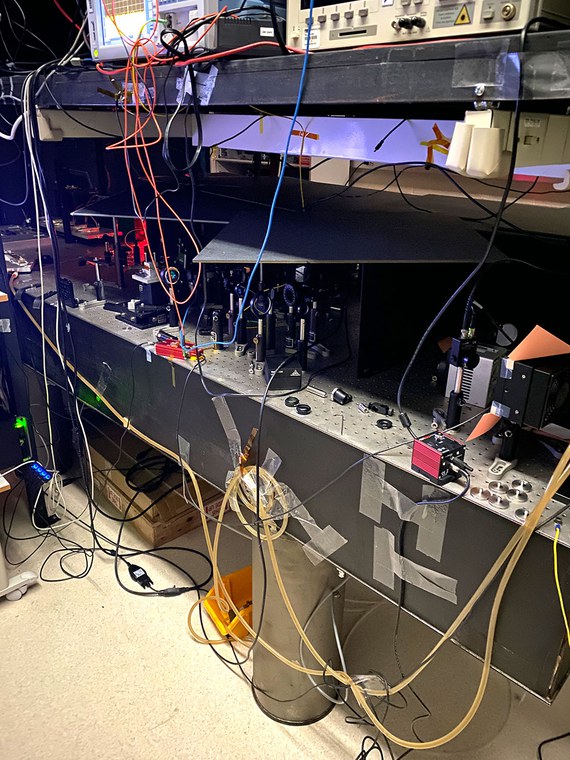
At high optical powers, optical systems are more susceptible to environmental noise, which is why multimode fiber amplifiers require shielding for isolation during operation.
I experienced the broad scope of the electrical engineering program as both a blessing and a curse. During the course of the studies, you undoubtedly get to know many fascinating and highly diverse technologies and their characteristics. Yet, well into my studies (as late as the seventh semester), I still had no idea in which industry I really wanted to work. At some point, I decided to specialize in automation, measurement, and control engineering because I had enjoyed the exams in that area the most up to the fourth semester. But whether I would actually want to practice that field in my professional life was completely unclear to me. For example, my first internship in the industry in automation was a complete disaster, and I ended it after just a few weeks. It was actually only when I was working on my thesis (the equivalent of a bachelor's thesis in a diplom program) that I took a closer look at the individual chairs and their research. Among the available topics, I was drawn to the current research of the then doctoral student Daniel Haufe in measurement technology. He invited me to a meeting in a very friendly and open manner and explained his current research topic to me in more detail. He was programming light waves that he sends through a glass fiber to build hair-thin microendoscopes. I still remember being completely astonished that something like this was actually possible – I was immediately captivated by the topic. So much so that I ended up doing my PhD on “secure fiber-optic communication” using light-wave programming – a topic I still work on today. Now, I build fiber lasers using light-wave programming. What impressed me most, however, was Daniel Haufe’s particularly friendly and respectful way of interacting with me – something I rarely experienced as a student. In a large lecture hall, you tend to feel that there is a greater distance between the lecturer and yourself.
Where are you employed today , and what are your responsibilities?
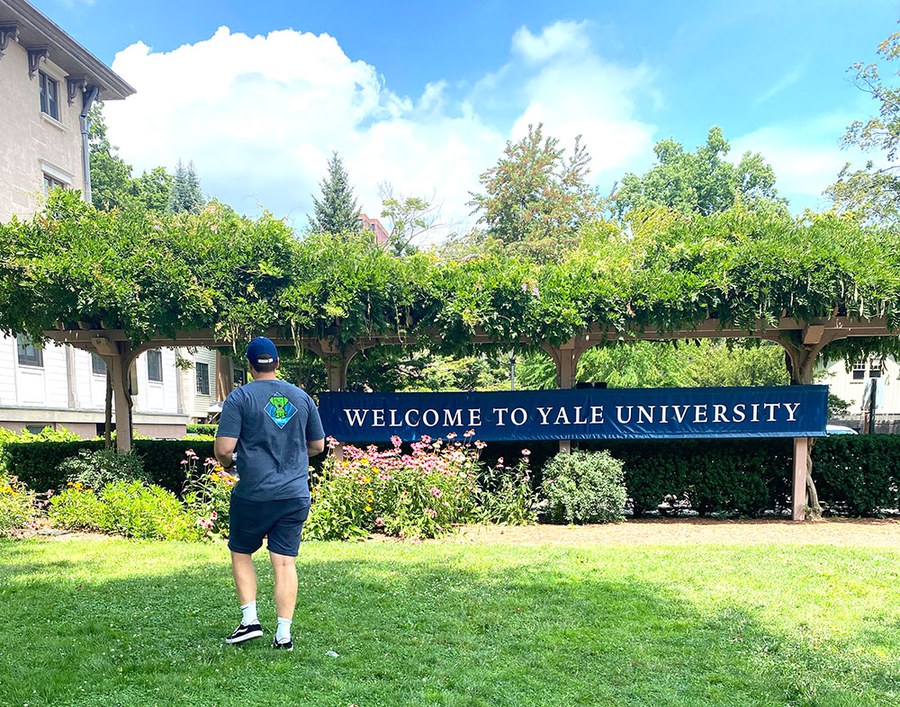
I have been conducting research at Yale University for just over a year now. We use programmed light waves to build particularly powerful fiber lasers. Although I have occasionally substituted for my supervisor in three lectures, my work here is almost entirely focused on research.
What advice would you give to our current first-years?
The examination offices won't like it, but: Don't stress yourself out and enjoy your time at university as much as possible It won't hurt you to consciously extend your time a little, for example with semesters abroad (I really enjoyed my ERASMUS semester in England) or by doing an internship or two. Since many people are forced to work alongside their studies anyway because their student loans aren't enough, you can also deliberately extend your time at university to make it more enjoyable. Having a few extra semesters on your record is not a problem!
And if you don't know what you want to do with your degree during your studies, try to stay curious and try out as many things as you can. Pursue even your smallest interests—it doesn't hurt to take a break and maybe work for a while as an intern or student assistant, or even move to a different city for a while to gain new experiences.
What do you remember most fondly about your time as a student?
During my first semesters, my time in Neustadt left a particularly positive impression on me. Later on, I really enjoyed the research-oriented work in the higher semesters, i.e., everything related to student research projects, advanced seminars, and my thesis. I especially enjoyed experimenting in the lab and programming the corresponding simulations.
What was your favorite place on campus?
We had to prepare a lot of things in our groups for many technical internships during our basic studies. Since most of us lived scattered around the city, we tried to meet at a central location. We ended up sitting at the long tables in the entrance area of the SLUB. Unfortunately, many others had the same idea. This area of the SLUB was always overcrowded and extremely noisy, and some people almost lost their nerves due to the heavy workload – yet I still look back on that time fondly.
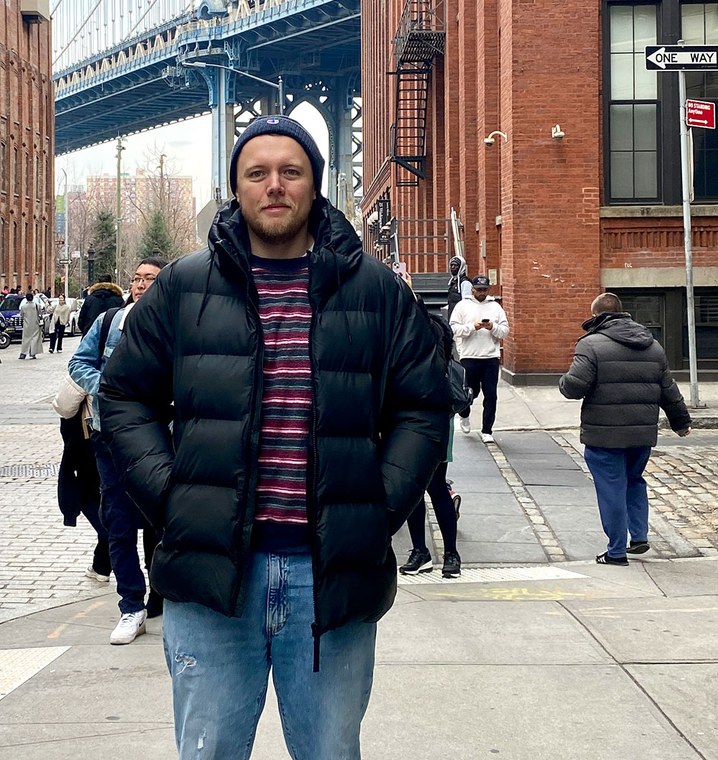
On a trip to New York City, at the famous Dumbo photo spot.
Then there was a period during my thesis when I often had breakfast alone at the Zebradiele in the “Alte Mense” canteen before going to work in the lab. In general, I find the seating area on the leather benches very comfortable, and it's a good place to watch the morning hustle and bustle. You sit there with a cup of filter coffee and a sandwich and watch the craftsmen and construction workers eating their breakfast of bockwurst and solyanka. Even today, thinking back on it gives me a warm, nostalgic feeling.
What still has a lot of value for you today / would you like to have had more of?
In research, you often encounter many complicated interrelationships. Technical systems in particular can be extremely complex. Keeping track of everything can sometimes be quite challenging. What helps me is often the way of thinking we were taught at the Faculty of Electrical and Computer Engineering: thinking in systems. I always imagine what is in front of me—be it a physical phenomenon or a technical detail—as a black box: Something goes in, something comes out, and then I try to gradually approach what happens in between. This abstraction of reality helps me a lot at times.
I would have liked to have worked with modern and relevant, but FEWER research topics earlier on. In some cases, we had to prepare 16 experiments per semester from three different Departments. Including the actual topic (what is it actually about?), the entrance test (you can fail it?!) and the protocol, it takes so much time in advance that in the end you switch your brain off and can hardly take anything in. What is a gyrator again?
What tips do you have for hitting the ground running in your industry?
Getting started in research begins with an exciting PhD topic. A good start usually depends on two key factors. First, the topic has to be something that genuinely excites you. During your doctoral studies, there will inevitably be times when you find it difficult to stay on track. However, doubts are part of the process and also show that you are engaging with the topic! But this is precisely why it is important that you find the topic exciting enough to make you want to return to the lab table or the office. Second, supervision is immensely important. Good supervision can not only help you through the aforementioned rocky stretches of the journey, but also prepare you well for the postdoc phase. It’s worth paying attention to whether you get a good impression of the supervisor in a personal conversation and whether there is mutual enthusiasm for the research topic. An international orientation of the chair (international team, English-language papers, co-authors from abroad, attendance at international conferences) can also provide information about how well-connected the chair holder is and how much support you will receive, for example, when attending international conferences or taking up your next postdoc position abroad.
What connects you to TU Dresden today?
TUD holds a very central place in my life, as I have spent almost 11 years of my still relatively young life there. Six of those years were devoted to my studies, and nearly five to my doctoral studies and first postdoc. At TU Dresden, I not only received an excellent education and training but also found my dream career. But even outside of academia, I had a great time in Dresden.
Throughout my years there, I formed lasting friendships, worked with amazing colleagues, cycled through picturesque landscapes, enjoyed magical moments at concerts, watched exciting Monarchs football games, and visited many fantastic exhibitions, markets, and museums.
Update 2026:
Since 2025, I have been working on smaller projects at the University of Twente and conducting research on photonic integrated circuits. On the one hand, we are building chips that form entangled quantum states based on single photon pairs, and on the other hand, I am trying to transfer the technologies I developed during my research at TU Dresden and Yale University to small programmable chips. The University of Twente, and in particular the group I work with, has clean room access and the necessary expertise. This provides me with an excellent ecosystem that I can access to take my research to the next level.
Contact
Dr. Stefan Rothe
Instagram: este_ban_g