
Aug 06, 2026
Diamonds Form Under Pressure
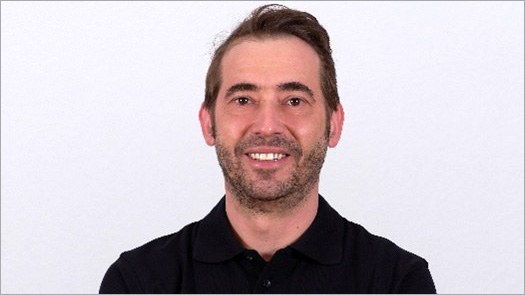
(interviewed in 2026)
Dagmar Möbius
As a child, Daniel Fleischer dismantled every device that he was interested in. Everything to do with technology fascinated him. Nevertheless, he made a last-minute decision to study electrical engineering. Today, the 45-year-old runs a company that specializes in custom machine building.
Daniel Fleischer grew up in Großschirma near Freiberg in Saxony — back then a village but now a booming town. “You were able to drive through the whole town in around 30 seconds,” he laughs. With a carefree smile, he reminisces about his childhood. Everything to do with technology fascinated him. He tinkered with mopeds and installed the engine in soapbox cars. He “never really gave it much thought” with regards to his future career. It was clear from the outset that it should be something to do with technology. It wasn’t until shortly before enrolling that his plans really took shape. In the fall of 2002, Daniel enrolled in the electrical engineering degree program, with a specialization in precision engineering, at TUD Dresden University of Technology. The proximity to his home town coupled with the university’s excellent reputation swayed his vote.
Lots of hands-on work, lots of construction
“The first few weeks were really tough,” he recalls. “I asked myself what I’d been learning all those years at school. You had to really have a solid grip on maths and physics.” And then of course: Theoretical electrical engineering — also not the easiest subject. Precision engineering: mechanics/construction was much easier to get into. It is therefore not surprising that this became his chosen specialty. The course content was really diverse. “You don’t need too much of it, but analytical thinking provided a fantastic foundation.”
Dr. Alfred Kamusella taught Daniel everything he knows about FEM simulation and design. “This led me to a lot of creative solutions,” he laughed. A model he built back in the day still works and is now in his office. In the TUD workshop, he got to grips with CNC milling. “Lots of hands-on work, lots of construction, a really good practical basis,” he says, summarizing his daily business. The program is well-suited to those with an affinity for technology, and it really “opens doors for anyone who manages to complete the course.”
A career path towards the semiconductor industry
Daniel set out on his future career path shortly after commencing his studies. But he wasn’t aware of this at the time. He first came into contact with the semiconductor industry through a summer job at Infineon. He spent one semester of his five-and-a-half-year degree program in Lausanne, Switzerland, as part of the Erasmus program.
For his Diplom thesis, which was supervised by Dr. Holger Neubert — now head of the Intelligent Materials and Systems department at the Fraunhofer Institute for Ceramic Technologies and Systems (IKTS) — he used a specialized simulation.
After completing his studies, he joined Feinmess Dresden — now known as Steinmeyer Mechatronik — in 2008. This is where he got involved in exciting projects and had a good rapport with management. Nevertheless, he resigned after two years — during an economically difficult period, shortly after the stock market crash — and went on to work as a freelancer. He worked indirectly on projects for Siemens in Dresden, and later for local semiconductor manufacturers. After four and a half years, he became a co-owner of an automation company and took over as head of design. This meant that he was “fully immersed in the semiconductor industry.”
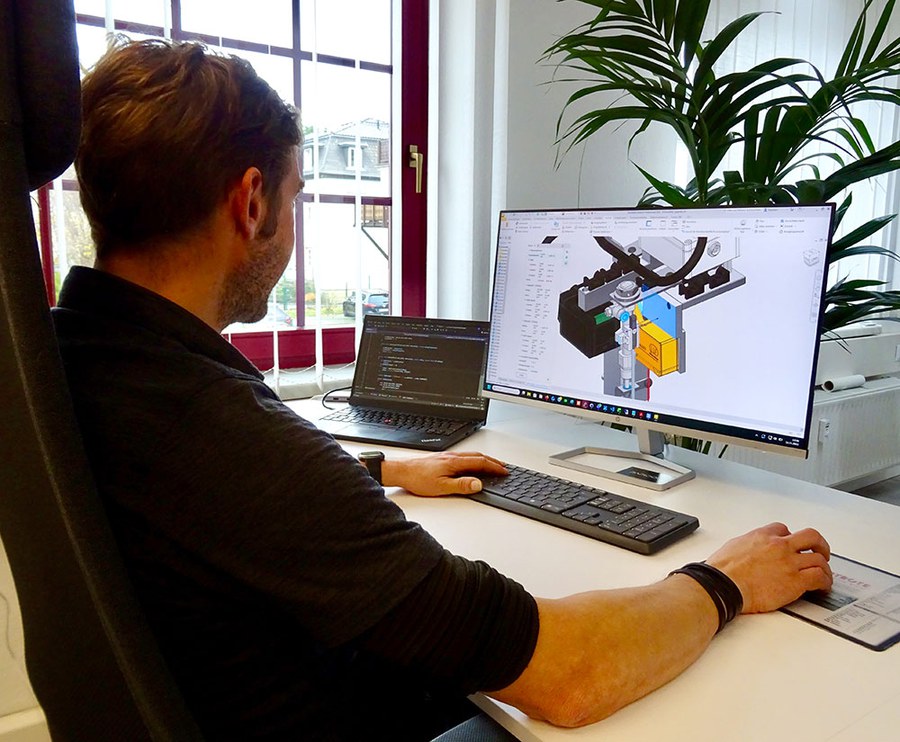
Design of a measuring device; the screen shows sensors for distance, hardness, and a QR code reader.
A more fulfilling freelance experience
In January 2023, Daniel founded a new company alongside two colleagues that specializes in custom machine building. Most of their projects currently focus on measurement technology for the semiconductor industry. Ranging from discussing customer requirements to creating a concept and the finished product, the company’s services cover nearly everything involved — everything except for the manufacturing itself. “We’ve been busy right from the outset,” he beams. “I could have looked for a different job, but once you’ve been self-employed, there’s no going back to working as an employee at a large company,” he says.
Rapidon, based in Dresden-Coschütz, develops automation solutions for the semiconductor industry and “custom motion and handling systems for high-precision production environments.” An example is the substrate thickness measurement system. Put simply: “This tool transformed a previously manual process into a fully automated measurement process. The benefits for customers include significant time savings, as well as seamless integration into the production chain and the plant infrastructure.”
At the Silicon Saxony Days, which took place in Dresden in July 2026 for the 20th time, Rapidon presented a new device for measuring reflectometric film thickness. “It is used for quality control and combines a great deal of expertise from various fields and technologies. Linear axes, control systems, optics, and camera systems, to name just a few,” Daniel explains.
What’s missing? More time to experiment
Of course, there are significantly less stressful jobs, says the CEO. His work situation is very good. He works a lot, but really values the freedom. He has nothing but good things to say about his small team, which currently consists of five people in addition to freelancers and students during busy periods.
If he could change anything, then it would be having more time dedicated to a mini research department. “More time to experiment,” he calls it. Time to try out new things and see what could effectively be implemented in machines in the future.
As the former leader of the funding body for his daughter’s school, he had developed ambitions for a prototype of a special device years before. “The idea was inspired by the waste paper collection program there. With 400 pupils, you can’t always be there when they want to recycle paper. I used a ToF camera to measure volume, which, combined with the weight of the scale, allowing the quantity deposited to be recorded automatically.” Unfortunately, the associated workshop on the technology — which was intended for the pupils — didn’t take place due to organizational complications, but passing on knowledge and a passion for technology remain close to the engineer’s heart.
Despite everything, he still lives by a saying he picked up during his studies, because he always started studying at the last minute but still got good grades: “Diamonds form under pressure.”
Given his experience, he doesn’t recommend that complete newcomers start their own company. It is better to gain a few years of experience at as many companies as possible and build up a network of contacts.
Contact:
Daniel Fleischer - Managing Director / CTO
Rapidon GmbH
Tel.: +49 176 487 36090
Email:
Website: https://rapidon.de