
Apr 13, 2026
"Job titles change - dynamics remain the same."
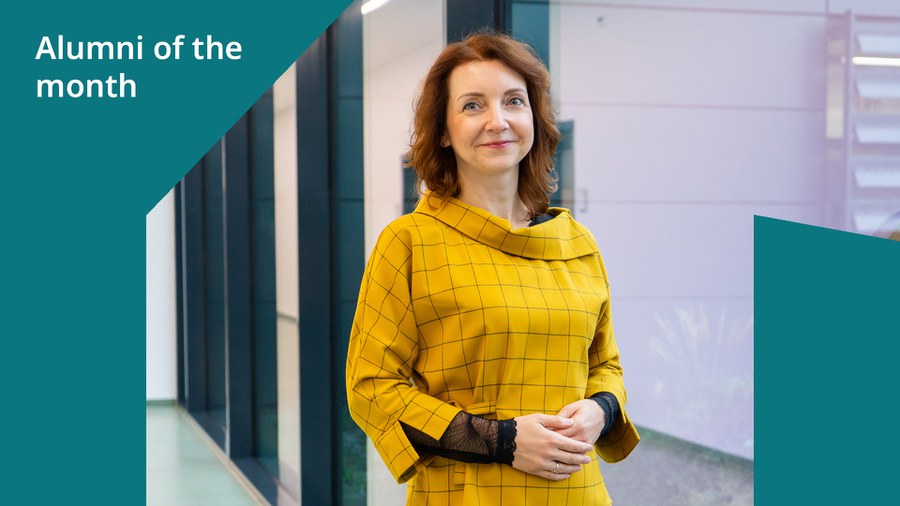
Prof. Katharina Bühn is the Alumna of the Month for June 2026.
(interview from 2025)
Thomas Scheufler
“Sorting through information, critically evaluating sources, and drawing clear arguments based on evidence – these are all skills I acquired during my studies and that continue to help me in my work today.”
Prof. Katharina Bühn studied and obtained her doctor)ate at TU Dresden. Today, she heads the Bautzen campus of the Duale Hochschule Sachsen (Bautzen campus), a university that combines academic study with practical work experience, where she also teaches human resource management and leadership as a Professor of Business Administration. When she first started studying, her goal was to understand people. She now uses her skills to improve teamwork, decision-making, and communication between people. With hindsight, her chosen field of study has proved to be a universal toolkit for life.
| Name: | Prof. Katharina Bühn |
| Degree program | Psychology |
| Faculty | School of Science |
| At the university: | 2000 - 2007 |
| Current work: | Director of Duale Hochschule Sachsen (Bautzen campus) and
Professor of Business Administration/Human Resource Management |
Where are you employed today and what are your responsibilities?
I’m Professor of Business Administration, esp. Human Resource Management and Leadership at the Duale Hochschule Sachsen (Bautzen campus). I was elected to the office of Director of the university in April 2025. As such, I hold two roles that complement each other well: First, I conduct research on and teach courses related to leadership, collaboration, and organization. Secondly, I actively contribute to shaping these very structures in the day-to-day operations of the university – from strategic decisions to the further development of our academic programs.
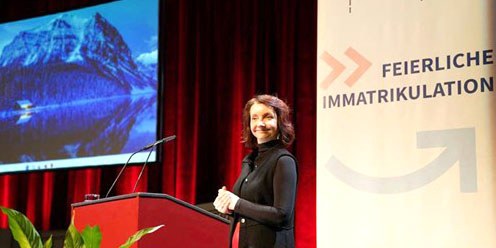
Erste feierliche Immatrikulation der Amtszeit von Prof. Katharina Bühn am 1. Oktober 2025 im Deutsch-Sorbischen Volkstheater in Bautzen.
What still has a lot of value for you today? What would you like to have had more of?
The intensive (offline) research I conducted during my studies has had a profound impact on me. It was time-consuming, but helped me develop a structured way of thinking: Sifting through information, critically evaluating sources, and drawing clear arguments based on evidence – all skills that continue to help me in my work today. I also now look back on oral exams in a positive light: They encourage spontaneous thinking, the ability to reason, and a deep understanding of topics – skills that are essential in the workplace. At the time, I would have liked more opportunities to apply academic content to practical situations, e.g. through application-oriented transfer programs or project work. Courses on academic writing per se, such as those currently taught as part of the AQUA modules, also felt somewhat underdeveloped. The first seminar paper was very much a “learning by doing” situation.
Why did you decide to study at TU Dresden?
For one thing, the proximity to my hometown of Bautzen was convenient. But the main reason was coming into contact with the university at an early stage: When I was still in high school, I went to the university open day in January several times. This not only gave me a clear picture of what studying there would be like, but also made me feel that the location was accessible and a good fit for me. Additionally, many of my friends who studied with me in high school also decided to study in Dresden.
What made you choose this degree program?
To begin with, I wanted to understand people. I wanted to understand why people behave in certain ways and why they develop mental health issues. Today, I use it to improve teams, decision-making, and communication. Looking back, psychology was less of an academic subject and more of a toolkit for life. Technical problems can usually be solved. Solving issues with people is where the bigger challenge lies – which is why, in retrospect, studying psychology was the most logical choice for my career. I studied psychology because, ultimately, every industry deals with people. Job titles may change – but dynamics between people remain the same.
What researchers or lecturers influenced you the most during your studies?
I was particularly influenced by Prof. Winfried Hacker’s classes. He’s a co-founder of the well-known action regulation theory. These lectures really honed my perspective on work organization and human behavior in a professional context from an early stage.
I also remember statistics and math: These subjects taught me how to think analytically – even if I didn't always appreciate that right away while I was at uni.
My career-oriented specialization left quite an impression on me, because that was where I first saw theory directly applied to real-world situations. Even back then, I took an interest in occupational health and stress management.
What advice would you give to our current first-years?
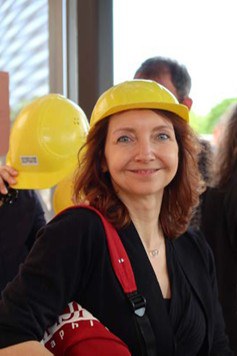
Visit to the Knappenrode Energy Plant as part of a staff event
Take full advantage of the resources offered at the university, even before you begin your studies. That will increase your chances of finding a degree program that's a good fit for you. When it comes to psychology, my advice is: try out different avenues. At first, I really wanted to become a clinical psychologist – but during my graduate studies and my first job at Leipzig University Hospital, I quickly realized that I was more passionate about occupational and organizational psychology. When I finally landed a PhD position at TU Dresden, I was really happy. Changing direction is a natural part of life. You should also read a lot! In my opinion, good scientific writing largely stems from reading.
And it’s also very important to consciously enjoy student life. While having specialized knowledge is vital, networks, shared learning experiences, and informal conversations often have just as much of an impact on one’s future path.
What do you remember most fondly about your time as a student?
One thing that really stands out in my memory is the sense of community. Although there were over a hundred students in my program, we quickly formed close-knit groups and friendships – people with whom I studied, struggled together, and ultimately succeeded in exams with. Of course, we also had the classic student experiences: Parties, concerts, and seasonal events like a Christmas lecture featuring mulled wine. I'll never forget rock band Sportfreunde Stiller's performance at the summer campus festival. It's this combination of intensive work and shared experiences that makes student life so unique when you look back on it.
What was your favorite place on campus?
The “Alte Mensa” canteen was a central meeting point for me – not just for food, but to meet people. During my doctoral studies, it became a social hub for me and many of my colleagues, along with the “Schummel” cafeteria in the Schumann Building.
For focused work, on the other hand, there was the SLUB and other libraries: places where content slowly gave way to understanding.
What tips do you have for hitting the ground running in your industry?
Getting off to a good career start depends above all on a combination of expertise and practical experience. Internships, part-time student jobs, or projects help students apply theoretical models to real-world situations. When working with people, communication skills, self-reflection, and a willingness to see things from different perspectives are also important. Those who not only know the methods but are also good listeners find it much easier to get started. In general, though, there's so much variety that it's hard to give a one-size-fits-all answer. During your studies, you should figure out which direction suits you best—is it clinical psychology, or are you more interested in industrial and organizational psychology, or are you interested in leadership or education? Or maybe can you imagine a career in academia?
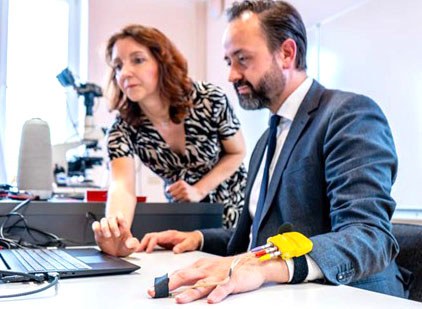
Visit by Science Minister Sebastian Gemkow to the DHSN’s Bautzen campus – he will undergo a “stress test” using biofeedback
What connects you to TU Dresden today?
I still have close ties – both with former colleagues from my doctoral studies and with professors who now teach at the Bautzen campus or are involved in tenure-track hiring processes. For me, TU Dresden is therefore not just a place where I studied in the past, but remains an integral part of my professional network. Last but not least, I met my husband at TU Dresden while I was pursuing my doctorate. We now both work at the Bautzen campus of the Duale Hochschule Sachsen. So my connection to TU Dresden couldn’t be any more sustainable!
Contact:
Prof. Katharina Bühn