
Oct 30, 2026
“The most exciting challenges of our time usually lie at the intersection of disciplines.”
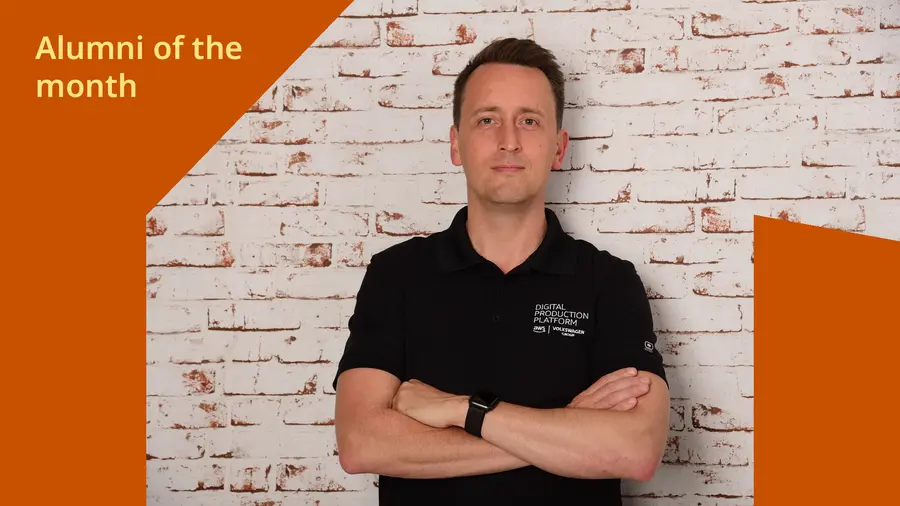
The Alumnus of the Month for November is from the Business Information Systems.
(interview from 2026)
Thomas Scheufler
“TU Dresden taught me to approach complex problems from an interdisciplinary angle and to solve them systematically. This way of thinking continues to shape my work today in industry, research and teaching.”
Prof. Uwe Wieland earned his PhD in Business Information Systems at TU Dresden. He currently serves as Senior Director of Software Product Development and AI-Based Solutions at Volkswagen AG and as an honorary professor of Business Information Systems at HTW Dresden, with his work spanning industry, research and education.
|
Name: |
Prof. Uwe Wieland |
|
Degree program |
Business Information Systems (PhD) |
|
Faculty |
Faculty of Business and Economics |
|
At the university: |
2012-2015 |
|
Current work: |
|
Where are you employed today and what are your responsibilities?
My work today revolves around the areas where industry, research and education overlap. My job at the Volkswagen Group involves developing AI-based software products for industrial transformation. On top of this, I serve as an honorary professor at HTW Dresden and I’m on the Industry 4.0 Research Advisory Board. I am also a member of the Supervisory Board of the German Research Center for Artificial Intelligence (DFKI). I am particularly interested in how people, organizations, and technologies can work together to shape the future. This idea also gave rise to the non-profit initiative matchIO, through which we promote intergenerational learning and exchange between education, industry and society.
What still has a lot of value for you today? What would you like to have had more of?
Even today, I continue to benefit from the analytical thinking and scientific approach to work that I learned during my studies. I would have liked even more early interaction between students, companies, and societal stakeholders, and this is exactly the vision we are pursuing today with matchIO.
Why did you decide to study at TU Dresden?
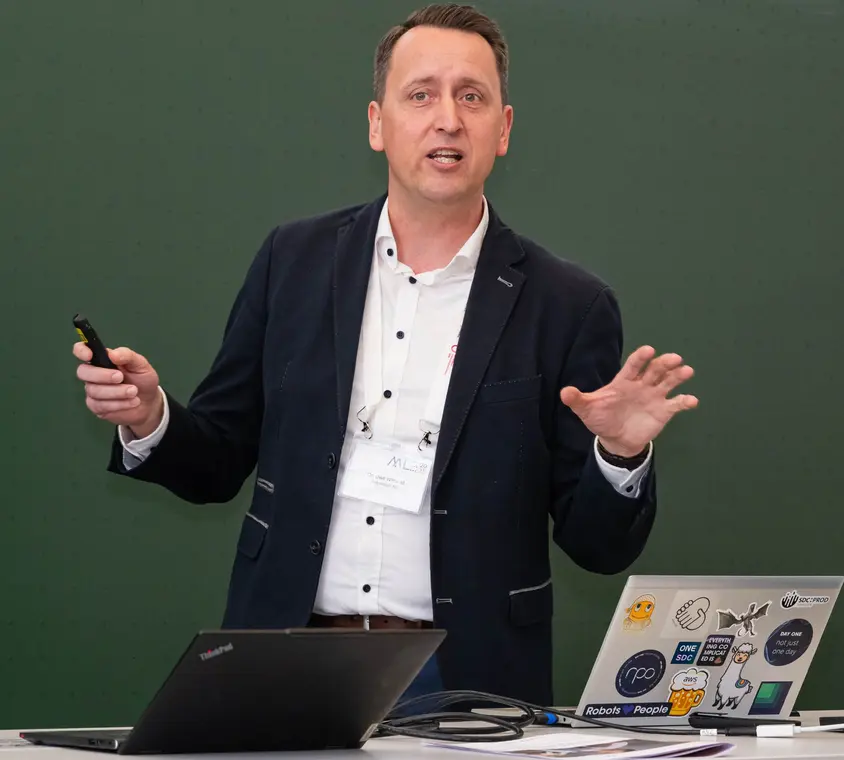
Prof. Uwe Wieland also serves as an honorary professor at HTW Dresden
While studying for my MBA at Dresden International University, Prof. Andreas Hilbert approached me to ask if I would be interested in pursuing a Ph.D. I was really excited at the prospect of combining practical experience in industry and digitalization with academic research. TUD offered an excellent environment, giving me the chance to explore, with a certain academic depth, the very issues that I deal with on a daily basis in my work.
What made you choose this degree program?
For me, Business Information Systems combines three world that are now inextricably linked: Technology, organization, and people. I’ve always been fascinated by the question of why some technologies have such a huge impact while others fail despite significant investments. Business Information Systems provides exactly the tools needed to understand and shape these worlds.
What researchers or lecturers influenced you the most during your studies?
Prof. Andreas Hilbert has had a particularly profound influence on me. He combined academic excellence with a clear understanding of the practical relevance of research. From him, I learned that research realizes its greatest value when it not only generates new insights, but when it also helps to solve tangible problems in business and society.
This perspective continues to shape my work today. Many of my current activities focus on how various insights, strategies and technologies can be effectively translated into action. Bringing together scientific analysis, well-informed decisions and successful implementation is really at the heart of what I understand to be "Decision & Execution Engineering.”
What advice would you give to our current first-years?
Don’t just focus on the technical stuff. Learn to properly understand problems, collaborate with others, and take on responsibility. The most exciting challenges of our time usually lie at the intersection of disciplines. Those who can bridge technology, business, and people will make a difference, even in a world full of AI and automation.
What do you remember most fondly about your time as a student?
I most fondly remember the close connection between science and practice. Throughout my doctoral studies, I was also working at Robotron at the same time and was able to directly apply many scientific insights in practice. Alongside Prof. Andreas Hilbert and Ulf Heinemann, whom I’d already got to know while I was at Dresden International University, a concerted exchange developed between the Chair and industry. This even led to the creation of a new business division at Robotron. This was a powerful demonstration of the incredible synergy between academic research and commercial enterprise.
What was your favorite place on campus?
It was actually the “Alte Mensa” canteen. And it was never just about the food. The campus area around the canteen was a place where people came together. Economists, mechanical engineers, computer scientists, and students from many other disciplines all met up there. There was always good food, nice places to hang out, and, above all, lots of interesting conversations to be had. Looking back at my time as a student, it was precisely these unplanned meet-ups that were often just as valuable as some of the lectures.
What tips do you have for hitting the ground running in your industry?
Expert knowledge is the ticket in, but in the long run, curiosity, a willingness to learn, and the ability to take on responsibility are what matter most. Anyone who understands the interplay of technology, organization, and people will also succeed in a world full of AI and automation. My advice: Don’t just look for your first job, look for problems that are worth solving.
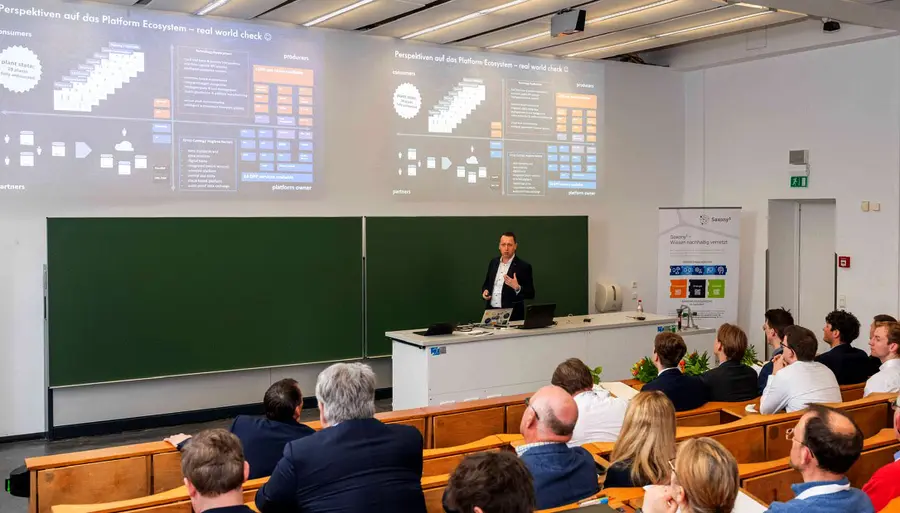
Lecture at HTW Dresden
What connects you to TU Dresden today?
In addition to the academic excellence, its really the people who still connect me to TU Dresden today. Over the years, this has led to the building of many valuable relationships and joint projects. I find it particularly impressive to see how talent develops. For example, Prof. Patrick Zschech was already an exceptionally dedicated student in our department back when I was doing my Ph.D. Today, he is the Chair, which is something the faculty can be proud of. I still maintain an ongoing professional relationship with Prof. Susanne Strahringer. Alongside my colleague Dr. Richard Rößler, I still publish on topics such as business information systems, including in the magazine HMD Praxis der Wirtschaftsinformatik. t the same time, I really value the regular exchanges I have with Prof. Buscher, Prof. Hornuf and Prof. Ihlenfeldt. With their support, I have even had to chance to advise my first doctoral student. It was a special moment for me, and was a real sign of how industry, research, and the promotion of young talents has come full circle over the years.It is precisely these people and the openness to cross-disciplinary collaboration that, for me, constitute an essential part of TU Dresden.