
Jan 07, 2026
"Diversity doesn't just mean rainbow flags and unisex toilets"
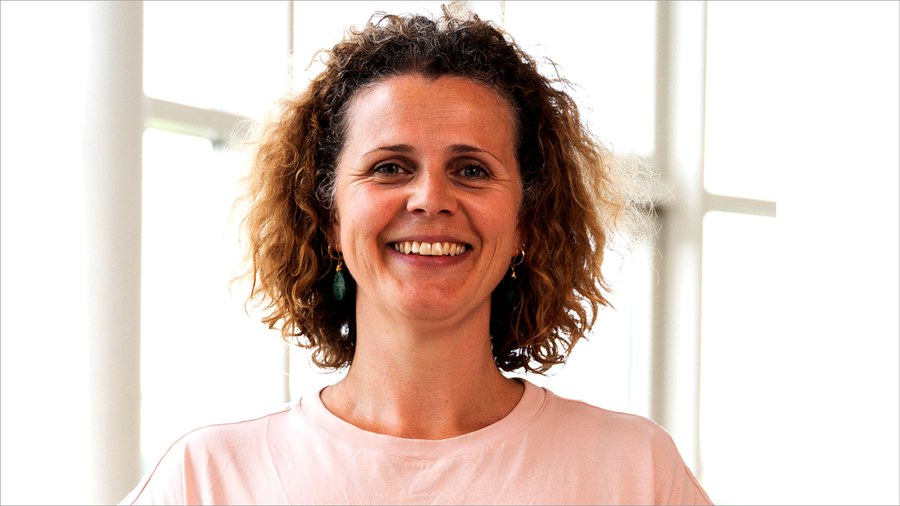
(interview from 2025)
Dagmar Möbius
After studying French, Spanish and English, Friederike Kühn graduated from high school with a French university entrance qualification. Born in 1982, the Dresden native experienced the uncertainties of the post-reunification period first hand. She ended up becoming a sociologist in a roundabout way. Contrary to common German clichés, her field of study did not lead to driving a cab. Instead, she is now Project Manager for Diversity at Klinik Bavaria Kreischa.
"There wasn't really any career guidance when I was at school," recalls Friederike. Her parents were confronted with professional upheaval in the 1990s and had to retrain. The 43-year-old remembers a kind of job aptitude test from an insurance company that she did during her high school years: "The result was sociology/social education." An advisor from the employment agency recommended studying tourism in Breitenbrunn, "because that's what her daughter did.” As a city child, however, it was unthinkable for Friederike to move from Dresden to the Ore Mountains. "I wanted student life, a shared flat, partying," she laughs. Instead, she traveled to America for a year after graduating from high school and worked as an au pair in Boston.
People are better than instruction manuals
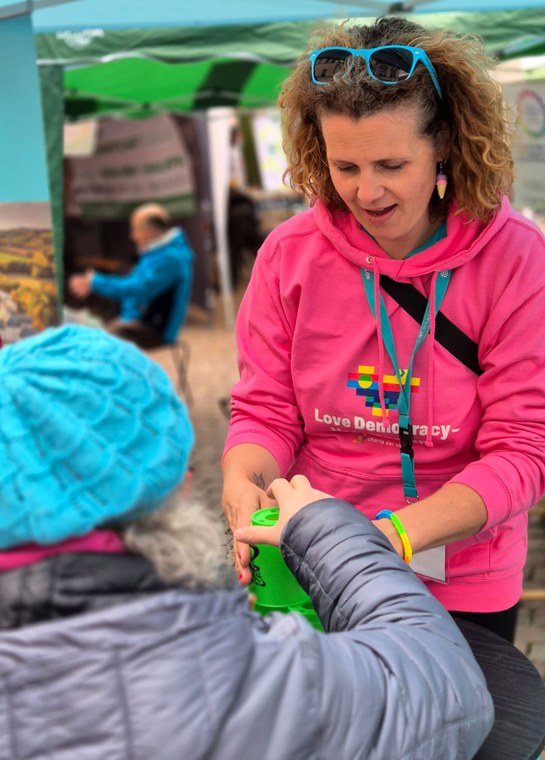
As a diversity-oriented employer in the region at the Market of Cultures in Pirna.
For the linguistically gifted, study opportunities were limited. She decided against a teaching degree after getting advice from one of her teachers. She started off studying translation in Magdeburg, but quickly realized that it was not her calling. And this was not only owing to her and her fellow students’ being told that they would "later translate instruction manuals." After two semesters, she transferred to studying sociology at the University of Magdeburg. After her undergraduate studies, she returned to her home town in 2006 to study for a master's degree in sociology at TUD. "This is the science that deals with how humans coexist with one another," she explains. She studied educational sciences and English as her minor subjects. She still praises the opportunities to learn languages at TU Dresden. "I started with Dutch and Swedish," she says and laments how much harder it is to learn foreign languages in life after school. In 2011, Friederike wrote her thesis on labor migration in the border triangle between Germany, Poland and the Czech Republic. She still finds it a shame that relatively little Polish and Czech is taught and spoken in Saxony.
"Nobody is looking for sociologists"
Although she had worked in the area of services and supports for people with disabilities alongside her studies, she found it difficult to really kick-start her career. "Nobody is looking for sociologists. That's still the case today," she says, noting that you have to really look for jobs for social scientists. She became a case manager at a youth welfare organization, to fill in for someone on parental leave. And there she was greeted with the prejudice of all prejudices: "Sociologists are cab drivers, aren’t they?" She had multiple fixed-term contracts, precariously paid. Friederike commuted to the district of Meißen every day, she never drove a cab. Because for that job, "you have to know every little street." She denies any existential fears and people believed her when she said: "If necessary, I'll sit at the supermarket checkout."
This, however, was not necessary, because between 2013 and 2016 she worked in a regional coordination office for career and study orientation in Pirna and supervised her own projects. She also completed a two-year degree in social management at the Saxon Academy of Administration and Economics.
Her personal take: Diversity is relevant
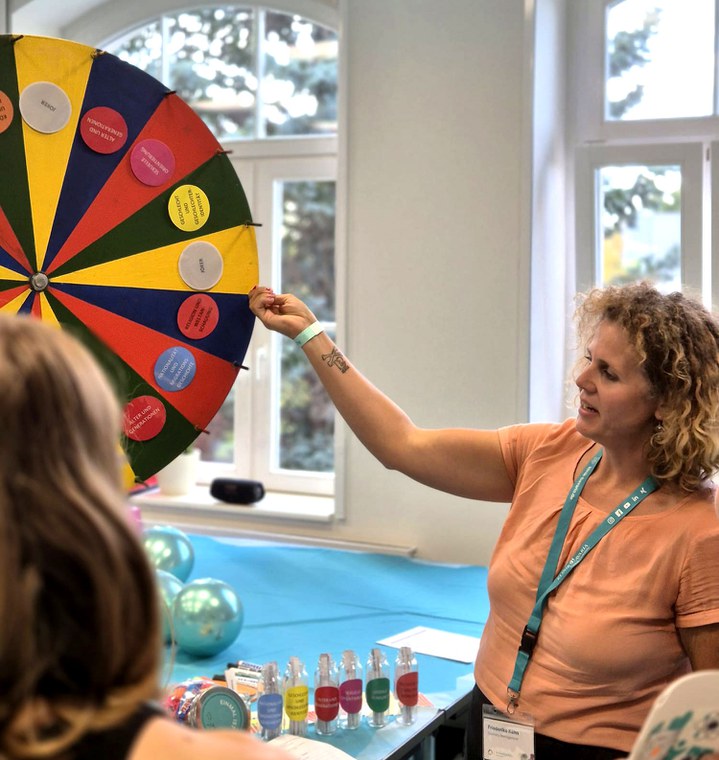
Wheel of Diversity – just spin the wheel and change your perspective.
Someone she met during her studies led her to her first permanent job. At ASB Dresden & Kamenz gGmbH, she set up the corporate communications/recruiting department in 2017. This is where she first encountered the topic of diversity: "I realized then that diversity was becoming more relevant." After seven years and becoming the mother of two children, she decided to break new ground in 2023. "I've twice experienced that a job no longer exists after parental leave." Her focal topics had also changed.
Meaningful activity is the be-all and end-all
Two years ago, Friederike applied for a job at the Bavaria Kreischa Clinic. Following a strategy process, the company had committed itself to the topics of sustainability, digitalization, employer branding, diversity management and health promotion. "I was accepted immediately after the interview," says the Project Manager for Diversity happily. Her previous experience in project management, her curiosity about people and her social streak stood her in good stead. She now deals with future-relevant issues alongside her four colleagues. "Diversity is not just about rainbow flags and unisex toilets, it’s about equal opportunities and participation," she clarifies. "We have the freedom to do things differently, to make them tangible. Trial and error is all part of it."
Not a job for everyone
Even though she was able to fall back on the theoretical foundations of her studies, she always learned what she needed for her work on the job. The concepts of "The Established and the Outsiders" by Niklas Luhmann had a lasting influence on her. She thinks back to TUD professors Karl-Siegbert Rehberg, Professor Karl Lenz, as well as a number of people who came and went. Her current work is very much about her approach to life, dealing with questions like: "What does it mean to have a career?" or "How do I view other people?" very much require self-awareness and a willingness to reflect. "Not just anyone can do a job like this," Friederike is convinced. "Of course, I also have prejudices, but I try my best to go through the world with a more open mind than others. Anti-discrimination can be learned." It's also a matter of getting down to the nitty-gritty: Classes, hierarchical system, symbolism in politics.
Allyship and normality
At Klinik Bavaria, for example, which pioneered the issue of employing migrant workers, there is a pool of nursing staff or flexible working hours for early shifts specifically for parents. But there is much more at stake. Academization of nursing care, integration of specialists, tolerance, resource orientation instead of deficit thinking. "In the field of diversity, there is the term allyship, to be an ally," explains the project manager. During her term of office, in August 2024, her employer signed the Charta of Diversity and, taking the same steps as around 6,500 other companies in Germany, committed their company to "creating an appreciative and respectful working environment and actively supporting the diversity of their employees." To concretize the thesis "not just rainbow flags and unisex toilets," this relates to factors such as age, gender and gender identity, physical and mental capabilities, migration history and nationality, religion and world view, sexual orientation and social background.
Friederike knows that the topic of diversity can also trigger conflicts and a sense of injustice. She posits: "We need to rethink and be better prepared for this." And she hopes that everyone will come to accept diversity as normal.
Contact:
Friederike Kühn
Email:
Linkedin
Transparency disclaimer:
The author Dagmar Möbius was employed at Klinik Bavaria Kreischa from 2000 to 2005.