
Tree sponsorship Gert Aurig Foundation Dresden Hop-hornbeam
- Scientific name
- Ostrya carpinifolia
- Planting
- December 2023
- Tree sponsor
-
Gert Aurig Foundation DresdenThe foundation has been promoting environmental and landscape protection since 2006.
- Handed over on
- Mar 29, 2024
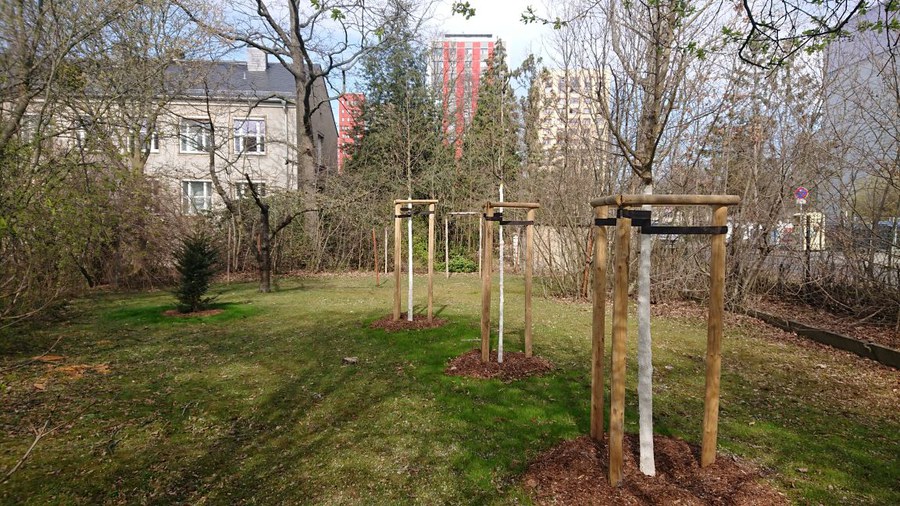
The Gert Aurig Foundation provided the financial means for the planting of four trees on the campus of the TU Dresden. In the outdoor area near the Drude building, a Hop-hornbeam, a Tree-Hazel, a Common Wild Medlar and two Juneberries were planted as large shrubs.
Location
Did you know?
The Hop-hornbeam is a medium-sized tree species up to 15 metres tall, native to the Mediterranean region. This tree species requires a climate of warm summers, mild winters and high precipitation, is extremely tolerant to heat and drought, and hardy. The hop-hornbeam is a fast-growing species and can live up to 100 years. The leaves of this deciduous tree are reminiscent of hornbeam foliage. They turn yellow in the fall. Its flowers are rather inconspicuous, but the inflorescences, reminiscent of hop cones, are all the more striking. The hop-hornbeam provides food for insects and birds in the form of pollen and seeds (nuts).
The Tree Hazel (Corylus colurna) is a deciduous tree with a height of approximately 20 meters. The species is native to the mountain forests of southeastern Europe and central Asia. This non-native wild form has been planted in Central Europe since the 16th century. The tree hazel reaches an age of 80 years. With its low soil requirements and high drought resistance, the tree hazel is considered to be resistant to urban climates. The robust and hardy species is one of the early bloomers, as large, green-yellow, catkin-like flowers appear in February. In autumn, the tree bears edible fruit. The hazelnuts are a valuable food source for insects, small mammals, and birds. The feeding track on a hazelnut shell reveals who ate the nut. A small round hole indicates the nut borer, a small weevil. The nuts contain potassium, calcium, vitamin E and magnesium.
The Common Wild Medlar (Mespilus germanica) is a thorny, deciduous shrub that grows up to five meters tall and has a moderately branched, rounded crown. In the past, the medlar was often planted as a fruit tree. Wildwachsende Restbestände sind in Büschen und Hecken, an Böschungen und Wegen sowie in lichten Laubwäldern erhalten geblieben. Its natural range extends from southern and southeastern Europe to the Caucasus. The medlar was once a popular fruit that was known to the ancient Greeks and spread by the Romans throughout their empire. It was well represented in the medieval monastery gardens, and was also used for medicinal purposes. The fruit is very tasty, but very sensitive to pressure and not long-lasting.
The shrub is quite undemanding, hardy, and can live up to 100 years. The large white flowers of the true medlar produce a lot of nectar, which attracts many insects, especially honey bees. The seeds are released through digestive dissemination after being eaten by birds and small mammals, as well as deer and wild boar.
The Juneberry (Amelanchier lamarckii) originates from eastern North America and is cultivated in Europe as an ornamental tree. The species often grows wild and is now considered naturalized in some areas. The deciduous, multi-stemmed, and richly branched shrubs have an initially upright, later umbrella-shaped crown. The flower color and foliage color are much more intense than those of the native Common Rock Pear (Amelanchier ovalis). The yellow, orange, and red autumn coloration is magnificent and one of the reasons why the species is often used as an ornamental tree. In the large and numerous flowers, the nectar is easily accessible for pollinators (flies, hoverflies, and bees). The small, apple-shaped fruits are good winter food for birds, especially songbirds, and for small mammals that eat fruit. The seeds are so-called cold germinators and require a cold period before they germinate.
The species is well-suited for urban climates and is also cultivated as a potted plant on rooftop terraces.