
Jul 17, 2026
Einstein Telescope: Lusatia and Sardinia confirm joint bid
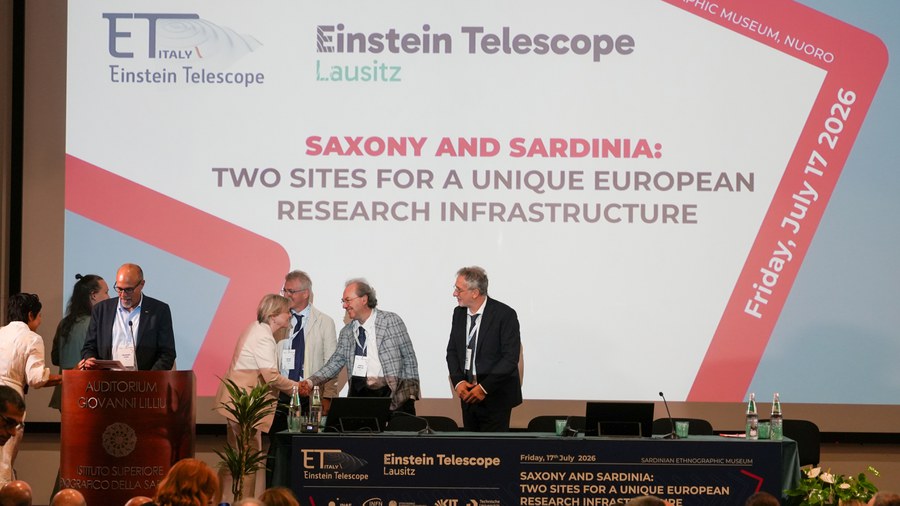
In Nuoro (Sardinia), representatives from German and Italian research institutions signed the cooperation agreement, including Dario Eickhoff (KIT), Prof. Angela Rösen-Wolff (TUD), Fabio Florindo (Istituto Nazionale di Geofisica e Vulcanologia), Prof. Antonio Zoccoli (National Institute of Nuclear Physics), and Prof. Roberto Ragazzoni (National Institute of Astrophysics).
Candidate regions Lusatia and Sardinia are moving forward with their joint bid for the Einstein Telescope (ET): Today, leading German and Italian research institutions signed a cooperation agreement in Nuoro, Sardinia, thereby agreeing to submit a joint application to host the European research infrastructure. The cooperation on the German side is spearheaded by TUD Dresden University of Technology and Karlsruhe Institute of Technology (KIT). The Italian partners include the Italian National Institute for Nuclear Physics (INFN), the Italian National Institute for Astrophysics (INAF), and the Italian National Institute for Geophysics and Volcanology (INGV).
The agreement forms the basis for scientific collaboration within the framework of a “double-L” configuration, in which the Einstein Telescope is to consist of two complementary L-shaped interferometers—one in Lusatia and one in Sardinia.
Saxony’s Minister of Science Sebastian Gemkow: "This is one more step in our partnership as a location candidate for the Einstein Telescope, a large-scale European project. Sardinia and Saxony are working together on a vision for this unique research infrastructure. The agreement signed between leading Italian and German research institutions supports our joint bid for a shared underground gravitational-wave detector and promotes cooperation across national borders."
Prof. Ursula M. Staudinger, Rector of TU Dresden: "The cooperation agreement is an important milestone on Lusatia's path to hosting the Einstein Telescope. It underscores the European spirit of this unique research project and reflects our commitment to fostering scientific excellence across national borders. As a University of Excellence, TUD brings its strengths in the fields of high-performance computing, AI-supported data analysis, optoelectronics, and precision measurement technology to the table. At the same time, the telescope offers a tremendous opportunity to scientifically and technologically advance these key technologies. We are fully committed to supporting this joint European bid."
Prof. Christian Stegmann, Scientific Co-Director at TU Dresden of the feasibility study for the future Einstein Telescope in Lusatia: "In the future, Europe will collaborate even more closely on the Einstein Telescope. This collaboration extends far beyond the actual research infrastructure at the two sites in Lusatia and Sardinia. It builds bridges between science, innovation, and people across Europe."
Prof. Antonio Zoccoli, President of the INFN: "We are convinced that implementing the Einstein Telescope as two L-shaped interferometer detectors will provide the best conditions for the project's success. This vision goes beyond the collaboration between the two candidate sites and paves the way for a truly European research infrastructure that involves all partners in the development of a major distributed network for gravitational-wave research."
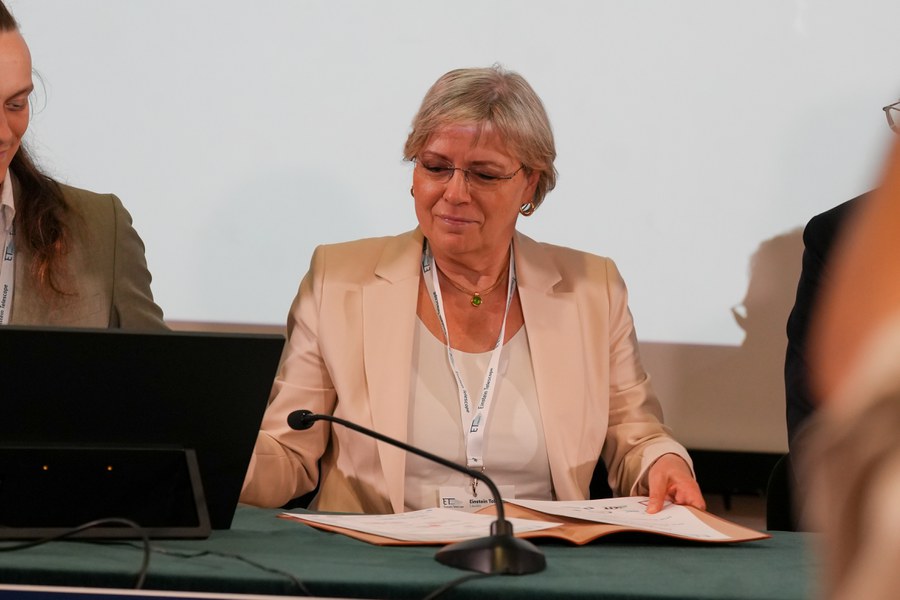
Vice-Rector Prof. Angela Rösen-Wolff signed the cooperation agreement on behalf of TUD.
In addition to Christian Stegmann, the signing was attended by State Secretary Heike Graßmann from the Saxon Ministry for Science, Culture and Tourism and Angela Rösen-Wolff, Vice-Rector Research and Technology Transfer at TU Dresden. The Italian delegation was accompanied by Alessandra Todde, President of the Autonomous Region of Sardinia.
Hubertus Rietscher, Mayor of Ralbitz-Rosenthal, as well as Emanuele Fenu, Mayor of the Nuoro, and Mario Calia, Mayor of Lula, were also present at the signing. Their municipalities rank among the potential sites for the telescope in Lusatia and Sardinia. The mayors support the research project and intend to promote it through joint community activities.
With this agreement, the partners have signaled their commitment to establishing cutting-edge research infrastructure in Europe. The Einstein Telescope is one of Europe's most important research infrastructure projects and is also one of the priority large-scale projects of the Federal Ministry of Research, Technology and Space (BMFTR). The cooperation agreement builds on the memorandum of understanding signed by the Free State of Saxony and the Autonomous Region of Sardinia in January 2026.
Background: Einstein Telescope
The Einstein Telescope is the proposed next-generation of European research infrastructure for observing gravitational waves. With sensitivity significantly higher than that of today's detectors, it is expected to provide novel insights into the formation of black holes and neutron stars, the evolution of the universe, and fundamental questions in physics. There are currently three internationally recognized candidate regions for the construction of the research infrastructure: Lusatia, Sardinia, and the Meuse-Rhine Euroregion. The decision on the location of the telescope is expected to be announced in late 2027.