
Sep 17, 2026
“Who’s actually involved in the research here?” New exhibition at COSMO showcases transdisciplinary research
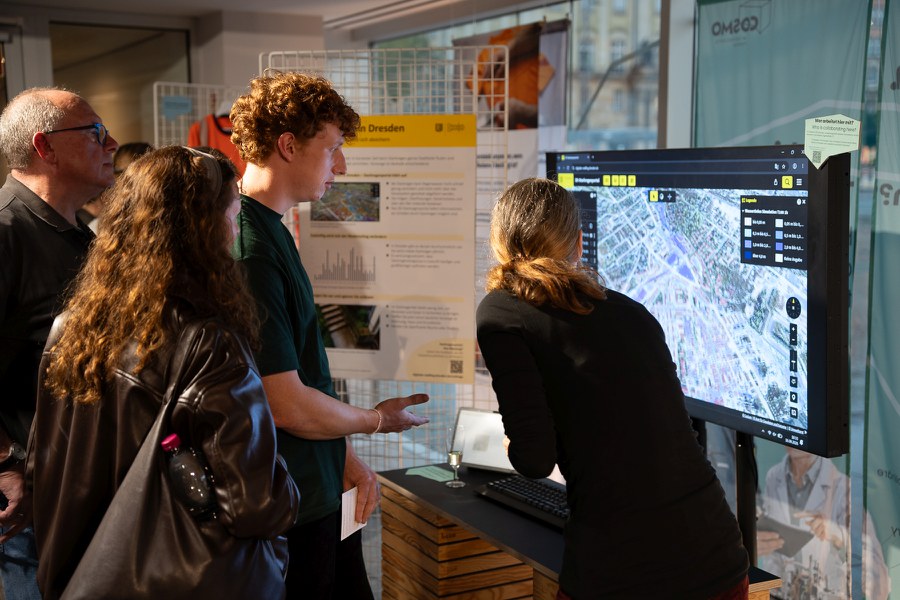
Opening of the COSMO exhibition ‘Thinking.Together.’
What happens when science, industry and society collaborate on research? The new COSMO exhibition “Thinking.Together. How do we conduct research together?” (German: Zusammen.Denken. Wer forscht hier eigentlich mit?”) is now on display at the Kulturpalast Dresden, showcasing eight projects from Dresden and Saxony, in which researchers collaborate closely with other scientists and members of the public to address specific issues. These projects highlight what can emerge when scientific knowledge and practical experience are amalgamated from the outset. The exhibition will run until November 26, 2026. COSMO is an interactive science forum in Dresden that communicates current research through events and interactive exhibitions. It is managed by the Department Speculative Transformation at TUD Dresden University of Technology, Barkhausen Institut and the Helmholtz-Zentrum Dresden-Rossendorf (HZDR).
When science, industry and society come together
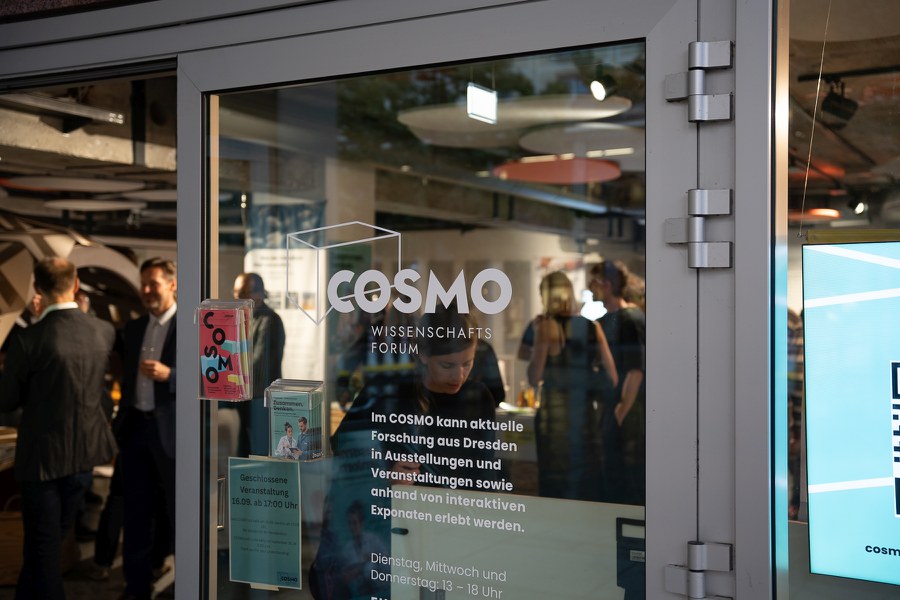
The COSMO exhibition ‘Thinking.Together’ at the Kulturpalast in Dresden.
Collaboration across different fields is not new territory: Interdisciplinary research fuses various scientific disciplines such as biology and physics, or computer science and medicine. Transdisciplinary research goes one step further. It integrates people outside the scientific community as equal partners into the research process. City administrators, patients, carers, entrepreneurs, firefighters, artists, and citizens all contribute their knowledge and experiences to the development of research questions and potential solutions.
This can be a challenging task, interweaving different languages, working methods, and time frames. At the same time, it is precisely this convergence that can lead to solutions that none of the participating parties would have developed on their own.
Collaborative research: From a map of cold places to water sample collector
Eight projects from various fields, ranging from climate adaptation and medicine to sustainable design and artistic research, demonstrate how this research collaboration takes shape. Exhibits, films and interactive stations illustrate how participants work together on research questions and solutions.
Combating heat together: As part of the European project Time2Adapt, Dresden, Lille, Middelburg, and Barcelona are developing new approaches to adapting to climate change. In Dresden, a map of cool places was created in collaboration with residents, showing where people can find free relief from the heat on hot days — for example, in parks, libraries or shaded areas.
Water samples when the water level rises: Researchers at HTW Dresden have developed an automated water sample collector in collaboration with an environmental agency. The device is suspended directly in water and fills up as the water level rises. Once the sample container is full, a smart sensor sends a notification. This reduces the need for monitoring trips. The design plans are published as open source and can be reused and adapted by other agencies, research groups, or environmental initiatives.
Understanding is part of the treatment: In the field of patient communication, researchers are collaborating with doctors and patients to develop visual treatment plans that use images and symbols to make medical procedures easier to understand. Patients can contribute their experiences and provide feedback: Which parts are too complex? What causes uncertainty? What provides clarity?
Repairable, high-visibility clothing: As part of the ZIRTEX research project and in collaboration with companies and stakeholders from the textile and high-visibility clothing industries (e.g. highway maintenance), a repairable design is being developed that will allow worn-out reflective strips to be replaced in the future. This is intended to extend the lifespan of high-visibility clothing and facilitate recycling.
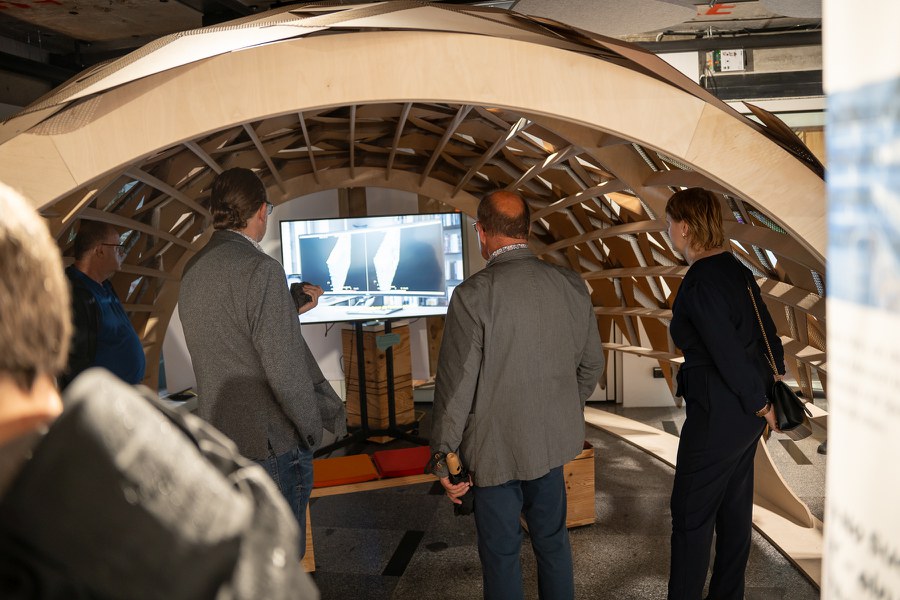
A look at the COSMO exhibition ‘Thinking.Together.’
In addition, the exhibition features a 3D, formable, wood-based material, a research film on the relationship between humans and zebrafish as well as projects supporting family caregivers and promoting climate-adapted urban development.
“We are looking to show that research doesn’t only come into contact with practice once the results are already set in stone,” explains Prof. Jens Krzywinski, Director of the Department Speculative Transformation. “The most exciting questions — and often the better solutions — arise when people contribute their knowledge and experience from the very beginning.”
Eva Jähnigen, Dresden’s Second Mayor and Councilor for Environment and Climate, Law and Order, adds: “All Dresden residents must prepare for the fact that we will experience more extreme weather events in the future. These range from very hot days to heavy rainfall — two very different climate events — and we in Dresden must adapt to them, both in the long and short term. To do this, we need not only sound strategies, but also solutions that are relevant to people’s everyday lives. With the map of cool spots and the 3D heavy-rain portal, we have created two tools that help people and businesses better assess how they could be affected by such extreme weather events. This allows them to prepare as effectively as possible and to take protective measures. We cordially invite the residents of Dresden to actively participate — all in the spirit of transdisciplinary research, which transcends the boundaries of scientific research and academic disciplines and involves experts from a wide variety of fields — and to help further improve these two solutions.”
Learn all about research and engage in conversation with researchers
The exhibition offers visitors the chance to get up close and personal with the people behind the projects. As part of the “Researchers Up Close” event series, visitors can engage directly in conversation with scientists and project participants. The series kicks off on September 17 with a conversation with artist and researcher Carolyn Kirschner, during which we will learn all about her film project “There Is No Such Thing as a Fish,” which explores how zebrafish are changing our perception of our own bodies and our relationship to the non-human world.
Further dates and information about the accompanying program can be found on the COSMO Science Forum website.
Who’s behind the exhibition?
The exhibition Zusammen.Denken. is organized by the Department Speculative Transformation (DST) at the Center for Interdisciplinary Digital Sciences (CIDS) of TUD Dresden University of Technology. Participants include researchers and partners from TUD, HTW Dresden, the National Center for Tumor Diseases Dresden (NCT/UCC), and the City of Dresden.
Participating institutions and projects include the Center for Open Digital Innovation and Participation (CODIP), the S+T+ARTS Ec(h)o Residency at TUD’s Office for Academic Heritage, Scientific and Art Collections, as well as TUD’s Chairs of Wood Technology and Wood-Based Bioeconomy, Industrial Design Engineering, and the Chairs of Water Management and Information Management at HTW Dresden.
The exhibition at a glance
Thinking.Together. How do we conduct research together? (German: Zusammen.Denken. Wer forscht hier eigentlich mit?)
September 15 — November 26, 2026
COSMO Science Forum, Schloßstraße 2, 01067 Dresden
Tuesday — Thursday, 1:00 pm – 6:00 pm (except on holidays) – Free admission
Group tours are also available upon request outside of our regular opening hours. Tours are offered in German or English, take around one hour, and are available for groups of ten or more. Please send any inquiries to:
Further information about the event program: https://www.cosmo-wissenschaftsforum.de/zusammen-denken/
Press inquiries:
Maria Matthes
Coordinator Department Speculative Transformation (DST), TUD Dresden University of Technology
Email:
Tel.: +49 351 - 463 35755