
Jul 06, 2026
University School Dresden Celebrates Its Third Graduating Class—and Prepares for Its First Class of High School Graduates
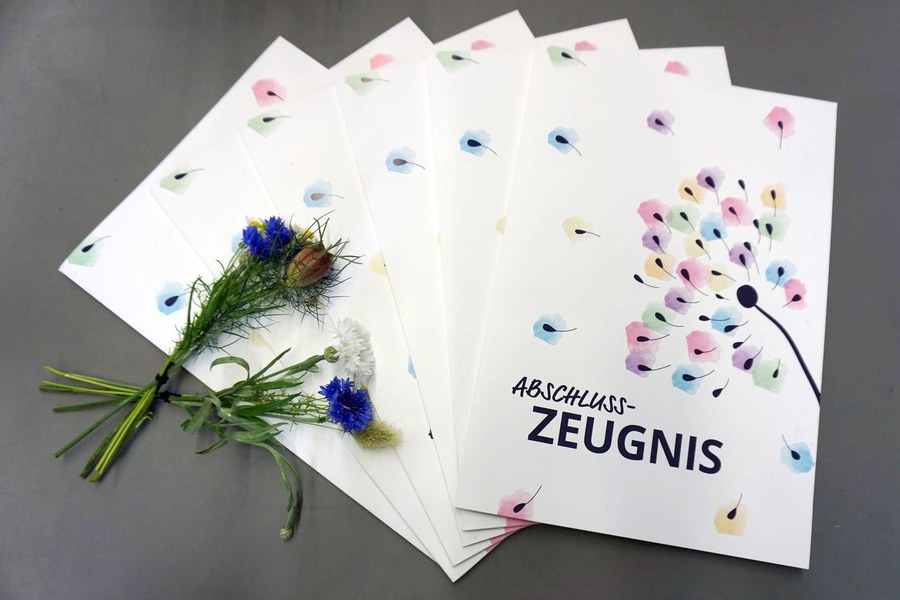
Maxi Heß describes the dandelion on the Class of 2026’s report card folders: “Many little umbrellas gathered in one place. But really, it’s clear: They’re ready. Ready to break free. Ready to fly away. Ready to put down new roots elsewhere.”
On July 3, the third class to graduate from University School Dresden (USD) met with members of their school community to celebrate their graduation from school education. In the 2026–27 school year, a new chapter for University School Dresden will begin, with about 40 pupils launching the University School’s first ever 11th grade class. Meanwhile, space constraints currently prevent the full implementation of this ambitious concept.
A third successful graduating class
On July 3, 7 proud graduates received their Hauptschule school leaving certificates, and 44 students received their Mittlere Reife school leaving certificates. Parents, siblings, and, of course, the learning facilitators attended the celebration, as did Dr. Eva-Maria Stange, representing the Advisory Board of the Dresden University School. Former Minister of Science for Saxony, she was instrumental in launching the school pilot project. “A school like the University School doesn’t come about solely through educational concepts, but because people believe in a VISION OF A NEW SCHOOL,” said Principal Maxi Heß as she thanked the members of the Advisory Board.
After the summer break, some students will move on to vocational training or an orientation year, for example, undertaking volunteer work. Some will start at the school's new upper secondary level. While others will prepare for it with their Realschule leaving certificate in hand.
Martha, a 2025 graduate, looked back on her time at the University School with some perspective: “You remember the people who made you feel seen. Maybe that’s exactly what makes this school so special: Here, we didn’t just learn how to solve problems. We also learned how to get along with one another.” She emphasized in particular: “Here, you are allowed to be yourself—with interests that don’t always fit into a box, with ideas, insecurities, and talents that others sometimes recognized before you did. I never felt like I just had to function here. Instead, it was a place that allowed me to grow.”
In her remarks to the graduating students, Principal Maxi Heß emphasized: “Learning often begins when a genuine question arises: What does this have to do with me? What don’t I understand yet? Why is that the case? How could it be different? What can I contribute? These questions are valuable. And I very much hope that you’ll hold on to them for the rest of your lives." She bid farewell to the third graduating class with an encouraging message: "The world you’re now stepping into doesn’t need people who just wait for someone to tell them what to do. It needs courageous people who think for themselves and take on social responsibility—people who recognize the bigger picture, who can tolerate contradictions, and who don’t give up right away when things get confusing.”
Preparatory year for Abitur studies
For about 20 10th-grade students, this academic year also marked the end of their GYM10 preparatory year. This preparatory course for upper secondary school is a prerequisite for the Abitur for those students who began their studies in the 5th grade at what was then known as the Universitätsoberschule. There will be another preparatory year in the 2026–27 school year, which will allow students who have earned their Oberschule certificates to review and deepen their understanding of curriculum content and skills to a Gymnasium level. About 10 young people have opted for this route.
In August, some 40 young people will make up the first 11th-grade class in which the project-based teaching concept will continue – within the framework provided by Saxony’s School Act and the relevant administrative authorities. They are in close communication with school principal Maxi Heß regarding this matter. After establishing the elementary, middle, youth, and qualification levels using innovative teaching methods that place greater emphasis on individual learning paths, self-regulated learning, and learning guidance, the pilot program wants to show how these concepts can also be put into practice as students continue their education toward the Abitur. At the end of the 2027–28 school year, the first high school graduates will leave the Gemeinschaftsschule.
Read more about TU Dresden’s research project: tu-dresden.de/gsw/unischule
Read more about University School Dresden: universitaetsschule.org
You can catch a glimpse inside the research project and daily school life on various social media channels at: Facebook, Instagram, YouTube and LinkedIn. There are also regular updates on University School Dresden in the School of Humanities and Social Sciences newsletter.
Media contact:
Maria Neuland Agüero
Communications Manager
University School Dresden Project
TUD Dresden University of Technology
School of Humanities and Social Sciences
Faculty of Education
Chair of Inclusive Education
Tel.: +49 351 463 41229
Email: