
Feb 16, 2026
When research is not reproducible: Volkswagen Foundation funds project at TU Dresden
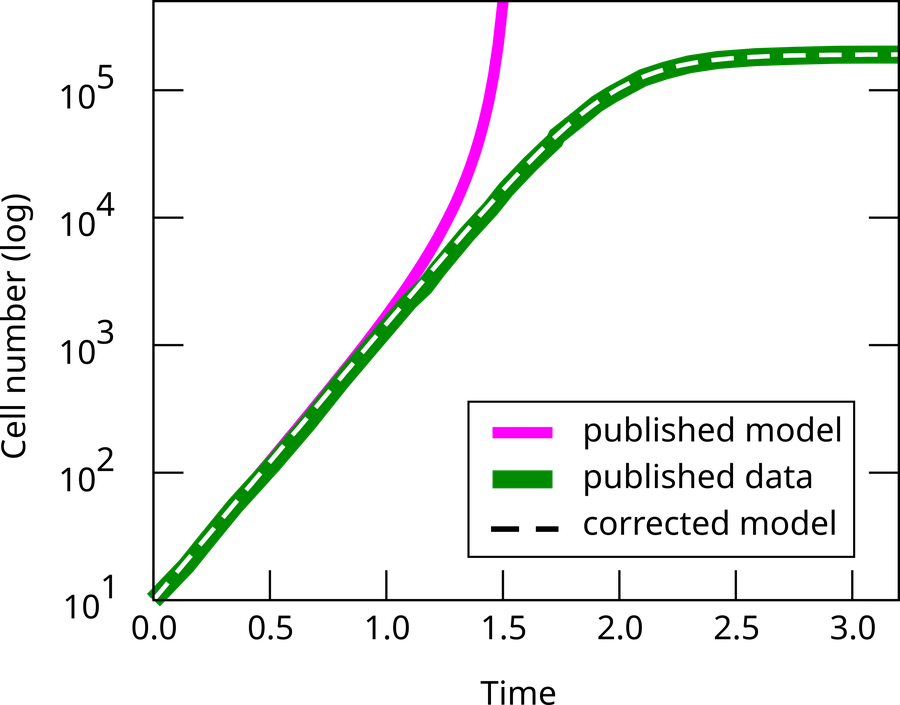
Reproducibility check of a published tissue growth model: Using the original parameters yields a deviating trajectory (red) instead of the reference curve (green); after correcting a parameter error, the simulation matches again.
“PublicationQuality” aims to improve the reproducibility of computational models
Publishing scientific discoveries in a way that allows others to understand, reproduce, and further develop them is a fundamental prerequisite for scientific progress. This is particularly true for theoretical and computational models in biology. To systematically address structural deficits in this area, the Volkswagen Foundation is funding the pioneering project “PublicationQuality” at the Center for Information Services and High Performance Computing (ZIH) of TU Dresden.
How difficult this ideal is to achieve in practice recently became apparent through an example at ZIH: As part of a student internship, two high-school students from Dresden attempted to reproduce the results of a high-impact scientific publication in the field of computational biology. Despite careful work, the reproduction failed. Only after a complete re-derivation of the published model did it become apparent that two parameter values had been swapped in the original publication. As a result, the published findings were not reproducible.
Such experiences are not isolated cases. A systematic study found that 49 % of 455 publications in computational biology were not reproducible (DOI: 10.15252/msb.20209982). Thus, even this highly formalized research field is affected by the international reproducibility crisis.
The team led by Dr. Lutz Brusch at ZIH has been documenting such cases for many years and, together with the original authors, publishes corrected and fully reproducible models in the MorpheusML Model Repository. The model investigated by the students has also been successfully republished there and is now fully reproducible.
Ensuring quality as the foundation of future science
There are many reasons for a lack of reproducibility: high publication pressure, tight deadlines, rapidly changing software environments, and complex simulation pipelines. Even when source code is published, it is often technically outdated or no longer executable after only a few years. Reproducibility is therefore not a trivial issue, but a structural challenge for modern science.
Through its funding initiative “Impetus for the German Research System: Pioneer Projects", the Volkswagen Foundation addresses such challenges by supporting sustainable approaches. Within this framework, the project “PublicationQuality” is being funded with € 432,080 over three years. The project started on December 1, 2025, at ZIH of TU Dresden and is being carried out in the Innovative Methods of Computing (IMC) department.
The goal of PublicationQuality is to fundamentally improve the reproducibility of computational models through better standards, sustainable infrastructures, and quality-assured scientific communication – in computational biology and beyond. A central approach is to consistently separate the scientific information of a model from its technical implementation. Instead of error-prone tables, equation systems, or manually transferred parameter lists, standardized, machine-readable model descriptions will be used. From these descriptions, both simulations and all representations required for scientific publications can be generated automatically, significantly reducing key sources of error in current publication practices.
To achieve this, PublicationQuality collaborates with an international network of research institutions, model repositories, software developers, and scientific publishers, including partners from Europe, Australia, and North America. Together, new standards for model description, metadata, peer review, and publication will be developed, tested, and established.
First impulse: current call for the “Model of the Year” award
As a first visible impulse, the project, together with international partners, awards the “Model of the Year” prize for particularly well-reproducible and FAIR-published computational models.
The submission deadline is February 28, 2026.
Further information: https://stura.link/ModelOfTheYear
The award ceremony will take place during the joint conference of the scientific societies ESMTB and SMB from July 13–17, 2026, in Graz, Austria.
About Volkswagen Foundation and the Impetus Research System and Pioneer Projects:
The Volkswagen Foundation is Germany's largest private, non-profit organization engaged in the promotion and support of academic research. Even though its name might suggest otherwise, it is not a corporate foundation and not affiliated to any automobile manufacturer. Its Pioneer Projects are practice-oriented and shall lead to pragmatic and focused improvements in the science system. The website https://www.volkswagenstiftung.de/en/funding/funding-offer/pioneer-projects-impetus-german-research-system introduces this funding format.
About Innovative Methods of Computing (IMC)
The ZIH department IMC develops mathematical models and simulation tools to uncover principles of cellular systems. By combining modeling with biological and medical data, the department investigates how cell interactions shape healthy and diseased patterns. With Morpheus, IMC also develops an environment for modeling and simulating multiscale and multicellular systems. Morpheus is a modeling environment that supports simulation and integration of cell‑based models with ordinary differential equations and reaction‑diffusion systems.
Additional information on MorpheusML
The corrected and reproducible models are published in the MorpheusML Model Repository: https://morpheus.gitlab.io/model/published-models/
The model analyzed and corrected by the students is also available there, including a complete demonstration of the successful reproduction of the originally published results: https://identifiers.org/morpheus/M6767
Contact
Dr. Lutz Brusch