
Oct 05, 2026
Strengthening AI Skills in Foreign Language Teaching — A Project of the DLL Fund
Report by Antje Neuhoff and Karin Schöne (Teaching Center for Languages and Regional Studies)
With support from the Fund for Digital Learning and Teaching, the TUD Language Center (LSK) implemented the self-study program“Sprachtraining@home with AI”and piloted it in two scenarios: 1. as individual training units to accompany courses (self-study components) and 2. as portfolio assignments in language learning seminars aimed at developing writing and argumentation skills.
The idea: The program provides students with a set of exercise and prompt suggestions that allow them to practice their language skills in a personalized way using text-generating AI. The self-study modules rely, among other things, on learning by example: prompts accompanied by concrete chat transcripts demonstrate what well-formulated prompts can achieve. Learners then adapt these prompts in their own chatbot account. In doing so, they clarify their learning goals, consider the context and evaluation criteria of their own text, and critically assess whether the foreign-language output aligns with their intended message or how, for example, a request for error correction could be improved.
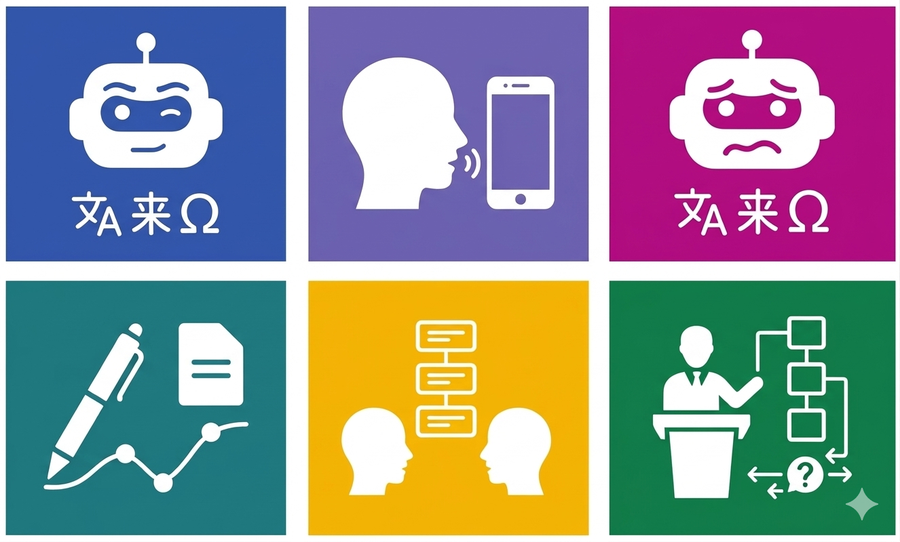
The program: Six modular, low-barrier self-study units, applicable to many target languages: While Module 1 uses a quiz format to identify knowledge gaps regarding how chatbots work, alternative tools, or personalization options, Module 2 provides prompt examples, such as for interactive exercises as well as listening and conversation practice. Module 3 shows how to identify and address weaknesses in foreign-language chatbot output or feedback.
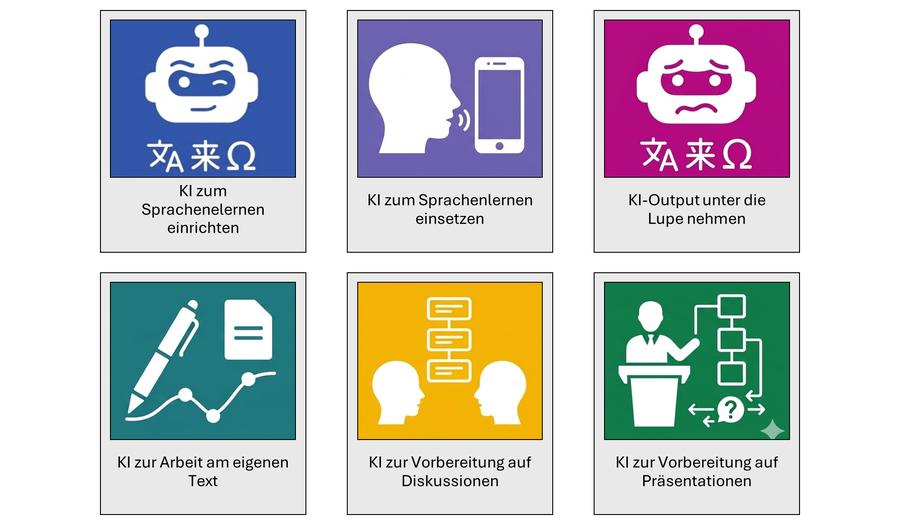
Modules 4 through 6 provide a framework for working on one’s own text and for preparing oral presentations. The structure is tailored to language courses focused on developing academic language skills and can therefore be easily integrated into existing courses at the TU’s Language Center (LSK).
Access: The course is published as an OER on the LSK’s Moodle platform. The course is available at t1p.de/LSK-KI and can be accessed without registration by selecting “Log in as a guest.” To access, use the password KISTE.
Maintenance and Further Development: The self-study modules are intended to be a “living” resource that must be continuously reviewed and updated. Their integration into language courses fosters lively exchange with colleagues and students and highlights areas for improvement. In peer workshops, the team continues to discuss with instructors how the AI self-study tips can be linked to course content. We’re happy to open this group to anyone interested. Initial best-practice ideas from the pilot phase in the course for trainers are available as a resource in the self-study course. Since the proportion of international students with limited German language skills is steadily growing, an English-language version of the learning materials is also planned.
The Digital Learning and Teaching Fund provides the Center for Interdisciplinary Learning and Teaching with a tool for the (further) development of digital teaching and learning scenarios. In this way, we are contributing to the sustainable improvement of teaching quality at TUD.
During the 2025–2026 funding period, we were able to support and guide five exciting projects from various academic disciplines. As part of a series of news articles, we’d like to introduce the individual projects on our website over the next few weeks and show how they will continue to influence teaching at TUD after the projects conclude. Stay tuned!