
Nov 12, 2026
New Event Series "Perspectives on Higher Education Teaching and Democracy", Winter Semester 2026/27
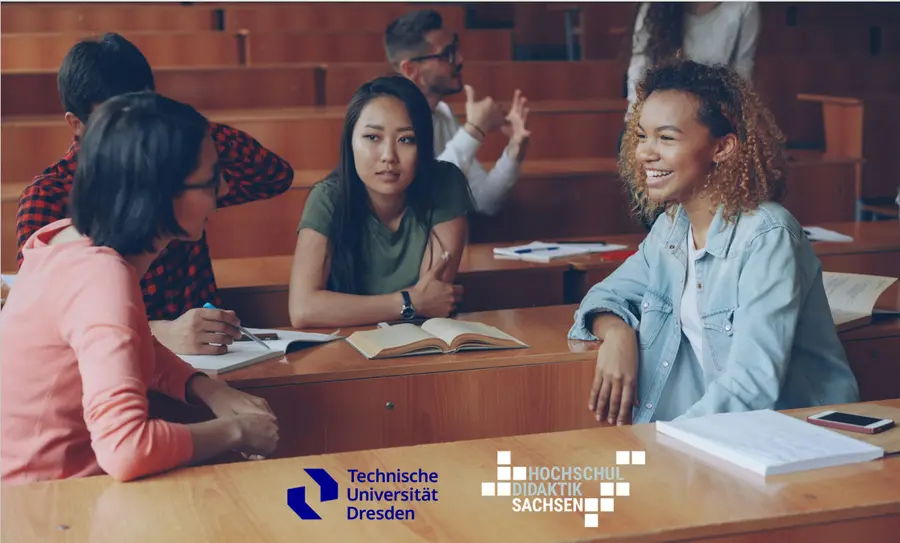
A cooperation between Hochschuldidaktik Sachsen (Saxon Centre for Higher Education Teaching and Learning) and the Zentrum für interdisziplinäres Lernen und Lehren (Centre for Interdisciplinary Learning and Teaching)
Democracy cannot be taken for granted. It thrives on the participation of different social groups, on respectful engagement with diverse perspectives, on open debate, and on the protection of fundamental rights. In view of growing social polarisation and democratic challenges, universities bear a particular responsibility. They are not only places where knowledge and skills are taught and newly created, but also places where democratic values and practices can be experienced in everyday teaching, or where they reach their limits. This raises the question of the conditions under which universities are experienced as democratic learning spaces, and what options exist to strengthen democracy, participation, and the assumption of responsibility in everyday teaching and learning.
The event series “Perspectives on Higher Education Teaching and Democracy” invites you to explore these questions from different angles. Five one-hour talks will take place between November 2026 and March 2027, each addressing a different perspective on this topic. Every session offers occasions for reflection as well as practical input for teaching and university life. Teaching staff and, explicitly, students are warmly invited to take part.
Register online. (Only the German Version of the Register template is available in the moment. The English translation will be published soon. Please excuse any inconveniences.)
You will receive the access link to the video conference room from us after registering.
25 November 2026 | 4:00–5:00 p.m.: Participation, Encouragement, and Democratic Experience in Courses from a Student Perspective
What do students wish for from university teaching? Why is it worthwhile to design courses in a participatory way? What can teachers do when students do not take up opportunities to help shape a course, and what reasons lie behind a lack of involvement? This input from a student perspective addresses these questions and reports, based on experience, on obstacles to student involvement, but above all on promising conditions for democratically designed teaching. In this way, students become visible not only as recipients of teaching but above all as co-creators of it. To this end, wishes and suggestions are derived from the obstacles students perceive in higher education, showing how student participation, discourse, and democratic involvement in teaching and learning processes can succeed.
The speaker, Sara Prochownik, is a member of the Gender Equality Policy Unit of the Student Council (StuRa) at TU Dresden.
Stefanie Gerstenberger, lecturer and research associate at TU Dresden, will comment on the input.
16 December 2026 | 4:00–5:00 p.m.: Democracy Begins in the Lecture Hall: How Democratic Participation in Higher Education Teaching Can Succeed from the Perspective of Teaching Development
Education for democracy is increasingly regarded as a task for universities. But what does this mean for the concrete design of teaching? Do teachers now have to convey democracy in addition to their subject content? The talk offers a different perspective and looks at how democracy can be not only a subject of teaching but also something experienced within the teaching and learning process itself. It is worth looking more closely and asking when teaching truly has democratic quality. The talk invites participants to view their own teaching from this perspective and to rediscover democratic qualities within it.
The speaker, Frank Linde, is a professor at TH Köln and has been working for decades on diversity-sensitive and participatory teaching development.
Bethany Knobloch, spokesperson of the Conference of Saxon Student Bodies (KSS), will comment on the input.
27 January 2027 | 4:00–5:00 p.m.: Resisting creeping erosion of academic freedom – an international perspective
Democracy and freedom are in retreat around the world, even in countries that were formerly considered to be stalwarts of democracy. Even in Germany, democratic backsliding is gathering pace, and academia is firmly in the crosshairs of anti-democratic actors. We are not powerless to meet those trends and I offer a few possible countermeasures for discussion.
Speaker Stephan Lewandowsky has been studying the threats to Western democracies for years, particularly those posed by misinformation, propaganda, and the denial of science. He is a professor of cognitive psychology at the University of Bristol.
Representatives of the Belarusian Students Association will provide commentary on the lecture.
24 February 2027 | 4:00–5:00 p.m.: Teaching That Makes Room for Everyone?! A Contribution from the Perspective of Those Affected
Who gets heard in the seminar, whose perspectives appear in teaching materials, and who is left out when groups are formed? A democratic teaching culture also shows in how these questions are handled. The input takes experiences of discrimination in everyday university life as its starting point and shows how teachers can take responsibility and make counselling and complaint procedures accessible. At its centre is the question of how a democratic teaching culture can combine protection from discrimination, equal participation, and open academic discussion.
The speaker, Anja Wiede, is the contact person at TU Dresden’s complaints office for incidents of harassment, discrimination, and violence.
Alaska Krakor, Education Policy Officer at the Student Council (StuRa) of Leipzig University, will comment on the input.
31 March 2027 | 4:00–5:00 p.m.: What Does Freedom of Teaching Mean? A Contribution from a Legal Perspective
Academic freedom is usually discussed as freedom of research. But it also includes the freedom of teaching. What does this constitutional guarantee mean in practice? Where do the legal limits lie, for example with regard to political statements? Even though there is certainly no “duty of neutrality” for academia: what responsibility do teachers bear? And do special requirements apply to political education in higher education?
The speaker, Tim Wihl, is currently covering the professorship for Public Law and Legal Foundations at the University of Erfurt.
Comment: tba.
The events can be recognised in the programme “AKTive Lehre” of Hochschuldidaktik Sachsen with 1 AE (work unit) each. A certificate of attendance will be issued on request after the event by email to josefine.marquardt@tu-dresden.de.