
Previous plants of the week - The Christ thorn
The Christ thorn Euphorbia milii Des Moul.
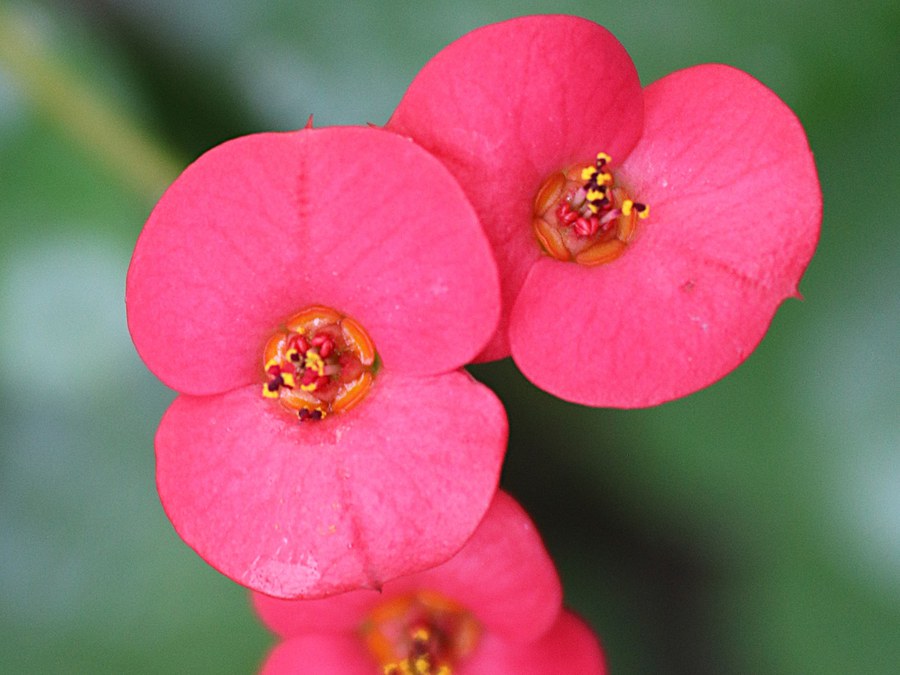
Der charakteristische Blütenstand der Wolfsmilcharten wird als „Cyathium“ bezeichnet. Beim Christusdorn erwecken zwei nierenförmige, meist rote Hochblätter den Eindruck von großen Einzelblüten.
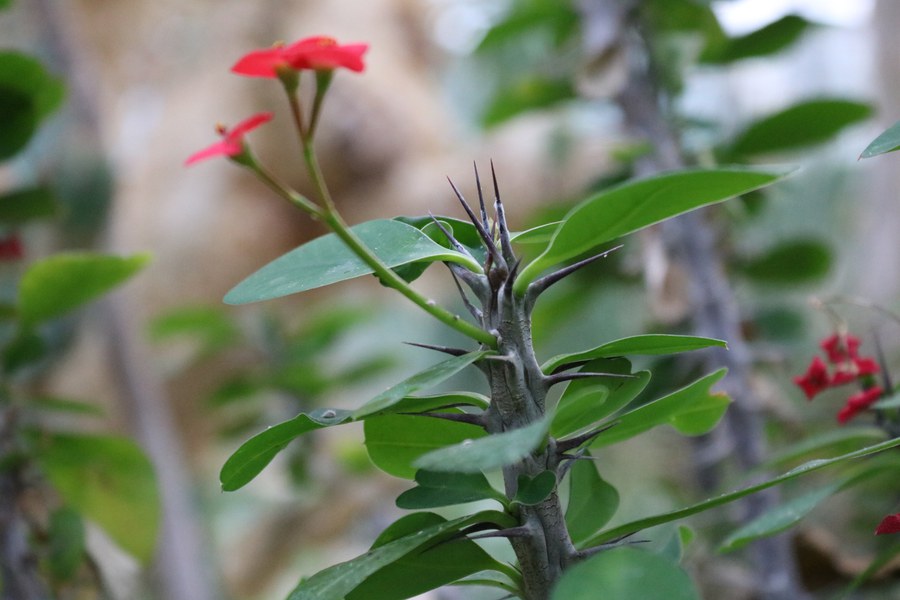
Dornige Zweige und giftiger Milchsaft schützen den Christusdorn (Euphorbia milii) vor Fraß.
Symbolic Christmas plants are not only to be found among the conifers. While nature goes into hibernation outside, tropical spurges decorate our living rooms in vibrant red and green. The best-known example is the poinsettia(Euphorbia pulcherrima Willd. ex Klotzsch). After a brief, spectacular appearance during Advent, it is usually soon disposed of again. This large Central American shrub is also missing from the Botanical Garden due to lack of space.
No less remarkable is a closely related and much more resistant houseplant, which tolerates drought and warm heating air without any problems: the Christ's thorn (Euphorbia milii Des Moul.). As an endemic species of Madagascar , it colonizes stony soils of the island with scrubland and dry forest up to altitudes of 1600 m. The thorny shoots of the plant, which can grow up to two meters high, are weakly succulent and can therefore store water. They evoke associations with the crown of thorns of Jesus Christ, to which the German name of the species refers.
Biologists explain the fact that the shape of some spurge species growing in arid regions resembles that of unrelated cacti with convergent evolution: similar morphological characteristics often develop under comparable environmental conditions. What is unmistakable and typical of all members of the genus Euphorbia, however, is the poisonous white milky sap that oozes out when the plants are injured and protects them from being eaten. It should never come into contact with the skin - it can be extremely damaging to mucous membranes in particular! Garden gloves help prevent the risk of injury when handling spurge plants.
The "flowers" of Christ's thorn are also very different from those of cacti. Botanically speaking, they are inflorescences: two red or greenish-yellow bracts - so-called bracts - attract the eye and frame bundles of individual male flowers, each consisting of just one stamen. A stalked ovary represents the single, also greatly reduced female flower of the inflorescence, which is typical of all the more than 2000 spurge species found worldwide.
(CW 50/25)
Around 10,000 plant species grow in the Botanical Garden of TU Dresden. On this page, we regularly present an example of this diversity in more detail. The special features of our scientific plant collection can be seen in many different ways: in amazing adaptations, strange names, interesting uses or even in the extraordinary splendor of their flowers.
You can view previous Plant of the Week articles in the archive.