
Sep 18, 2026
Our Plant of the Week: The Coral Bush
A rather atypical appearance for a legume: the tubular keel of the flower points upward, the standard points downward, and the lateral wings are very small.
Banksia integrifolia L.f.
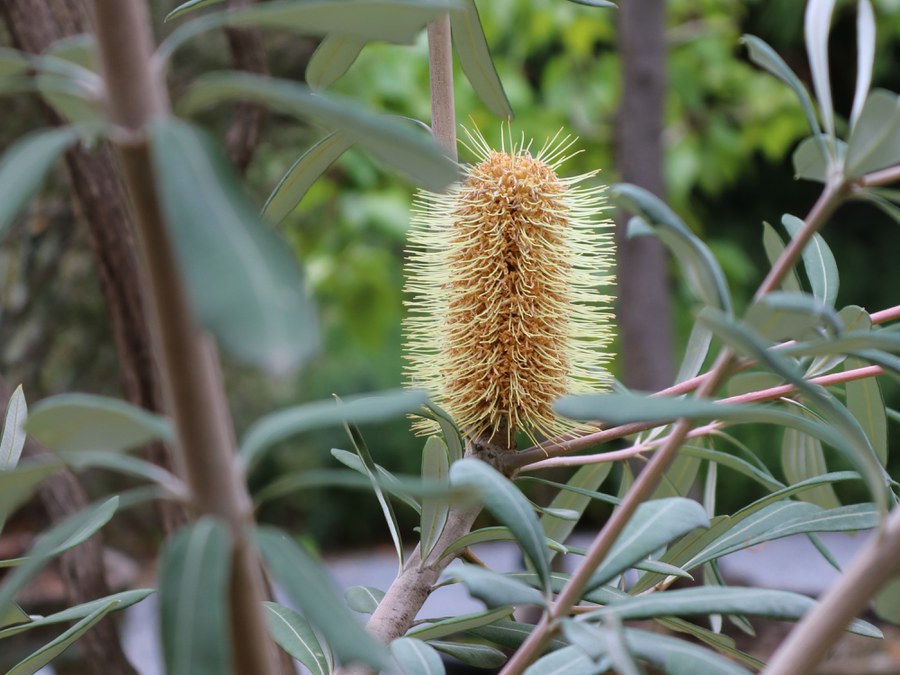
In the container plant section, the striking, cylindrical inflorescences of the coastal banksia (Banksia integrifolia L.f.) are currently attracting a lot of attention.
It belongs to the Proteaceae family, which is found exclusively in the Southern Hemisphere. In the wild, this evergreen tree or shrub can grow up to 20 meters tall. The Latin species name“integrifolia”means “whole leaf” and refers to the characteristic entire-margined leaves that distinguish this species from other banksias.
Banksia integrifolia is found in eastern Australia, where it is widespread on sandy soils along the coast as well as in mountainous regions. The species is considered hardy and can help protect coastlines from erosion.
Its pollen- and nectar-rich inflorescences are an important food source for Australian wildlife. Among others, flower bats, various species of nectar-eaters, and insects feed on them. We previously explored the fascinating flower biology of the Banksias in a 2020 “Plant of the Week” feature (Banksia serrata).
Only months after flowering do the impressive inflorescences develop into cones with extremely hard, leathery fruits that can persist for a long time. This makes them perfectly adapted to their habitat, as regular bushfires and wildfires are part of the natural cycle in Australia. As so-called fire plants (pyrophytes), banksias require exposure to fire to release their seeds. They can then germinate well in the fertile ash.
In addition to fires, cockatoos also manage to crack open the fruits with their powerful beaks. The nutritious seeds are an important food source for them.
(Week 38/2026)
About 10,000 plant species grow in the Botanical Garden of TU Dresden. On this page, we regularly highlight an example from this diverse collection. The unique features of our scientific plant collection manifest themselves in many ways: through astonishing adaptations, whimsical names, interesting uses, or even in extraordinary floral displays.
You can view previous “Plant of the Week” posts in the archive.