
Track-bridge interaction
Table of contents
Project data
| Titel | Title TP der TU Dresden im Verbundvorhaben Gleis-Tragwerk-Interaktion (TraBI) | SP of TU Dresden within the joint research project Track-bridge interaction (TraBI) Auftraggeber | Contracting authority |
Short description
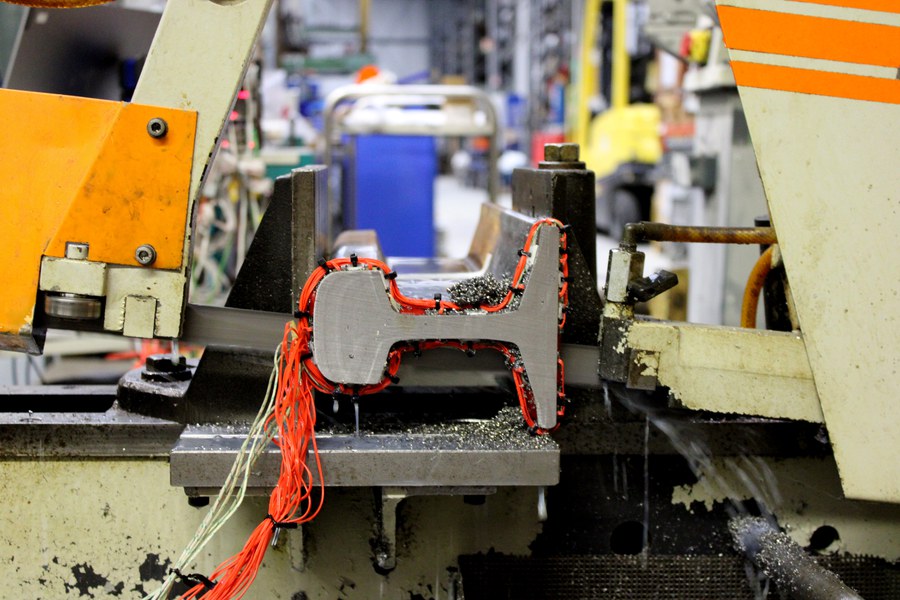
Residual stress measurement
Track–bridge interaction describes the effect that deformation of the bridge induces additional deformation in the rail. These deformations lead to additional stresses. If these stresses exceed the permissible limit, track buckling (compressive failure) or rail breakage (fatigue failure) may occur. The current verification concept is outdated and, due to numerous modifications in the past, can no longer be derived on a scientific basis. As a result, its application is limited. In many cases, project-specific assessments or the installation of rail expansion devices are required, both of which involve significant investment and maintenance costs. The objective of the TraBI project is to revise the existing verification concept. To this end, realistic investigations of track–structure interaction are being carried out on a test bridge by MKP GmbH. These studies are complemented by laboratory investigations conducted at the Chair and Testing Office for Transport Infrastructure Engineering at the TU Munich and at the Institute for Concrete Structures (IMB) at the TU Dresden.
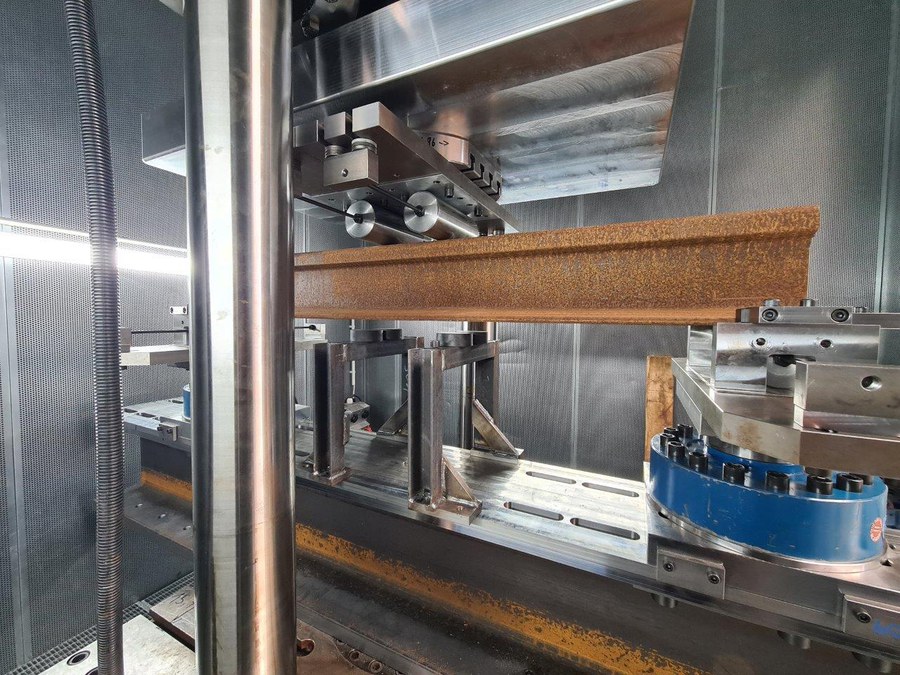
Fatigue test setup
At our institute, tests are conducted to determine the fatigue properties of rails. The investigated rail profiles are 49 E5 and 54 E4 with steel grade R260, as well as profile 60 E2 with steel grade R350HT. The tests focus on the fatigue strength of the rails. Prior to the fatigue tests, the rails are artificially corroded. This procedure reflects the conditions in service and avoids results that would be non-conservative. Due to the manufacturing process, railway rails contain significant residual stresses, which reduce the fatigue strength of the rail. To quantify the influence of these residual stresses, residual stress measurements are performed on rails from the same batch as those used for the fatigue tests. For this purpose, a thin disc is cut from a rail segment, and the resulting contraction or expansion of the disc is measured. This deformation is used to determine the residual stresses present in the rail.
The objective of the project is to develop new design provisions for the investigated rail profiles. These provisions will be used to determine the permissible additional rail stresses.