
Cracking behavior of concrete specimens
Table of contents
Project data
| Titel | Title TP Experimentelle und photogrammetrische Untersuchung des Rissverhaltens von Betonprüfkörpern im Verbundvorhaben Einflüsse auf das Rissverhalten unterschiedlicher Betone kerntechnischer Anlagen unter statischer und Impaktbeanspruchung | SP Experimental and photogrammetric investigation of the cracking behavior of concrete specimens in the joint project Influences on the cracking behavior of different concretes in nuclear facilities under static and impact loading Förderer | Funding Bundesministerium für Umwelt, Klimaschutz, Naturschutz und nukleare Sicherheit (BMUKN) / GRS Zeitraum | Period 11/2025 – 10/2028 Verbund- und Teilprojektleiter | Leader of joint research project and subproject apl. Prof. Dr.-Ing. Birgit Beckmann Bearbeiter | Contributor Thomas Schubert Projektpartner | Project partners Institut für Photogrammetrie und Fernerkundung (IPF), TU Dresden | FG Massivbau und Baukonstruktion, RPTU Kaiserslautern-Landau |
Abstract
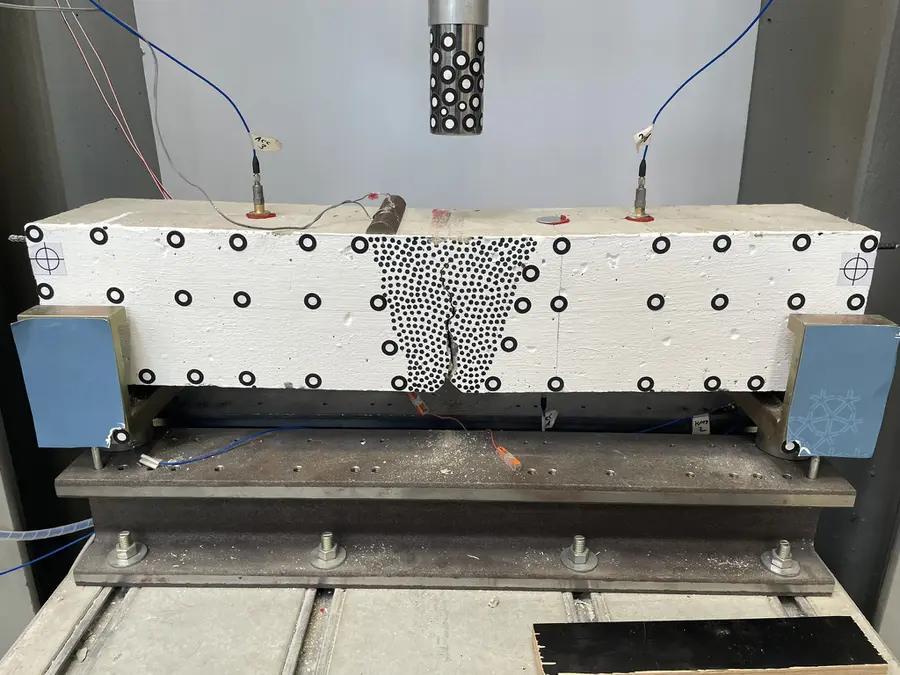
Test specimen with a large central crack in the test stand following a drop-weight impact
The aim of this research project is to investigate how the heterogeneity of concrete influences the increase in strength observed at high loading rates. The study analyzes the relationship between this heterogeneity and the behavior of crack and wave propagation within the concrete. To characterize and quantify the heterogeneity, the three-dimensional structure of the concrete matrix is examined using computed tomography (CT). Deep learning will be employed to analyze the digital data and segment relevant structural components. The resulting heterogeneity parameters are correlated with the characteristics of the crack surfaces, providing insights into crack propagation velocity and the structural integrity of concrete elements. Experimental investigations involve impact tests to determine crack velocities in various types of concrete, with parameter variations used to identify factors influencing crack propagation. Additionally, split-Hopkinson bar tests are conducted to study wave propagation in relation to the concrete's heterogeneity. Finally, the project focuses on crack propagation at the surface of specimens subjected to dynamic loading.
Crack velocity is evaluated using image sequences captured by a high-speed camera, with automated image analysis techniques developed to detect cracks. A pilot study has already indicated crack velocities of approximately 800 m/s. Crack morphology and fracture surfaces are characterized across multiple scales using 3D laser scanning, photogrammetry, and tomographic methods; scanning the resulting fragments allows for a precise assessment of crack roughness. Computed tomography facilitates both in-situ and ex-situ testing, enabling the analysis of 3D CT scans of specimens under static loading, as well as before and after dynamic loading. A comparison provides insights into crack paths and their relationship to the internal heterogeneity of concrete. Stereo-photographic techniques will support the analysis of surface cracks.
Synthesizing all investigations aims to identify key influencing factors and reveal the interconnections between heterogeneity, crack propagation, wave propagation, and strength enhancement. The research findings advance the understanding of concrete behavior under highly dynamic loading and contribute to the safety of structures. The study investigates the influence of heterogeneity and varying wave propagation on crack propagation and crack velocity in concrete, utilizing methods such as computed tomography. Furthermore, the impact of heterogeneity on strength enhancement is to be quantified. Ultimately, this work contributes to ensuring the integrity and durability of structural components in nuclear facilities.