Transportation Economics and Data Science (Master)
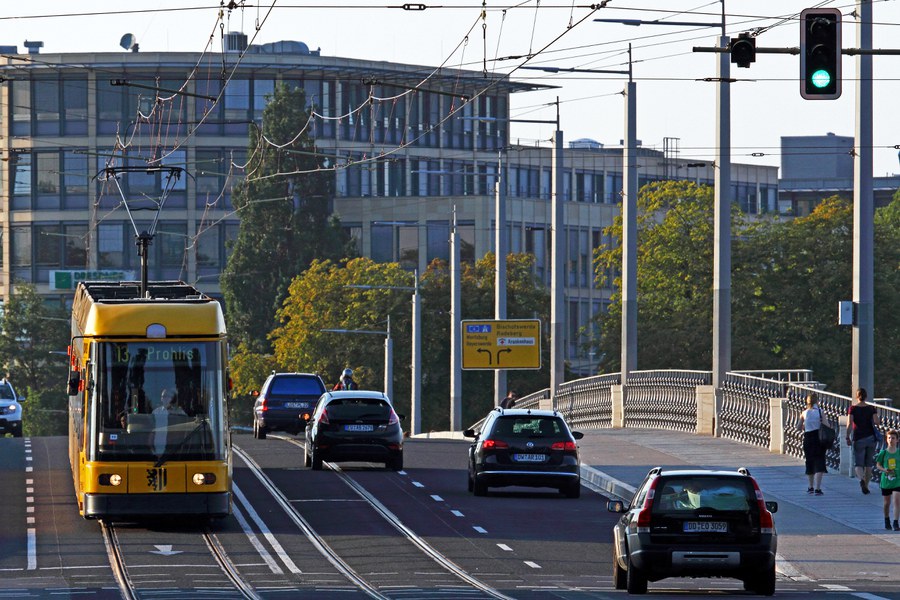
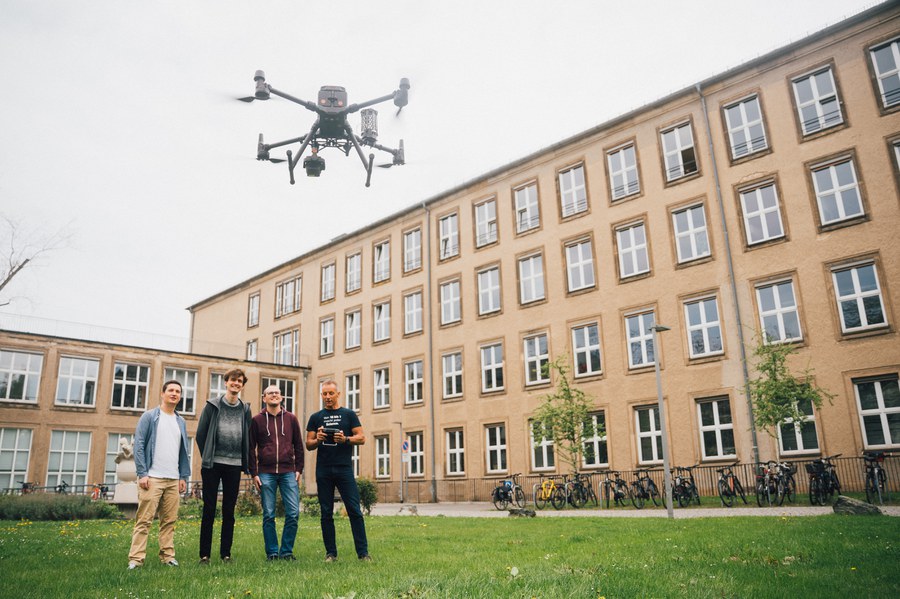
Mobility determines participation in social and economic life, the spatial structure of society, and the extent of the environmental impact caused by transportation. Its design faces immense challenges. Therefore, the means of transportation (automated driving, electric vehicles, drones, high-speed railroads), the organization of transport (intermodal mobility, sharing technologies, mobility platforms, use of big data), transport infrastructure (smart roads, charging stations) as well as the financing of mobility (user financing) are facing far-reaching changes.
This results in extensive transport-focused economic and methodological tasks on an operational, societal and methodological level. The degree program provides the knowledge and methods required to understand, research and design the challenges of mobility in terms of its economic, ecological and spatial effects.


© Benjamin Jenak, TUD


© Benjamin Jenak, TUD
© Benjamin Jenak, TUD
| Degree | Master of Science (M. Sc.) |
| Standard period of study (full time) | 4 Semester |
| Primary teaching language | English |
| Part-time studies | possible (50 %) |
| Numerus clausus | no NC |
| Program start | Winter Term (October 1st) |
| Application Deadline | April 1st – July 15th (EU applicants) April 1st – May 13st (Non-EU applicants) |
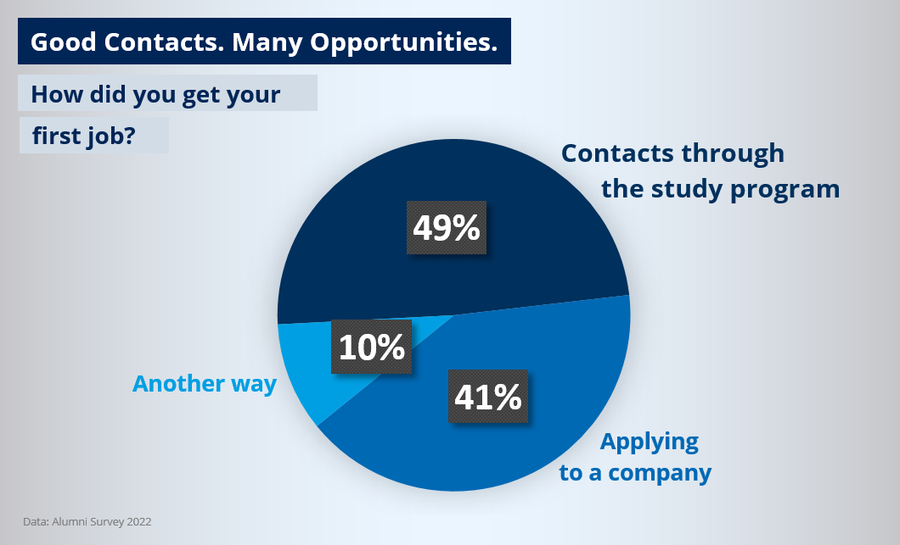
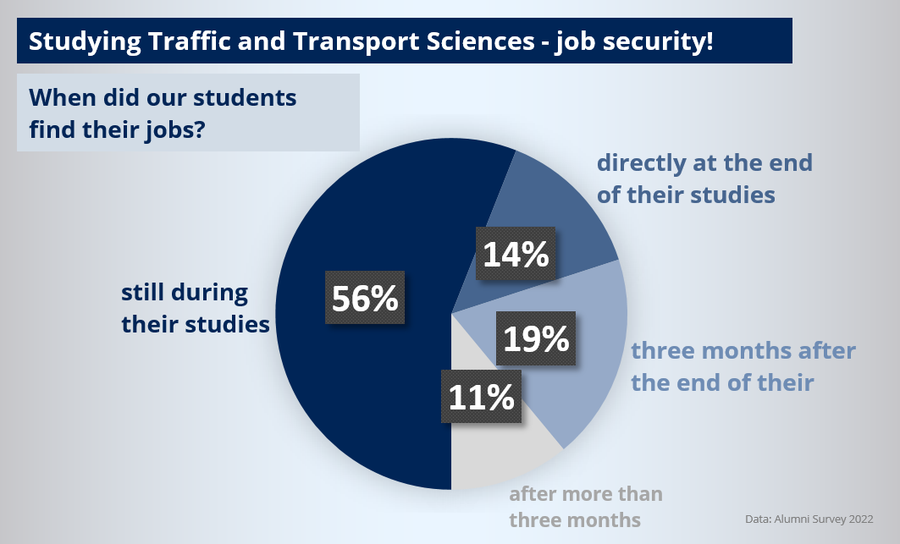
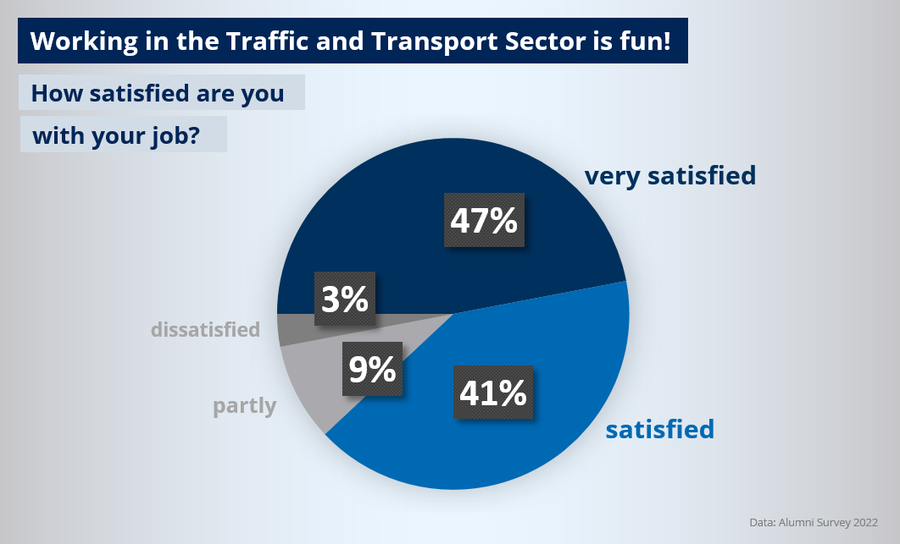
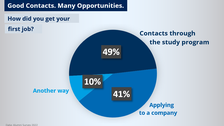
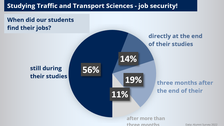
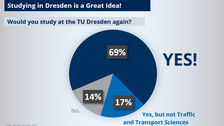
Studying Traffic and Transportation Science means job security! 70 percent of our students have their first permanent job while still studying or directly at the end of their studies. Almost all of our graduates enter attractive career paths after three months of job search at the latest. Career planning and orientation is a top priority for us even during our studies - with an annual in-house carreer fair, job portal, alumni association, and much more.
© TUD
© TUD
© TUD
© TUD
© TUD
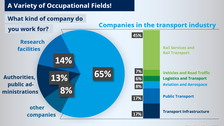
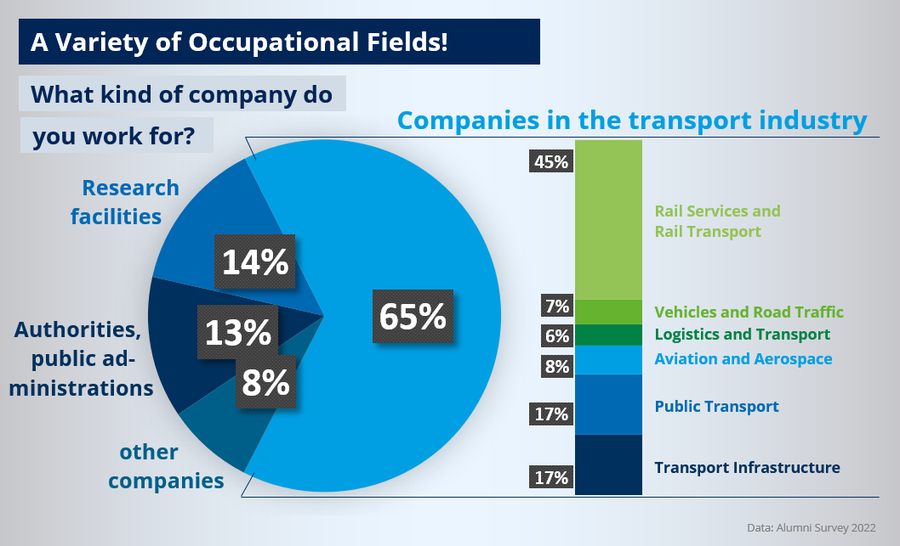
Those who have studied Transportation Economics can work in transportation and logistics departments in Germany and abroad, especially in associations and public organizations, public administrations, ministries, politics and policy consulting, research and teaching institutions, and in data science departments.
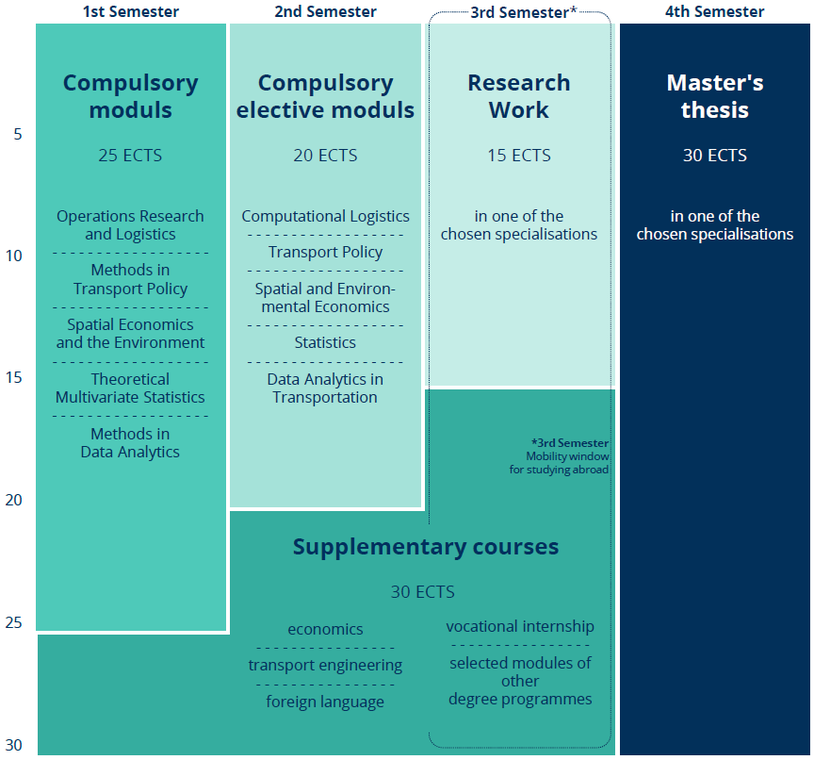
Five specialisations are offered in the degree programme, of which you choose two. In these specializations, you will gain expertise in transportation economics.
Students must then choose at least four modules from the following specializations:
- Computational Logistics: Contents are analytical methods for solving problems and supporting decisions in transport and logistics companies, and managing transport systems and services.
- Transport Policy: Contents are economic and econometric methods for the analysis of a variety of transport policy issues (e.g. emissions, congestion, noise, and safety) and the design and assessment of adequate transport policy measures.
- Spatial and Environmental Economics: Contents are economic and econometric methods for analysing the spatial, economic and environmental impact of mobility in cities and regions as well as the evaluation and design of relevant policy interventions to improve the spatial allocation and reduce negative environmental impacts of transport.
- Statistics: Contents are methods of multivariate statistics. The theoretical basics as well as the application of the methods to transport and economic data are covered.
- Data Analytics in Transportation: Covered are methods of data analytics and their application. These methods are relevant for preparing and analysing surveys and experiments and studying structured and unstructured data (Big Data) in the transport sector.
You can deepen and expand your knowledge of transport economics by choosing supplementary courses. You can not only choose transport economics modules, but also certain economics and transport engineering courses. In addition, you can acquire skills in foreign languages or integrate a vocational internship into your studies. Therefore, the Master's programme provides a high level of flexibility. You can include your ideas, wishes and interests in your studies.
The programme includes a mobility window in the 3rd semester. This opportunity you can use to study abroad or for a vocational internship. You can transfer up to 30 ECTS from modules completed at a university abroad.
»Society’s mobility behavior will change a lot in the future, and I want to develop new concepts and solutions for that. That's why I decided to study transportation economics at the TU Dresden.« (S. Breitkopf)
»The exceptional thing about this study program is that the faculty offers enormous advantages in terms of subject-specific development and the spirit of the students is very special. The faculty and especially the student representatives quickly give you a feeling of home away from home. Last but not least, there is the professional expertise of the professors.« (A. Straubinger)
»This degree program is still relatively rare, but very welcome in the logistics industry. Many companies are specifically looking for transportation graduates. It is a very interesting, important, and thus promising professional field.« (T. Wenk)
»With the specialized knowledge acquired during their studies, graduates can fulfill many criteria that are sought after on the job market. In addition, the city of Dresden offers everything that students are looking for: Learning and relaxing on the Elbe meadows, student-friendly prices, and plenty of culture with the Semper Opera, the cinemas, and theaters.« (S. Breitkopf)
- The prerequisite for admission to the program is a first university degree recognized in Germany that qualifies you for a specific profession, or a degree from a state or state-recognized university of cooperative education in the field of economics, transportation economics, or from the STEM field (mathematics, information technology, natural sciences and technology) or a degree in another course of study with a strong quantitative orientation in terms of content.
If, at the time of application, proof of the first degree qualifying the applicant for a profession is not yet available, the application will be considered under the precondition that 80% of the credit points attainable for the degree have already been achieved based on completed module examinations or the final thesis and the colloquium (if applicable). A certification from the awarding institute of higher education (examination office) serves as proof of the above-mentioned academic achievements. You can find the appropriate form on the Admissions Office website. - In addition, special knowledge in the fields of economics, business management, and quantitative methods (mathematics, statistics, econometrics, operations research, programing, data analytics) is required.
- Furthermore, knowledge of English at B2 level of the Common European Framework of Reference for Language is a prerequisite.
The proof of this special knowledge according to sentence 2, as well as the English knowledge, is assessed according to the aptitude assessment regulations for the master’s degree program for Transportation Economics and Data Science. Read more ⬇ next tab
The admission requirements for the Master's degree program in Transportation Economics and Data Science are regulated in § 2 of the aptitude assessment regulations (English version: here).
According to § 5, special aptitude for the program is present if the following conditions are met:
- Acquisition of at least 60 ECTS from the subject areas of Business Administration (BWL), Economics (VWL) and quantitative methods (mathematics, statistics, econometrics, operations research, programming, data analytics) with no overlapping content, of which:
- at least 15 ECTS credits from the subject area of economics, including at least 6 ECTS credits in microeconomics
- from the Department of Quantitative Methods at least 15 ECTS credits, including at least 6 ECTS credits in Statistics and 4 credits in Operations Research, Optimization and Programming
- at least 15 ECTS credit points from the subject area of Business Administration.
- If there are more than 30 non-overlapping credit points in quantitative methods, the required credit points for Business Administration can be reduced to the same extent:
- the required credit points for Business Administration by up to 10 ECTS credit points and
- the required credit points for Economics by up to 5 ECTS credit points.
The admission committee will check proof of special aptitude on the basis of the documents enclosed with the application. The documents to be submitted are described in detail in § 4 para. 2 of the aptitude assessment regulations (English version: here). In accordance with § 4 para. 2 no. 1, the signed application form "Application for determination of special aptitude" must also be submitted to .
All regulations concerning the study program are defined in the study documents, which have been officially announced:
Studienordnung (Amtliche Bekanntmachung vom 25.05.2021) (english version)
Erste Satzung zur Änderung der Studienordnung (03.02.2023) (english version)
Prüfungsordnung (Amtliche Bekanntmachung vom 27.05.2021) (english version)
Erste Satzung zur Änderung der Prüfungsordnung (03.02.2023) (english version)
The curriculum and modules may be adjusted to meet current needs. These adjustments include the following not legally binding documents:
Module descriptions (current version), (English version)
Study schedule (current version), (English version)
The degree program can completely or temporarily be studied on a part-time basis (50%). This may apply if you are caring for children or other dependents while studying, or if you yourself are affected by health issues.
While studying part-time, the standard period of study for full-time students and the examination periods are doubled. If necessary, you can switch between part-time and full-time studies between semesters. More information on part-time studies
A separate study schedule is recommended and issued for part-time studies. Adjustments must be made when switching between full-time and part-time studies:
part time study schedule, (english version)
The video gives you the most important information about the online application. © TU Dresden
Did we convinced you to study traffic and transportation? Then follow this link to get important information for your application and to find the right application portal for transportation studies.
Application deadlines:
April 1st - June 15th (for EU applicants)
April 1st - May 31th (for non-EU applicants)
Further information on Transportation Economics and Data Science (Master) in the Study Information Systems (SINS).
Multimedia insights into the study programs
Verkehrswirtin Jessica bei ihrem ersten Job als Trainee bei der Deutschen Post © alpha Uni
Jessica studied transportation economics at TU Dresden - from 2014 to 2018 in the Bachelor's program and from 2018 to 2021 in the Master's program. In January of 2023, she was taken on as a section manager for transport at Deutsche Post. She is now responsible for truck scheduling and a team leader for other planners.

A “child of the uni” with a love of research. Angela Francke started a degree in Transport Economics at TU Dresden in 1998 because she wanted to run her own hotel. During her first few semesters, her focus changed. Today, the 42-year-old from Dresden holds one of just seven chairs in cycling in all of Germany at the University of Kassel. Further information
Contact Person
 © Michael Kretzschmar
Dean of Studies Transportation Economics
NameProf. Dr. rer. pol. habil. Jörn Schönberger
Send encrypted email via the SecureMail portal (for TUD external users only).