
Communities in Virtual Learning Spaces
Table of contents
Concerns
This research group is dedicated to exploring the constitution and evolution of communities in virtual learning spaces. Using social VR and interactive 3D technologies, it aims to explore and increase interactivity and engagement in digital educational environments. By analyzing the adoption and implementation of these technologies, we aim to transform pedagogical practices and promote an inclusive educational landscape that can provide educational access and experiences for all learners, regardless of their physical, cognitive or social conditions.
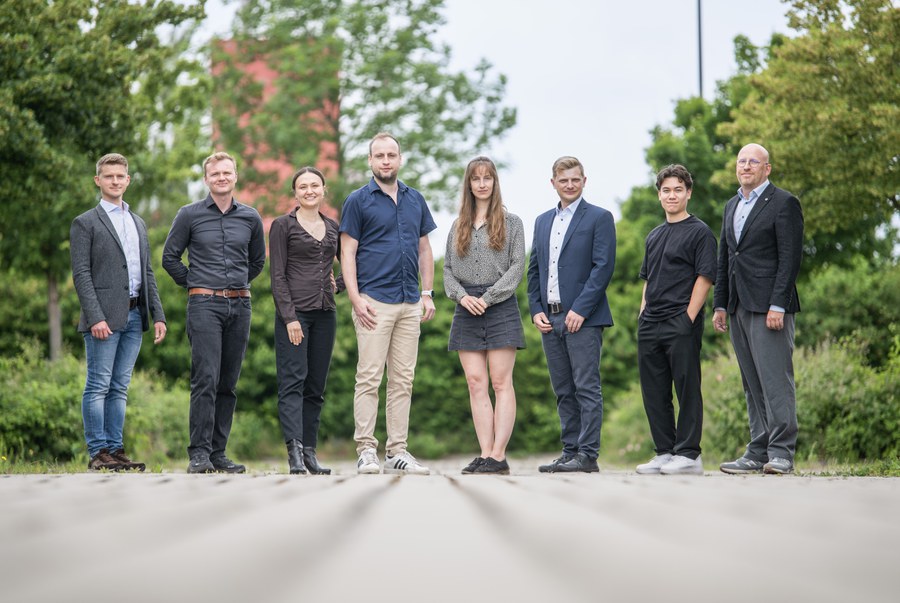
Forschungsgruppenmitglieder (Norbert Pengel, Thomas T. Richter, Emma Weidhaas, Jonathan Dyrna, Johanna Spirling, Mattis Altmann, Kevin Hoang, Alexander Clauss; v. li. n. re.)
Main topics
- Development and evaluation of social VR applications for educational contexts
- Investigation of support models within online communities
- Design and implementation of immersive VR learning environments
Research questions
The research group "Communities in Virtual Learning Spaces" is interested in the organizational, didactic and individual level. It aims to take a holistic view of the object of investigation. The following central questions serve as a starting point.
Organizational level:
- What are the requirements for the design of learning and knowledge communities in virtual environments?
- What factors influence the suitability and implementation of (social) VR learning environments and tools for educational and communication purposes?
Didactic level:
- How should supervision concepts be designed to support online knowledge communities?
- How can (social) VR learning environments and interactive virtual 360-degree panoramic learning spaces be designed didactically to promote the learning experience and learning outcome?
Individual level:
- How can learners and learning facilitators build skills for proactive participation in communities in virtual environments?
- What factors influence the technology acceptance of (social) VR learning environments and tools?
Research approaches and methods
- The group uses both qualitative and quantitative research methods to gain insights into the dynamics of use and pedagogical effectiveness of VR in educational environments. This includes the development of prototypical learning environments and their empirical evaluation.
- Competencies for the implementation of design science research approaches and technology acceptance models as well as (meta-)statistical social research will be developed and expanded.
Further information
2024
-
Blending Physical and Virtual Mobility in Higher Education, 2024, Communities in New Media. Inclusive digital: Forming Community in an Open Way Self-determined Participation in the Digital Transformation: 26. Workshop GeNeMe‘23 Gemeinschaften in Neuen Medien. Köhler, T., Schoop, E., Kahnwald, N. & Sonntag, R. (eds.). Dresden, Vol. 26. p. 329-334Electronic (full-text) versionResearch output: Contribution to book/conference proceedings/anthology/report > Conference contribution
-
Design Dimensions of Virtual Collaborative Learning – Synthesizing Iterative Research, 2024, Handbuch E-Learning. Köhler, T. (ed.). Wolters Kluwer, Vol. 106. p. 1-22, 22 p.Research output: Contribution to book/conference proceedings/anthology/report > Chapter in book/Anthology/Report
-
European University Collaborations with the Western Balkans Building Sustainable Academic Communities, 2024, Gemeinschaften in Neuen Medien. Vertrauen in der Krise: Kommunikationsmodelle in digitalen Gemeinschaften: 27. Workshop GeNeMe‘24 Gemeinschaften in Neuen Medien. Köhler, T., Schoop, E. & Sonntag, R. (eds.). Dresden: TUD Press, p. 3-4, 2 p.Electronic (full-text) versionResearch output: Contribution to book/conference proceedings/anthology/report > Conference contribution
-
Preparing E-Tutors for Success: A Qualitative Analysis of a Community Management Training Module for Students, 2024, The Asian Conference on Education 2023: Official Conference Proceedings. p. 161-176, 16 p.Electronic (full-text) versionResearch output: Contribution to book/conference proceedings/anthology/report > Conference contribution
-
Supporting virtual learning and international academic visits with AI, 2024, IDIMT 2024: Changes to ICT, Management, and Business Processes through AI - 32nd Interdisciplinary Information Management Talks. Doucek, P., Sonntag, M. & Nedomova, L. (eds.). Trauner Verlag, p. 141-146, 6 p.Electronic (full-text) versionResearch output: Contribution to book/conference proceedings/anthology/report > Conference contribution
-
Virtual Reality-gestützte Rollenspiele für die berufliche Bildung: Drei Anwendungsbeispiele und ein Implementierungsleitfaden, 2024, Handbuch E-Learning. Köhler, T. (ed.). Wolters Kluwer, p. 1-23, 23 p.Electronic (full-text) versionResearch output: Contribution to book/conference proceedings/anthology/report > Chapter in book/Anthology/Report
2023
-
Weiterbildungsbeteiligung von Kleinst- und Kleinunternehmen durch digitale Lernszenarien fördern: Abschlussbericht zum Projekt weiter.digital, 4 Apr 2023, In: Open Research in Progress – Reports of the Center for Open Digital Innovation and Participation. 1, 1, 67 p.Electronic (full-text) versionResearch output: Contribution to journal > Research article
-
Implementation of Virtual Mobility and Internationalization at Home in Albania’s Higher Education: A Catalogue of Recommendations for Action, Feb 2023, In: International journal of management, knowledge and learning. 12, p. 69-78Electronic (full-text) versionResearch output: Contribution to journal > Research article
-
Aufsuchende Bildungsarbeit als Chance zur Förderung digitaler Kompetenzen älterer Erwachsener – Ein Peer-to-Peer Ansatz, 2023, In: Der pädagogische Blick. Zeitschrift für Wissenschaft und Praxis in pädagogischen Berufen. 31, 1, p. 30-44, 15 p.Electronic (full-text) versionResearch output: Contribution to journal > Research article
-
Exploring Critical Learning Incidents in Collaborative Online International Learning: Implications for Digital Readiness and Learning Design, 2023, Inklusiv digital: Gemeinschaft offen gestalten Selbstbestimmte Teilhabe an der digitalen Transformation: 26. Workshop GeNeMe‘23 Gemeinschaften in Neuen Medien. Köhler, T., Schoop, E., Kahnwald, N. & Sonntag, R. (eds.). Dresden : TUDpress, p. 80-90, 11 p.Electronic (full-text) versionResearch output: Contribution to book/conference proceedings/anthology/report > Conference contribution
 This information is provided by the FIS.
Research Group Leader

Research Associate
NameAlexander Clauss M. Sc.
Head of Research Group
Send encrypted email via the SecureMail portal (for TUD external users only).
Visiting address:
BSS, 4th floor, room 437 Strehlener Str. 22/24
01069 Dresden
 © Sven Ellger
Research Associate
NameDr. Mattis Altmann
Deputy Head of the Research Group
Send encrypted email via the SecureMail portal (for TUD external users only).
Visiting address:
BSS, 4th Floor, Rooms 437 and 445 Strehlener Str. 22/24
01069 Dresden
Research Group Members
 © Sven Ellger
Research Associate
NameMr Jonathan Dyrna M.Sc.
Send encrypted email via the SecureMail portal (for TUD external users only).
Visiting address:
BSS, 4th floor, room 467 Strehlener Str. 22/24
01069 Dresden
 © Sven Ellger
Research Associate
NameMr Thomas Tobija Richter Dipl.-Wirtsch.-Inf.
Send encrypted email via the SecureMail portal (for TUD external users only).
Visiting address:
BSS, 4th Floor, Room 437 Strehlener Str. 22/24
01069 Dresden
Research Assistants

Research Assistant
NameMr Magne Ortmann B. A.
Send encrypted email via the SecureMail portal (for TUD external users only).
Student Assistants
 © Sven Ellger
Student Assistant
NameMr Kevin Hoang
Send encrypted email via the SecureMail portal (for TUD external users only).
Visiting address:
BSS, 4th Floor, Room 437 Strehlener Str. 22/24
01069 Dresden
Student Assistant
NameMs Johanna Spirling
Send encrypted email via the SecureMail portal (for TUD external users only).
Visiting address:
BSS, 4th Floor, Room 442 Strehlener Str. 22/24
01069 Dresden
 © Sven Ellger
Student Assistant
NameMs Emma Weidhaas
Send encrypted email via the SecureMail portal (for TUD external users only).
Visiting address:
BSS, 4th Floor, Room 446 Strehlener Str. 22/24
01069 Dresden