
Feb 23, 2026
Annual review 2025 of the "Communities in Virtual Learning Spaces" research group
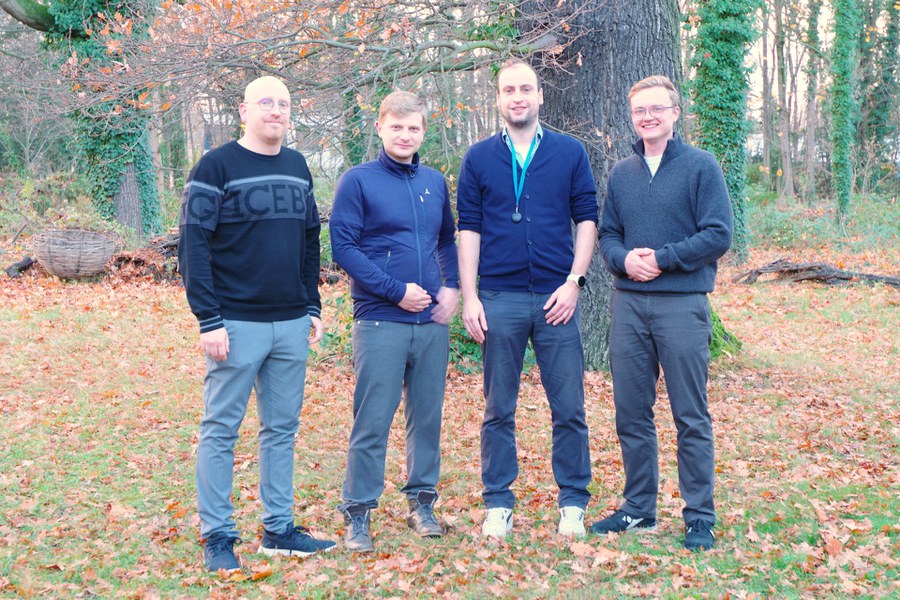
Alexander Clauss, Mattis Altmann, Jonathan Dyrna and Thomas T. Richter (from left to right) from the Communities in Virtual Learning Spaces research group
Annual review 2025 of the "Communities in Virtual Learning Spaces" research group
The "Communities in Virtual Learning Spaces" research group can look back on an eventful and successful 2025. Through numerous scientific publications, approved project applications, intensive promotion of early-career researchers and the organization of specialist events and internal exchange formats, it was equally active and visible in various fields of activity. The focus was on topics relating to virtual collaboration and digital education, particularly with the use of virtual reality (VR). In addition, issues relating to the in a targeted manner development of future skills and the acquisition and management of action knowledge with the support of artificial intelligence (AI) - predominantly in international contexts - were addressed. Technological developments, didactic issues and practical application scenarios were combined in a targeted manner and examined in integrative research approaches.
20 peer-reviewed publications and high international visibility
In 2025, the research group published a total of 20 peer-reviewed publications. A particular highlight was the open access anthology "Higher Education Contemporary Learning Landscape: Virtual Collaborative Learning", which was co-edited by Dr. Mattis Altmann. He is also represented in the volume with two contributions of his own. The anthology is dedicated to contemporary forms of virtual collaboration in the higher education context and brings together international perspectives on digital learning landscapes. Other highlights included two open access articles published by the research group in scientific journals. In "Human Systems Management", first author Dr. Mattis Altmann published the article "Designing Formative Feedback in Collaborative Online International Learning", which examines design principles for formative feedback in international online learning scenarios. The article "Digital and AI-supported solutions for the safe and efficient decommissioning of nuclear facilities - The K.I.S.S. research and development project" was published in the "atw - International Journal for Nuclear Power" with Jonathan Dyrna and Thomas T. Richter as co-authors. This publication shows examples of how innovative AI and VR technologies can be used to develop skills and support work processes in safety-critical industrial contexts.
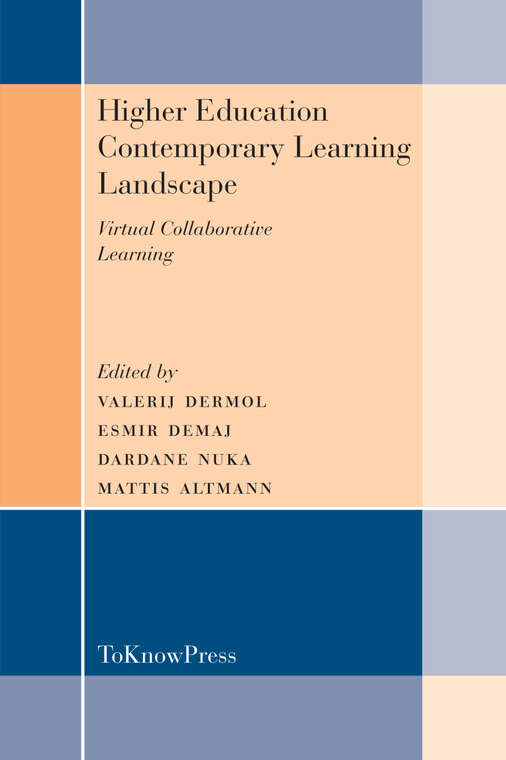
Abbildung 1: Titelseite des Sammelbandes „Higher Education Contemporary Learning Landscape: Virtual Collaborative Learning”
The specialist articles were supplemented by various conference contributions. Alexander Clauss presented his research findings at the 16th International Conference on Computer Supported Education (CSEDU) in Angers (France). Jonathan Dyrna presented a paper at the DELFI Conference on Educational Technologies 2025. The research group also published its first joint conference publication entitled "Identifying Key Features and User Experience Criteria for an Online Social Learning Community Platform in the Nuclear Power Sector" at the annual conference of Communities in New Media (GeNeMe). The research group was thus present in the scientific discourse both nationally and internationally.
Project acquisition: high approval rate and new funding lines
2025 was also a successful year in terms of project acquisition. A total of eleven applications for personnel funding were submitted, in particular to ERASMUS+, foundations and the Free State of Saxony. Of these, five applications have already been approved - with two rejections. All other submissions are still under review. One of the approved projects is the ERASMUS+ project "Building Data Wisdom and Governance in Schools for Evidence-Informed Educational Improvement (SchoolWISE)", which starts in April 2026 and deals with data-informed school development in a European context. The project "Infrastructure expansion for the information-secure stabilization of Saxon innovation projects on artificial intelligence in centrally used teaching/learning infrastructures (InfraSax.KI)", funded by the Saxon State Ministry of Science, Culture and Tourism (SMWK), has been running since December 2025. Both projects complement the thematic spectrum of the research group in a targeted manner and at the same time create new personnel and structural perspectives.
Continuity and success in the qualification and promotion of early-career researchers
The promotion of early-career researchers remained a central component of the research group's work in 2025. In 2025, a total of six doctoral students were working on their dissertations within the research group, four of them in the Business Information Systems department and two in the Educational Sciences department. Two dissertations in the field of Business Information Systems were submitted, one of which has already been successfully defended: Dr. Mattis Altmann successfully completed his doctoral thesis on "Formative Feedback in Collaborative Online International Learning" in early January 2026 with the top grade of "summa cum laude". In addition, the research group supervised 37 student theses as part of research and teaching, including two Master's theses and two diploma theses in Business Information Systems as well as one state examination thesis. A particular highlight was the international hackathon organized by Thomas T. Richter in collaboration with Stellenbosch University in South Africa and held in the Open Science Lab of the Saxon State and University Library (SLUB). It will take place again in 2026.
The close integration of research projects and academic teaching makes it possible to directly integrate current issues into qualification processes and introduce students to academic work at an early stage. In addition, the group actively participated in TU Dresden's structured graduate program "Education & Technology" and took part in its winter and summer schools. In this way, it contributes to interdisciplinary networking and the structured qualification of doctoral students.
Scientific events and mutual support
To strengthen scientific dialogue and interdisciplinary networking, the Research Group 2025 was involved in the organization and implementation of several specialist events. Dr Mattis Altmann played a leading role in the organization of the annual summer school of the structured graduate programme "Education & Technology". Thomas T. Richter and Jonathan Dyrna were involved in the planning and implementation of the annual Communities in New Media (GeNeMe) conference, which is organized by CODIP in collaboration with other universities, and its pre-conference workshop "Fostering Competence and Inclusion in VET through Digital Innovation". Dr. Mattis Altmann also gave the keynote speech at the other pre-conference workshop "GameChangers: Innovating Business Education". In addition, two editions of the Life@Lab AI Symposium were organized and led by Alexander Clauss and Thomas T. Richter in 2025.
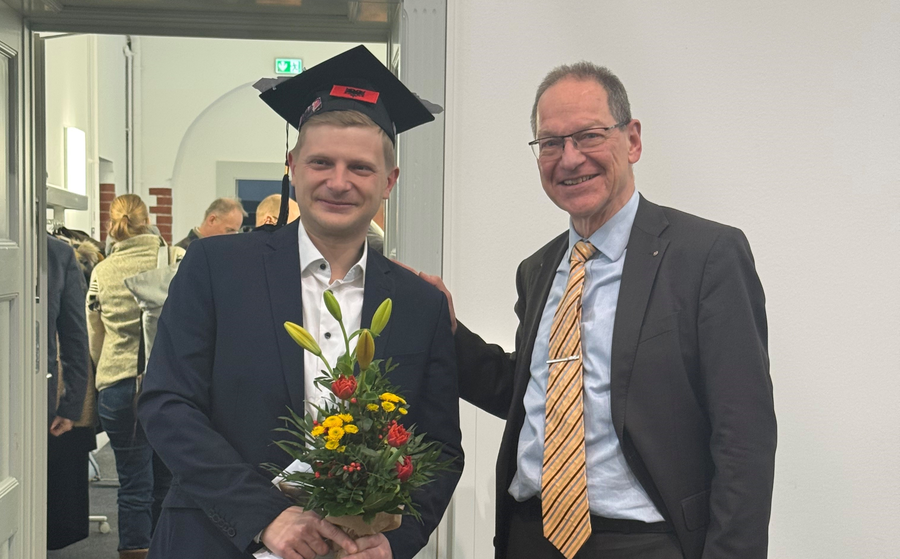
Abbildung 2: Mattis Altmann (li., mit Doktorvater Prof. Dr. Eric Schoop) verteidigte erfolgreich seine Promotion
In addition to these publicly visible formats, internal scientific collaboration within the research group also played an important role. Mutual support, for example through internal trial lectures as part of ongoing doctoral procedures, as well as continuous professional exchange within the team contributed to quality assurance and the further development of individual and joint projects. To promote scientific exchange and prepare for future collaborations, Thomas T. Richter and Alexander Clauss visited the Department of Information Science at Stellenbosch University (SU) in South Africa for two weeks in November as part of a 10-day research stay, which was kindly funded by the ERASMUS+ mobility program. This revealed a high degree of mutual compatibility between the respective research topics, which provides fertile ground for future collaboration.
The end of the year was marked by a joint visit to the Dresden Christmas market. After a year full of projects, publications and events, this moment provided an opportunity to look back together and look ahead at the same time. With ongoing projects, established and new collaborations and committed young researchers, the course has already been set for an equally productive 2026.