
May 13, 2026
Research methods for the Unischulkids - students create learning materials
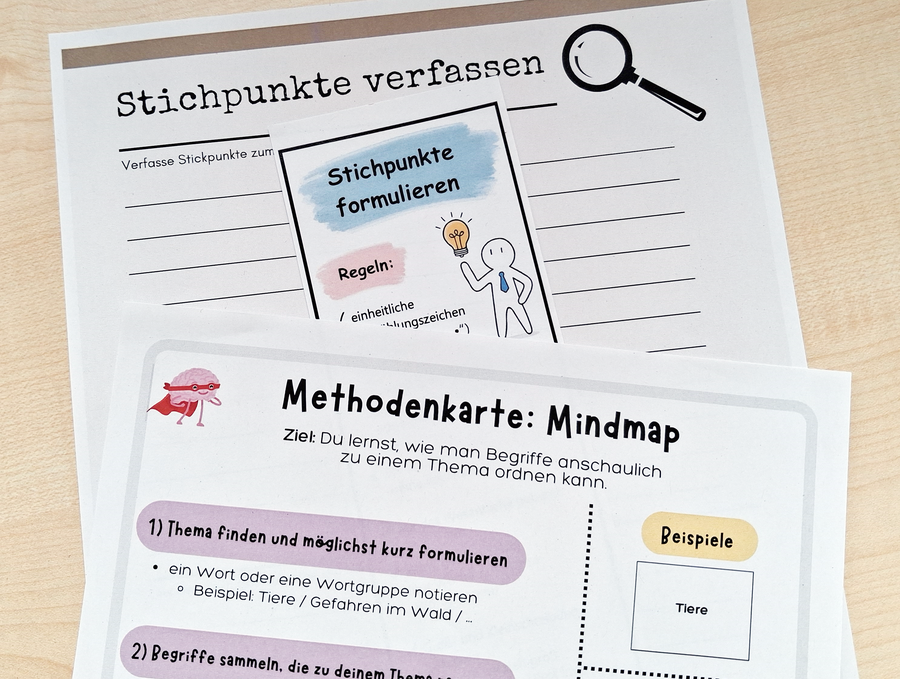
Teacher training students at TU Dresden can also get to know the Dresden University School in the 2026 summer semester. How does the concept, with the project method as its didactic core, enable students to learn at their own pace and guided by their interests? What learning materials are used to implement this in everyday school life and how are they created? These questions will be answered by future teachers in the seminar "Research methods - developing and testing learning materials with pupils" through classroom observations and hands-on experience in creating and testing learning materials. These materials developed by the students are added to the Dresden University School’s resource pool.
Students have already created and tested materials on the methods 'Create a mind map' and 'Create bullet points', which are now being used at Dresden University School. In the last round, the seminar participants focused on the middle school. Here, the children learn in mixed-grade groups from grades 4 to 6.
Two topics on digital research are now on the wish list for the intermediate level with materials on 'Extracting information from digital texts' and 'Extracting information from videos'. In addition, materials on 'Creating bullet points' are also to be developed for the primary level (years 1 to 3). All topics were developed in consultation between teachers and seminar leader Dr. Marlis Pesch from the ForUS University School Research Center.
Learning in the real laboratory on the school of the future
In the seminar, students first learn about the concept of the Dresden University School and the structure of the school experiment as a school for Dresden children as well as a research project and training center for prospective teachers. During the subsequent observations, they can experience the practical implementation of the concept, which focuses on increasing independence in the management of the individual learning process, on site. In this way, they get to know the children and young people, but also the learning guides for whom they create the materials.
Ideally, the students will also experience the 'performance' learning format during the observations. During a presentation, learning content - for example technical or methodological topics - is developed with a group of learners. This does not have to be the entire core group - this is the name given to the "classes" at Dresden University School, which do not form a fixed group over several school years - but includes the students for whom the presentation topic is relevant and meaningful in their project work. For example, during the presentation on the topic of "Creating bullet points", a learning guide works together with the pupils on what bullet points are, what to look out for when writing bullet points and how they can support learning. This is also practiced together in the presentation.
Learning format presentation: observe, design, try out
The students observe project lessons as well as various performances in different subject areas and ask the pupils and learning support staff questions about learning in the project work. The students then discuss their observations and develop initial ideas for creating materials.
In the subsequent method workshops, these initial ideas are further developed, whereby the students can also draw on results from the previous seminars. In addition to a presentation including learning materials and instructions for implementation for the learning guides, the material development also includes a follow-up task in which the students are asked to apply their acquired methodological knowledge once again. The students thus carry out the material creation in the seminar in the same way as the teachers at the university school when they develop learning material: with peer feedback from fellow students, practical testing of the materials and feedback rounds with the learners.
An idea becomes part of the university school material pool
The 'Create bullet points' presentation was implemented particularly creatively in a detective story during the last seminar: The candy store "Die Naschecke" was burgled. In order to find the burglar, the most important information for the description of the person had to be written down in brief notes. When comparing notes, the students came up with the solution together.
While practical testing of teaching or learning material designs is not possible as part of all courses in the teacher training program, in the seminar "Research methods - developing and testing learning material with students", seminar participants can try out their presentation concept with small groups of students from different home groups. This allows for multiple perspectives and role changes during the trials: from the performer to the observer and vice versa. In this way, peer observation can also be practiced, as can the collection and evaluation of student feedback.
In a subsequent step, the performance concept, learning material and follow-up task are adapted on the basis of this knowledge and transferred in the revised form to the material pool of the Dresden University School. To this end, a performance training session is held for the learning facilitators using the materials created by the students. In May 2026, seminar leader Dr. Marlis Pesch presented the materials for the methods 'MindMap erstellen' and 'Stichpunkte erstellen' from the summer semester 2025.
Educational research and practical testing for future teachers
The seminar "Research methods - developing and testing learning materials with students" enables students to explore various methods of empirical social research and their application in a school context. Students will engage intensively in theory and practice with one of the most innovative teaching-learning formats used in the "Real-world laboratory for the school of the future" in Dresden for more self-regulated learning. In addition, they gain numerous insights into the Dresden school experiment and reflect intensively on the understanding of the role of teachers and learning support as practiced at the university school.
The seminar will also be offered during the 2026–27 winter semester. You can find all the details in the overview of all courses offered by the Chair of Education/ Inclusive Education:Inclusion, University School and ALSO - Courses in the field of educational sciences (winter semester 2026/27).
About the seminar leader
Dr'in Marlis Pesch has been a member of the University School Dresden Pilot Project Research Unit team since the start of the pilot project and has been working at the University School Dresden Pilot Project Research Unit since 2022 with a focus on individual and social regulation processes in cooperative project work and the development of materials to support learning. To the employee profile.
In the News of the Chair of Education / Inclusive Education (EWIB) you will find an overview of the courses of the Chair EWIB in the field of educational research in the summer semester 2026.
All opportunities for TU Dresden students at the University School as a training school are presented on the project website for teacher training.
About the University School Dresden
Dresden University School is a joint project of the state capital of Dresden and the TUD Dresden University of Technology. It is a public and free community school run by the city, where innovative forms of teaching and learning are tested under academic supervision. In addition, it is a training school for future teachers and, in the future, a further education school for teachers. The school trial is being scientifically supported by the ForUS - University School Research Unit at TU Dresden.
Information on the research project at TU Dresden: https: //tu-dresden.de/gsw/unischule
Information on the Dresden University School: http://universitaetsschule.org
You can find insights into the research project and everyday school life on various social media channels under @unischuleTUD: Facebook, Instagram, YouTube and LinkedIn. News from the University School Dresden project can be found regularly in the GSW newsletter.