Oct 15, 2026
“I can apply what I’ve learned to my own teaching practice.” – State examination theses at the University School Research Unit
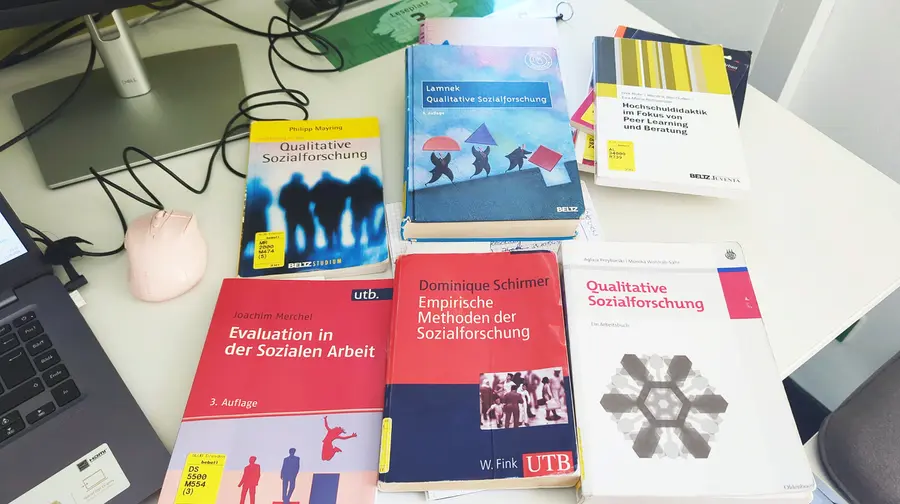
As part of the Stex in educational research, students also familiarize themselves with the methods of empirical social research.
Julia Pöschel and Jessica Rößler are studying to become teachers at TU Dresden. This Friday in August, they are about to take a crucial step: They will present and discuss the findings of their state examination theses to date with their advisors at the University School Research Unit (ForUS). They still have about a month left for their final research and would like to hear today from Prof. Dr. Anke Langner, Dr. Marlis Pesch, Hannah Bartels, and Wiebke Bergjürgen to find out which of their findings seem particularly relevant, whether additional literature should be included, and how best to incorporate audio transcripts into the text. After the colloquium they took the time to answer some questions about their "stex experience".
After graduation, Julia Pöschel plans to teach ethics, general studies, German, and mathematics at an elementary school. In her research paper, she is examining “Strategies and Methods Used by Learning Facilitators to Support Self-Regulated Learning at the Dresden University School.” Her fellow student Jessica Rößler plans to teach geography and history at a high school. For her state examination thesis, she chose the topic “Peer Case Consultation in Teacher Education—A Qualitative Study” and is examining a support format for the alternative teaching practicum ALSO.
In this interview, they explain why they both applied to the field of educational sciences and how their advisors supported them on their path to the First State Examination.
When you think of teacher education, subject-specific pedagogy and general pedagogy come to mind first, rather than empirical educational research. How exactly did you come to choose this topic for your state examination thesis?
Julia Pöschel: That’s actually quite easy to explain. I took the seminar “Research at the University School,” which provides an initial insight into research and the University School of Dresden. My advisor, Ms. Pesch, had already supervised my small research project as part of that seminar. Since I really enjoyed the research work itself as well as the collaboration, it quickly became clear to me that I also wanted to write my state examination thesis at the research center. Another factor in my decision was that the research center publishes suggested topics for the state examination thesis, which students can apply for. This gives you an idea of what the thesis should focus on and allows you to find a suitable, narrowly defined topic. In elementary school education, this process works differently. There, you choose a topic for your state examination thesis yourself in advance and apply with that topic independently to the chairs.
And there’s certainly always a small risk that another student has already done that topic and that your own topic will be adjusted by your advisor, right?
Julia Pöschel: Exactly . That’s another reason why a topic suggested by the research center—one related to the university school—was a good solution for me. In the seminar “Research at the University School,” we examined the Hamburg Writing Test (HSP) and analyzed data from the survey using the standardized test for writing skills. We administered the test ourselves at the school, formulated a research question, and then analyzed the data accordingly. Ultimately, it was the same process as in the state exam thesis, just on a much smaller scale and as part of a group. Back then, I gained valuable insight into the research process and was able to exchange ideas with my fellow students at the same time.
That means methods of empirical social research don’t otherwise play a major role in teacher education. Does your choice of topic also give you good insights into how, for example, a study like PISA is actually conducted in practice?
Julia Pöschel: Yes, exactly. Outside of the seminar, I had no other direct connection to empirical research. But in the current research process for my state examination thesis, I’m gaining a deeper insight into it: How do I collect data? How do I analyze the data? What do I need to keep in mind during the analysis? We can discuss the procedure and any questions that arise with our advisors. That’s definitely something new.
Ms. Rößler, you’re working on a topic related to the ALSO transfer project from the Dresden University School pilot program. How did that come about?
Jessica Rößler: It was relatively simple for me, too. As a student, I participated in the Collegial Case Consultation (KFB). This is a student-led peer group where we discuss challenging situations that arise in the classroom. Later, as a Student Assistant, I also served as a group leader for the KFB. By then, at the latest, it was clear that I found the topic very exciting and could see it as the subject of my state examination thesis. I didn’t have a specific research question yet, but I developed one together with my advisor, Hannah Bartels.
Each student decides for themselves whether to write a thesis in subject-specific pedagogy—in my case, that would have been history or geography—or in another field such as educational sciences. There are guidelines from the State Office for Schools and Education (LaSuB) on how to combine the oral exam and the state exam thesis.
Students who wish to work with children and adolescents as teachers not only learn about educational theories at the university and apply them during practical training phases, but also learn how to conduct academic research. For the first state examination, future teachers also demonstrate their ability to address a topic both theoretically and practically in their state examination thesis. With the so-called “Stex” and the associated exams, they complete the first phase of their teacher training program. They demonstrate “that they have acquired the educational, subject-specific, subject-didactic, or professional-field didactic qualifications—and, where necessary, artistic aptitude required for admission to the preparatory service for the intended teaching position.” Only then do students enter a long practical phase with their teaching internship, before the program concludes with the second state examination.
Students may apply to the chairs within the Faculty of Education at TU Dresden with a topic of their own choosing. However, the professors also offer a wide range of topics within their respective research areas. At the Chair of Education / Inclusive Education (EWIB), topics for the upcoming semester are typically announced in January and June on the following pages:
Once you’d decided on the advertised topic—or rather, once your initial idea had been accepted—what were the next organizational steps for you? Did the registration and further communication go smoothly?
Julia Pöschel: The response from the research center came very quickly, and I was very relieved about that, because the application deadlines for the state examination thesis vary widely. In the other areas of elementary school teacher education, they had already expired more than a month earlier, before the topics from the University School Research Center were published. After receiving approval from the research center, the first discussions took place quickly to narrow down the topic’s scope and plan the next steps. That was really great.
Jessica Rößler: I originally wanted to write my thesis under the supervision of Julia Nowak, who was then the director of the Educational Science Research Workshop (ELF). At that time, the KFB and the ELF were still affiliated with Anke Langner’s Chair. Although that has since changed, the staff at the research center responded quickly to my inquiry, and I was able to work on my planned topic even without Ms. Nowak. She was very helpful in finding someone who could supervise me, and the process with Hannah Bartels went very smoothly. We were able to narrow down the topic well together. That was a huge relief.
Are you generally more interested in research, or do you plan to follow the traditional path into teaching after your teaching internship and the Second State Examination?
Julia Pöschel: My top priority is to complete my teacher training program and then begin my teaching internship. My research has strong practical relevance, and I can immediately apply the insights I’ve gained about strategies and methods for promoting self-regulated learning in my everyday school life outside the university school. So, even beyond the realm of research, the results of my work are beneficial to me for my future career.
Jessica Rößler: For me, too, it’s not so much about the research as it is about the topic itself. You spend a long time working on your Stex thesis, and for me it’s important that the topic itself interests me—that I want to write a lot about it. That’s where I draw my motivation from, because I can take my findings with me into my teaching career. For me, the academic aspect takes a back seat.
After registering with LaSuB, the first Stex colloquium took place at the research center in May. What was that like for you?
Jessica Rößler: We actually exchanged ideas with the other students about the topics—how far we’d progressed with our work, what our first steps had been, where we might still be facing difficulties—basically, where we stood overall in the entire process.
Julia Pöschel: Yes , exactly. At that point, we were all in the midst of theoretical research, and the colloquium allowed us to learn about the various topics and possibilities. Through these discussions, we were able to draw inspiration: What other literature is available? Which method is best suited for the practical part? Should I conduct interviews, or should I just look at written sources? It was a great exchange with the other students and, of course, with the advisors. Everyone described their topic and current progress, and afterward, everyone had a chance to ask and answer questions—going around the room once.
Jessica Rößler: Everyone had the chance to comment on the topic or suggest what might be helpful. Even though the colloquium was a completely new setting with a new topic, it was very pleasant. There’s a respectful atmosphere, and the focus is always on constructive feedback that you can really build on.
Until the second colloquium in August—about a month before the submission deadline—the individual supervision continued. Did that take place in writing, or did you meet with your advisors again in the meantime?
Jessica Rößler: My advisor was always available and responded quickly—except, of course, when she was on vacation. We also met fairly regularly every two or three weeks. Especially during the planning phase for the group discussion with the KFB students—and particularly when we were agreeing on the guidelines—it was a very intensive exchange, which I have to say I really appreciated. These were often short meetings, no longer than 10–15 minutes. But the feedback was very helpful, so I knew whether I was on the right track or heading in the wrong direction.
In the last month before the deadline, written and oral exams take place alongside work on the state examination thesis; there may be final coursework due from seminars; applications for the teaching internship must be submitted; and many students also have part-time jobs. Good supervision can really take some of the pressure off. But your work is also valuable to the research center. For some topics, students analyze data they’ve already collected and address real-world issues related to the school pilot program and the alternative teaching internship program, ALSO. Did that motivate you as well?
Prof. Dr. Anke Langner, Inhaberin der Professur, gibt gemeinsam mit Dr. Matthias Ritter die Zeitschrift „Spe – Schulpraxis entwickeln. Journal für forschungsbasierte Schulentwicklung“ heraus. In diesem OER-Online-Journal können geeignete studentische Arbeiten gemeinsam mit den wissenschaftlichen Betreuer:innen veröffentlicht werden.
Julia Pöschel: I believe it’s motivating to know that I’m not just doing this for my degree, but that the results also benefit others. It means a lot to me when the staff at the research center say that others can benefit from my work, that these are truly relevant topics that can be revisited time and again in everyday school life. It’s great when they say, “There’s something exciting here. We should take a closer look at this!” And it also opens up the possibility of expanding my own research project a bit further after graduation.
Jessica Rößler: I’d love it if my work could change and improve university life for other students. During the group discussion on peer case consultation in the ALSO project, many issues were raised where students would like more support or a different structure. And I know my work will be read, and perhaps one or two things will be adjusted or improved. I like that.
Your work is, so to speak, a very well-researched and well-reasoned piece of feedback to the ALSO project team—going deeper than the usual questionnaires.
Jessica Rößler: Exactly—I was able to dig deeper and find out more. Especially during the group discussion, I could see where my participants were very much in agreement, even though they had completed the ALSO internship at different schools in eastern Saxony.
Articles for the online journal “Spe – Schulpraxis entwickeln” were subsequently published based on selected state examination theses related to the university school. What do you think of this opportunity?
Jessica Rößler: It’s definitely exciting to distill the results from 70 pages down to 20, especially when you’re so deeply immersed in the subject matter. The problem, though, is definitely finding the time, because the exam period begins right after the paper is due. It’s definitely a great honor to be able to publish the work I’ve done over the past half-year.
Julia Pöschel: Yes , it’s a great way to show: I’ve done something cool. The faculty at the University School of Dresden have confirmed to me that my work is relevant. Many have come up to me and asked, “Hey, wouldn’t you like to give another presentation for us? Can you summarize your findings for us again so we can get some insight, too?” But these are topics that don’t just affect one school—they can be implemented just as effectively at public schools as well. With publications like this, you can reach a broader audience.
Jessica Rößler: Especially with my topic, it would give other universities a chance to see what works well—or perhaps doesn’t—with the KFB at TU Dresden. During my research, I found that peer case consultation is often offered only after the first state exam—that is, during the teaching internship. However, it can already contribute a great deal during the first phase of training to a teacher’s self-reflection: How are certain methods applied? What could I possibly improve? What is effective?
I think peer case consultation can encourage students even during their studies to later exchange ideas with colleagues: What works well for you? What works well for me? I’ll definitely take that with me.
Julia Pöschel: Since I’m already working at a school, I can incorporate new insights from my state exam thesis directly into my lessons and test them in practice. I find the opportunity to try out new ideas and methods right away particularly exciting. That’s incredibly beneficial for me.
That’s a wonderful closing remark! Thank you very much for the interview.
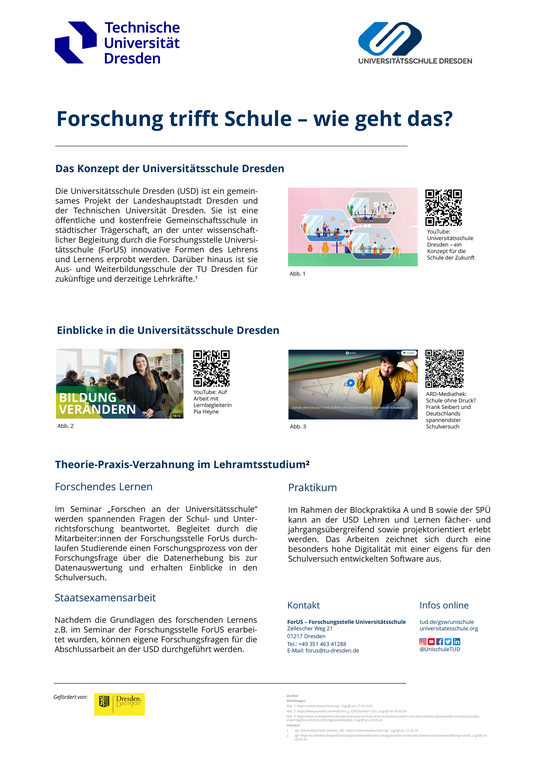
Research Meets School—How Does It Work?
The opportunities for students in applied educational research at the Dresden University School (see poster below) and the semester-long ALSO school internship—which fosters a close and early integration of theory and practice in teacher education —combine the themes of school development and professional development in an innovative way.