
Sep 10, 2026
Prof. Philipp Lorenz-Spreen – New Professor of Computational Social Science
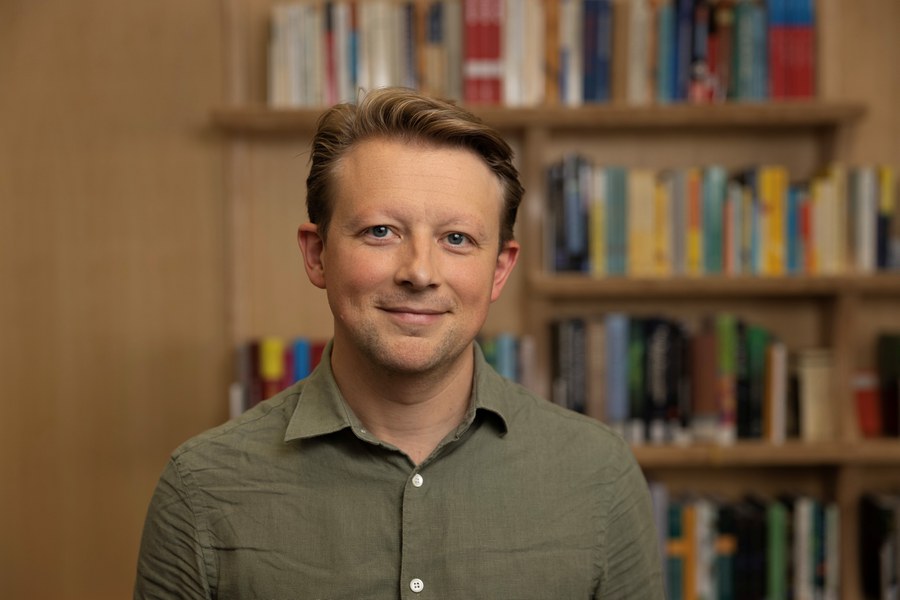
Philipp Lorenz-Spreen has been a professor of computational social science at the Institute of Media and Communication and the Center Synergy of Systems (SynoSys) at TU Dresden since September 2026. He studied physics at LMU Munich (B.Sc. 2013, M.Sc. 2016 with a focus on complex systems) and received his Ph.D. in theoretical physics from TU Berlin in 2018, with a dissertation on empirical methods and models for the dynamics and acceleration of collective attention on social networks. He then conducted research at the Max Planck Institute for Human Development in Berlin (Center for Adaptive Rationality) on individual and collective information behavior in online environments. In Dresden, he leads a research group on computational social science that investigates how digitalization is transforming public discourse and politics worldwide and develops principles that democratic platform logics could follow in the future. For his work, he received the Leopoldina Prize for Young Scientists in 2021 and the Rising Star Award from the Association for Psychological Science in 2024.
Name: Prof. Philipp Lorenz-Spreen
Position / Chair: Chair of Computational Social Science
Institute: Institute of Media and Communication / Synergy of Systems (SynoSys)
Faculty/Institution: Faculty of Arts, Humanities and Social Science / Center for Interdisciplinary Digital Sciences (CIDS)
What are your core research areas and interests?
I investigate how digital media, online platforms, and algorithmic systems are transforming society and democracy. My research focuses on political discourse, opinion formation, polarization, collective attention, and the dissemination of information—in other words, the interplay between human behavior, social networks, and the design of digital platforms. Methodologically, my research combines communication studies, social sciences, and complexity research: I work with online experiments, field studies, large platform datasets, and computer simulations, utilizing network analysis, time-series analysis, causal inference, agent-based modeling, and computer-assisted text analysis. Another goal is to design digital spaces in such a way that they better support informed decision-making, social participation, and democratic debates.
What has been your most interesting or exciting research project so far?
For me, the most exciting project has still been the study from my doctoral dissertation on the acceleration of collective attention (“Accelerating dynamics of collective attention,” Nature Communications 2019). Using a wide variety of data sources—ranging from Twitter hashtags to Google search queries and Wikipedia page views to centuries-old book corpora—we demonstrated that individual topics capture the public’s attention at an ever-faster rate and lose it just as quickly. What was fascinating was that this pattern can be reproduced using a relatively simple model: When more content competes for a limited amount of attention, attention cycles inevitably shorten. For me, that was the moment when simple modeling and social questions truly came together.
What project are you currently working on?
I’m particularly focused on two lines of research at the moment. First, together with the legal scholars at TU Dresden, Katharina Kaesling and Anne Lauber-Rönsberg, are using Article 40 of the Digital Services Act to gain access to platform data that was previously off-limits to researchers—such as information on how algorithms work and which content is actually shown to which demographic groups.
Second, we’re building our own experimental environments, either as complete social media mock-ups or on open platforms like Eurosky. There, we can experiment with alternative algorithms and test whether digital spaces can be designed to promote constructive debates rather than rewarding polarizing content.
What’s one thing you absolutely can’t do without on your desk?
Above all, good coffee—other than that, I don’t need much.
Do you have a favorite quote? If so, what is it, and who said it?
David Bowie in an interview with Jeremy Paxman, BBC Newsnight, 1999:
“I think the potential of what the Internet is going to do to society—both good and bad—is unimaginable. I think we’re actually on the cusp of something exhilarating and terrifying.”
What was the last book you read?
“The Politics of Language” by David Beaver and Jason Stanley
For more information about you, visit...
... SynoSys: https://synosys.github.io/team/philipp-lorenz-spreen/
... LinkedIn: https://www.linkedin.com/in/philipp-lorenz-spreen-56805ba5/
... Bluesky: https://bsky.app/profile/lorenzspreen.eurosky.social