
Sep 01, 2026
Higher Education Reform in Eastern Germany: The Transformation of Knowledge and Science at TUD
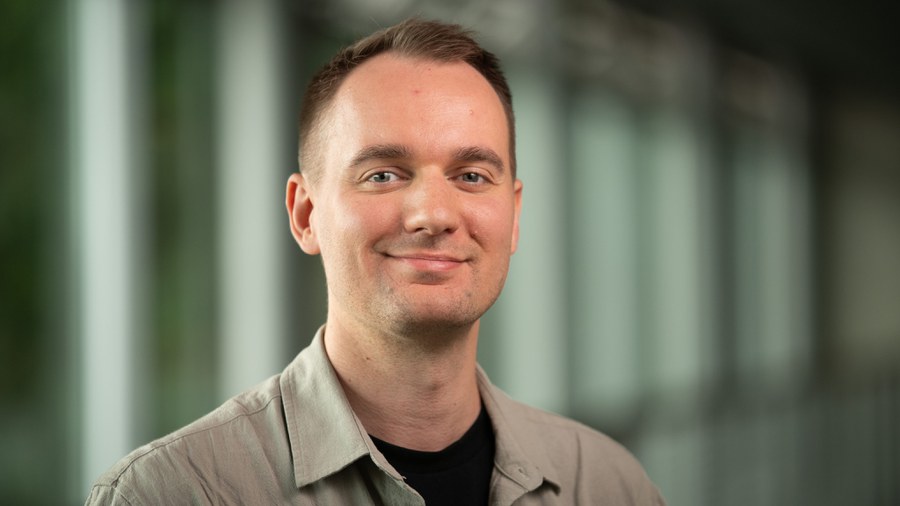
Aron Schulze is a Research Associate at the Chair of Modern and Contemporary History. In his doctoral dissertation, he is researching the transformation of East German universities in the 1990s, using the TU Dresden as a case study. As such, he is an associate doctoral student in the research project “Technical College of Dresden under National Socialism: Transformations of Knowledge and Science in the 20th Century” and a member of the project team “Narrative Transformation”. Aron Schulze studied history, German language and literature, and educational sciences at the University of Leipzig from 2017 to 2023, where he passed the First State Examination for Teacher Training – Secondary Schools.
Your doctoral project is titled “Special Status in the Transformation? The TU Dresden in the 'University Reorganization East' after 1989/90”—how can the TU Dresden’s special status be identified?
First, a certain special status arose from the university’s typology: As a technical university, Dresden’s research and teaching focused on subjects such as mechanical engineering, electrical engineering, and computer science. The STEM disciplines faced fundamentally different conditions in the transformation of the East German higher education system than the humanities and social sciences, as they were considered less politically corrupted at the time. However, as recent research shows, the number of SED members among professors and lecturers was at least as high. Nevertheless, the TU Dresden differed significantly in its profile from the GDR universities in Berlin, Jena, or Leipzig, which had large departments in the humanities and social sciences and were thus more heavily affected by phenomena such as “liquidation” or “elite transfer.”
In Dresden, by contrast, there was a greater East-West mix of staff after 1990. There were also staff transfers from the West to Dresden—especially in the newly established faculties of law, Business Administration and Economics, and the Faculty of Arts, Humanities and Social Science. And this is where another aspect of the TU’s special status comes into play: while other universities were forced to downsize, Dresden was expanded into a comprehensive university. Factors such as its status as the state capital and its proximity to the ministry may have played a role in this, a development viewed critically, in particular, by its competitor in Leipzig. This is corroborated, among other things, by sources from the Saxon Main State Archives. At the same time, I take a critical view of the “special status” thesis, since other locations also claim to have had their own local characteristics in the restructuring of higher education (e.g., Jena).
In addition to examining sources from various archives, you are conducting guided expert interviews for your doctoral project. As part of the “Narrative Transformation” project, starting in September, so-called “storytelling cafés” will be held with people who witnessed the higher education restructuring in Dresden. In both cases—interviews and storytelling cafés—contemporary witnesses share their accounts. To what extent would you say these two approaches differ? What are your expectations for the storytelling cafés?
In the expert interviews, I ask people who held specific roles during the period of political transition about their concrete activities in those positions. I ask specific questions about decision-making processes or events in order to supplement my source research with the knowledge of those involved. Another reason for this approach is that some details do not appear in the minutes and correspondence in the archives but may still be very vivid in the experts’ memories, thereby filling in gaps. Nevertheless, I must cross-reference the statements from the expert interviews with the content of the files and, where necessary, compare and contrast them so as not to rely solely on personal memories, which are subjective and sometimes selective.
The storytelling cafés are designed differently and therefore represent an exciting addition to my research: The focus is primarily on personal stories, experiences, and anecdotes that, while related to the institutional development of the TU, highlight the individual perspectives of the participants more strongly. The participants in the storytelling cafés may not have been directly involved in decision-making processes, but they were often directly affected by them. Although this experiential-historical level is not the focus of my project, I nevertheless hope it will provide new insights into everyday university life during the period of political transition and the personal consequences of the transformation process I am researching.
You have already indicated that the humanities and social sciences were affected by the restructuring differently than the STEM disciplines. For this reason, we are seeking eyewitnesses from various academic departments for the storytelling cafés; furthermore, we aim to take into account the different status groups. The call for participants, “Narrating Transformation!” is directed at both former students and current staff members from administration, management, research, teaching, or the current student services organization. Based on your research to date for your doctoral project: Do you already have an idea of the extent to which the experiences of these groups might differ or, conversely, overlap?
Generational cohorts are a key distinguishing factor in the perception of the East German transformation process, not only at universities but also in society as a whole. Applied to the university context, belonging to a particular status group thus had a significant influence on how the process of upheaval was experienced. Due to a generational barrier within the higher education system of the late GDR, the fall of the Berlin Wall likely generated a sense of new beginnings and euphoria for many students and young researchers, especially in the early days. In contrast, the experiences of employees between the ages of 49 and 59 in the wake of rapid job cuts were far more negative and at times dramatic, as they not only felt that their life’s work had been devalued but also often faced professional and financial uncertainties.
We should take this divide into account at the storytelling cafés. In this regard, it is good and right that as many different perspectives as possible are given a voice—and, by the way, I feel the same way about West German perspectives as well. West Germans, too, have a history of experiences related to the “University Reorganization East”—and not only, as is often claimed, as “colonizers” or “careerists,” but also as uncertain newcomers and eager learners. In that sense, the experiences of East and West may not be as different as one might initially assume.
Thank you for this insight into your research topic!
Anyone interested in becoming part of the research project “Erzähl(t)e Transformation” and sharing the story of TU Dresden’s transformation from their own perspective can register via email or by phone: , +49-351-463-36270. Constanze Wirsing is the main contact person for the storytelling cafés.
“Narrative Transformation” is a collaborative project of the Emerging Field on Societal Change, the Chair of Modern and Contemporary History, the Chair of Sociological Theories and Cultural Sociology, the Office for Academic Heritage, Scientific and Art Collections, the Hannah Arendt Institute for Totalitarianism Studies, and the Institute of History and Folklore.