
Program Structure
The 1-year program of the master's program is divided into 2 semesters that are aligned with each other. The program can be started in the fall/winter semester as well as in the spring/summer semester.
Please find here general information on the organisation of the academic year at TUD in the winter semester and the summer semester (information on lecture times, i.e. on start and end date of the teaching period, start and end of the core exam time, lecture-free periods and public holidays).
Information on program details, schedule, exams and further study content and -material can be accessed by students via learning platform OPAL. You can obtain access details to the current academic year from the course coordinators.
Timeline LL.M. Studies:
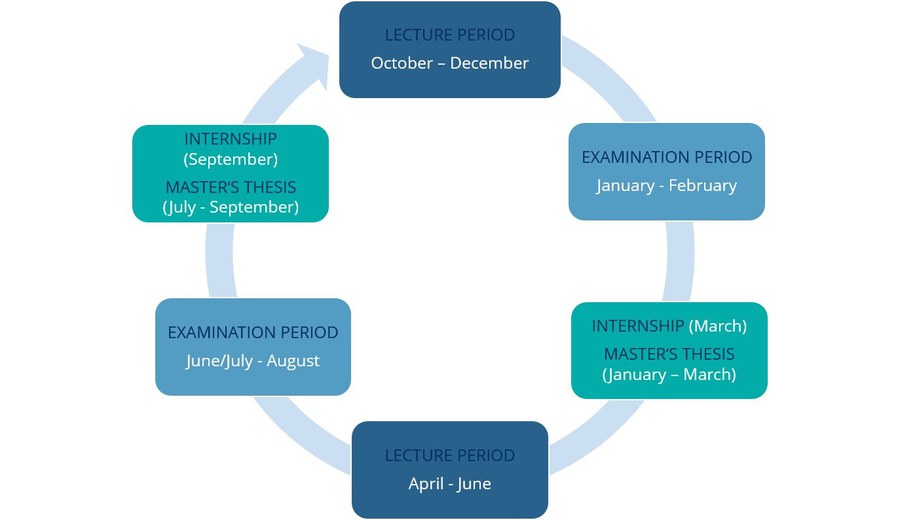
During the IP-LL.M. program, students take various compulsory and elective modules from the from the different areas of European IP law with international references, whereby an individual focus is possible. Four main areas of law - of which patent law and copyright law in the winter semester and data law and trademark and design law in the summer semester respectively determine the timetable - form the basis. Students complete at least three of these four basic elective modules during their studies. In addition, the program offers further elective module options such as lecture series in form of a practitioner’s panel on patent law and copyright or trademark/design law and data law topics as well as various seminars on current IP topics or a negotiation seminar. Students thus have the opportunity to tailor their studies to their own interests and needs. In addition to language courses, an introduction to European law, a mandatory internship of at least four weeks in the first semester, students will attend a specific seminar on writing and plagiarism in the second term. Students will learn about the correct citation styles used for the program’s theses and general tips for writing, finding and identifying the right literature. By the middle of the second semester at the latest, students begin to start with their master's thesis, which they usually submit by the end of September.
Curriculum Study Program
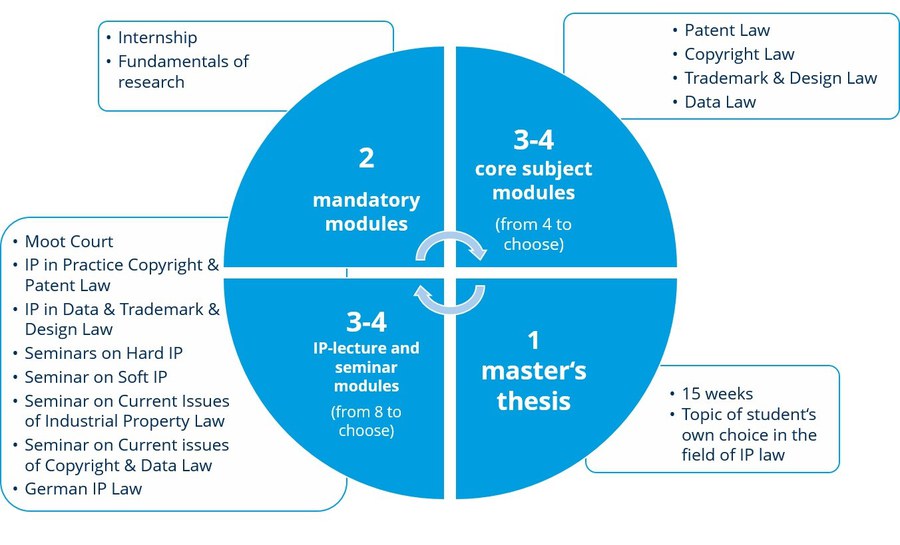
Modules fall/ winter semester
|
Module |
ECTS |
Lectures |
Mandatory/ Elective |
Exam |
|
Patent Law & Allied Rights |
5 |
Lecture Patent Law |
Basic elective modules (1 of 3) |
Written exam |
|
Copyright Law |
5 |
Lecture Copyright Law |
Basic elective modules (1 of 3) |
Written exam |
|
Copyright & Patent Law in Practice |
5 |
(Ring-) Lectures |
further compulsory elective module |
Portfolio |
|
Current Issues in Soft IP |
5 |
Seminar |
further compulsory elective module |
Presentation/ Essay |
|
Current Issues in Hard IP |
5 |
Seminar |
further compulsory elective module |
Presentation/ Essay |
|
IP & Negotiation |
5 |
Seminar |
further compulsory elective module |
Komplexe exam |
|
Internship |
5 |
At least 4 weeks |
Mandatory module |
Portfolio |
|
Fundamentals of Research |
5 |
Lecture |
Mandatory module |
Presentation |
Modules spring/summer semester
|
Modul |
ECTS |
Lehrveranstaltungen |
Pflicht-/Wahlfach |
Prüfung |
|
Trademark and Design Law & Allied Rights |
5 |
Lecture TM & Design Law |
Basic elective modules (1 of 3) |
Written exam |
|
Data Law |
5 |
Lecture Data Law |
Basic elective modules (1 of 3) |
Written exam |
|
Trademark/ Design & Data Law in Practice |
5 |
(Ring-) Lectures |
further compulsory elective module |
Portfolio |
| Industrial Property Law Specialization |
5 |
Seminar |
further compulsory elective module |
Presentation/ Essay |
| Specialization in Copyright & Data Law |
5 |
Seminar |
further compulsory elective module |
Presentation/ Essay |
|
Characterisitics of German IP and Unfair Competition Law |
5 |
Seminar |
further compulsory elective module |
Written exam |
|
Praktikum |
5 |
At least 4 weeks |
Mandatory module |
Portfolio |
|
Fundamentals of Research |
5 |
Lecture |
Mandatory module |
Presentation |
Studies Abroad (winter semester)
During winter (October - January) students have the opportunity to spend a huge part of their studies at one of our partner universities in Exeter, Krakow, London, Prague, Seattle, Strasbourg, Szeged, Tallin or Tokyo. In their application candidates may set priorities for two of the partner universities. More information on the study program in winter semester and regarding partner universities can be found here!
Internship
During the lecture-free period of the first semester, i.e. in the months of February and March or August September, our students complete an internship of at least four weeks. This can be done at public authorities or courts, in companies or law firms worldwide, in Germany or abroad. Further information about the internship can be found here!
Seminar
The seminar is a central form of teaching in the study programme and serves to provide in-depth academic examination of a selected topic area. The aim of a seminar is to prepare students specifically for independent academic work and, in particular, for writing their Master's thesis.
During a seminar, students will acquire important technical and methodological skills, including researching and evaluating academic literature, writing a seminar paper in a structured manner, and critically reflecting on and presenting research results.
The seminar usually consists of three elements: At the beginning, there is an introductory session in which topics, working methods and organisational procedures are explained. Building on this, students work independently on a specific topic and write a seminar paper in accordance with academic standards. The seminar concludes with an oral presentation in which the seminar topic is presented and discussed.
Examples of current and past seminars:
- Tour d'horizon of Data Protection Law: DPIA and landmark decisions by the CJEU
- Current and Future Issues of Trademark and Related Laws
- Architecture & Interior Design in IP
- Creativity and Innovation in IP Law
- Recent Judgements of the CJEU in the field of Copyright Law
- AI Assurance
- Seminar in Patent Law
- Fashion Law
Practical courses: moot court and contract negotiation simulations
Moot courts and out-of-court contract negotiation simulations are practical courses in the study programme that specifically prepare students for legal practice. They enable students to apply theoretical knowledge in realistic case scenarios and acquire key practical professional skills.
The focus is on legal case analysis, structured argumentation, drafting pleadings and contracts, and persuasive oral presentation. In addition, negotiation skills, strategic thinking, teamwork and communication skills are taught.
The courses usually begin with an introduction to the facts of the case, the distribution of roles and the methodological basics. Students then prepare their legal positions in writing. The courses conclude with simulated court hearings in the moot court or out-of-court contract negotiations, which are jointly evaluated and reflected upon.
Master's Thesis
The master's thesis demonstrates the ability to conduct independent scientific research in the field of intellectual property law, competition law, data protection law or media law. The topic of the Master's thesis can be chosen by the student, the issue is made in consultation with the members of the institute and the supervisor. In total, the processing time for the preparation of the thesis is 15 weeks; ideally, the processing should begin in the 2nd semester of the master's program. However, the work should be completed no later than one year after the last semester of study. In order to achieve the most successful result possible, a presentation of the research question is scheduled during the processing period. During this colloquium, the objectives of the research will be defined and discussed. The colloquium offers the opportunity to discuss the legal issues to be investigated with the supervisor, fellow students and members of the institute. We support the independent publication of particularly good master theses in German or international journals.
HOW YOU CAN BENEFIT:
Education
- Highly qualified education focusing on European and International Patent and Trademark Law, Data Law as well as Copyright Law,
- Presentations and Colloquiums
- Negotiation Exercise/ Moot Court
- Weekly lectures/talks by highly distinguished practitioners
- Access to legal databases and a well stocked library
Personal Benefits
TU Dresden is proud of its international character. Get in contact with different languages and cultures. Have the chance to meet fellow students from around the world over one exciting year.
Networking
Meet distinguished lawyers, patent judges and other experts during the practitioners’ forum and during our study trip. Since June 2016, the Institute of International Law, Intellectual Property and Technology Law (IRGET) [Link zur Institutsseite] has been a member of the Pan-European Seal Professional Traineeship Program. Graduates of the Master's program "International Studies in Intellectual Property Law" have the opportunity to complete a one-year traineeship program at the European Union Intellectual Property Office (EUIPO) in Alicante and the European Patent Office (EPO) in Munich, The Hague or Luxembourg.
For more information on the Pan-European Seal Program and other career opportunities, please click here!