
Curriculum for Crisis and Community
Shaping school together in exceptional times
Table of contents
- What is the disaster curriculum?
- Where can I download it?
- Who developed the Disaster Curriculum?
- From which (professional) perspective was the curriculum developed?
- A Curriculum for Crisis and Community - isn't that far too alarmist?
- Doesn't that already exist?
- Isn't it far too late to offer material once the catastrophe has struck?
At a time when crises - from pandemics and extreme weather to war and disinformation - are increasingly influencing everyday school life, a central question arises: How can schools maintain their action-taking capacity in such exceptional situations?
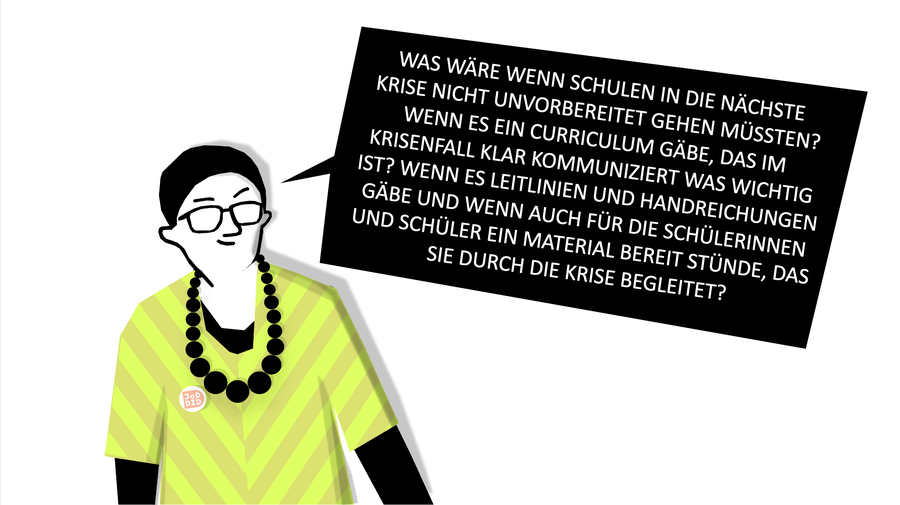
What is the disaster curriculum?
With the "Curriculum for Crisis and Community", we have developed an alternative educational program that can be activated in the event of an acute crisis - flexible, solidary and community-strengthening. This is not about emergency plans in the traditional sense, but about an educational framework that provides orientation, strengthens community and enables learning in difficult times.
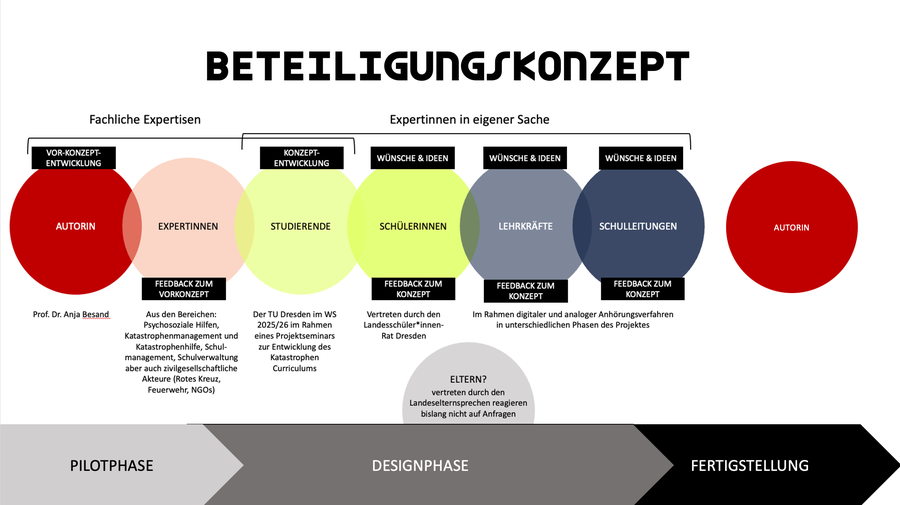
Central to the project is its participatory development: the disaster curriculum was not designed at a desk, but developed together with students, the state student council, parents, head teachers and teaching staff. Experiences from school, university and educational administration were continuously incorporated into the concept. The aim was to make real perspectives, needs and conflict situations visible and to take them seriously - especially those of the pupils.
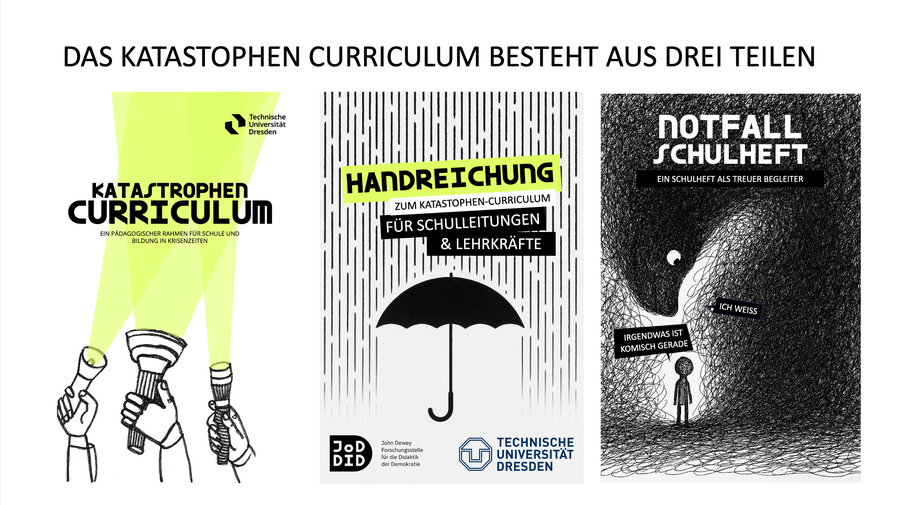
The Curriculum for Crisis and Community consists of three parts. The actual curriculum part, a pedagogical handout and an emergency school booklet (Notfallschulheft) aimed directly at pupils.
Where can I download it?
You can download all three parts of the disaster curriculum free of charge via the download link on this page - as soon as they have been editorially finalized. This is expected to be the case at the end of March 2026. Until then, we have prepared some work samples for you so that you can get a first impression. We are planing to publish an englisch Version shortly after the german version is avaliable.
The disaster curriculum (the table of contents of the preliminary version)
The pedagogical handout (first 40 pages of the preliminary version)
Emergency school booklet preliminary version
Who developed the Disaster Curriculum?
The material was developed at TU Dresden under the direction of Prof. Dr. Anja Besand in a participatory research project. The development process involved a group of students, the Saxony State Student Council, a group of head teachers from primary and secondary schools, as well as head teachers from grammar schools and vocational schools, who were involved in hearings.
From which (professional) perspective was the curriculum developed?
We developed the curriculum at the Chair for the Didactics of Civic Education and this perspective is also the dominant one in the project. Why did we do this? Firstly, we have observed that schools in crisis situations like to concentrate on core subjects or examination subjects. This often seems obvious in the context of emergency operations. As people who work in the field of democratic/civic education, this narrow focus hurts us. We are convinced that democratic/civic education is one of the most important areas of education, especially in times of crisis, because it offers help to understand conflict situations and promote to act in solidarity.
A Curriculum for Crisis and Community - isn't that far too alarmist?
We are asked this question time and again. In view of the current state of the world, we honestly don't believe it. Or let's put it this way: if we've done all this work for nothing and our material will never be needed - then of course we'll be happy. It's not about being right or spreading panic, but on the contrary, being able to act in a well informed and prepared manner when crisis hit.
Doesn't that already exist?
According to our research, there are indeed some emergency plans (in German schools) that have been developed by the ministries of education or state school authorities. They are developed for cases of emergencies like school shootings, sudden deaths, e.g. during school trips and other things like this. They contain organizational information such as reporting chains and advice on psychosocial support. We have not yet been able to discover any material that schools can use to prepare for complex social or political crises such as war, pandemic, flodding or civil unrest. However, it is also possible that we have overlooked something - such documents are mostly not usually public.
Isn't it far too late to offer material once the catastrophe has struck?
The honest answer is: Of course it would be great if schools start to consider how they would like to understand their role and task in such an event before a social crisis event. But in regard of the many challenges schools are facing and the still unresolved problem of the shortage of teachers in schools, we do not believe that this is to be expected across the board. What we do firmly believe in, however, is that schools are willing to act responsibly and will look for available concepts at lightning speed in situations of crisis. This is precisely what motivated us at TU Dresden to think about these issues in advance - together with students and to invest in the stability of our society and its cohesion right now.