
Democratic education as a profession between attitude and action
A JoDDiD study on the professional understanding and professionalization needs of extracurricular political educators
David Jugel and Stefan Breuer
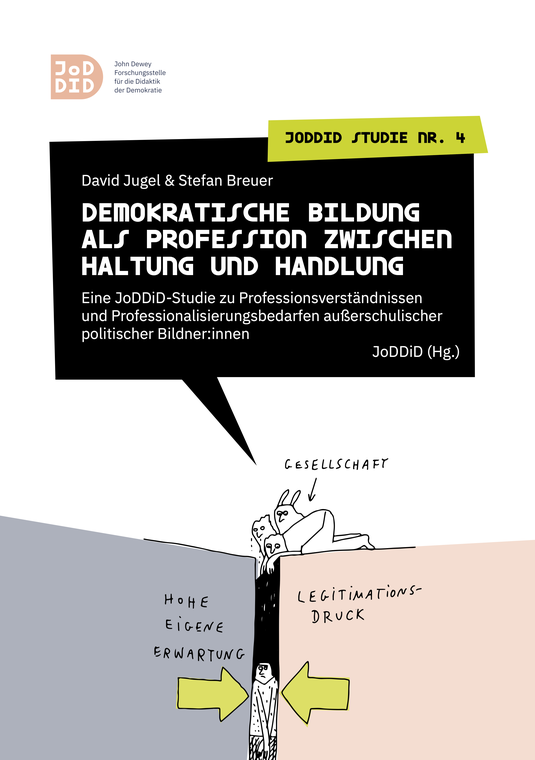
Download here: The study can be downloaded here as a PDF.
Extracurricular civic education opens up learning and experience spaces beyond curricular requirements - and at the same time is under high pressure of expectation and legitimation: educators are expected to strengthen democratic values, moderate conflicts, promote participation and deal with polarization and anti-democratic attitudes. Against this background, the study asks how political educators themselves interpret their professionalism, role and requirements - and what professionalization needs result from this.
Results
In summary, the authors David Jugel and Stefan Breuer show in the study that professionalism in extracurricular civic education is understood by the interviewees primarily as a reflective, continuous and strongly practice-oriented process. Central points of reference are a normative democratic attitude, self-reflection, broad context-sensitive interpretative knowledge and situational action-taking capacity. Formal qualifications are often relativized compared to experience-based learning and collegial exchange. At the same time, individual professionalism repeatedly comes up against structural limits.
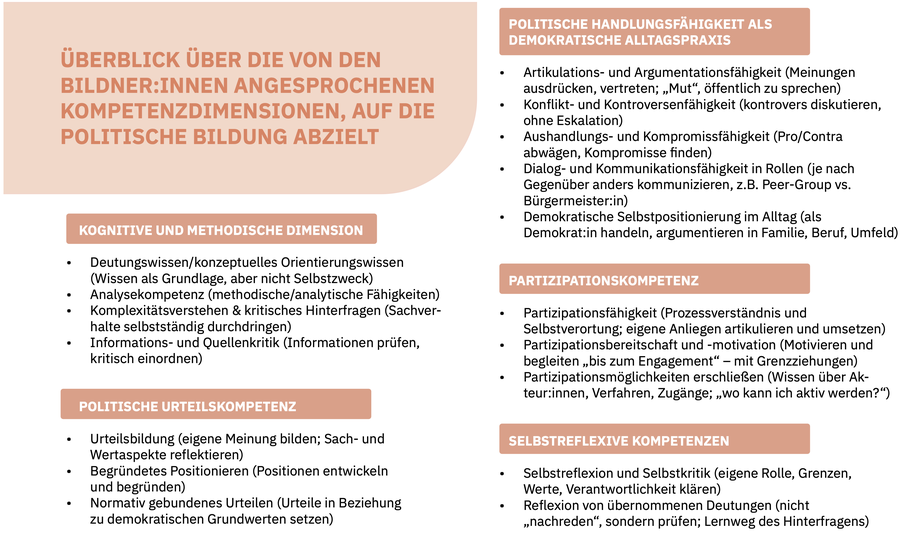
The findings bundle professionalization as a field task in several, closely interlinked fields of professionalization:
- Reflective self-positioning & self-protection (motivation, self-efficacy, demarcation, dealing with excessive demands)
- Normative foundations and role clarification (attitude, controversy, positioning, professional distance)
- Systematize professional knowledge (technical, pedagogical-psychological, didactic; common orientation framework)
- Didactic profile development (learning objects, quality criteria, competence goals - balance of openness and political contour)
- Target group work & outreach (scope, approaches, dealing with heterogeneous/conflictual groups, relationship practice)
- Organizational knowledge (funding logic, administration, public relations, quality and project management, networking)
- Establishment of reliable training and further education structures as an overarching prerequisite for sustainable professionalization.
Methodology
The study is based on 16 guided interviews with 20 stakeholders (28.5 hours) from all over Saxony as well as a participatory workshop discussion with practitioners (focus group elements). The data was evaluated using qualitative content analysis in an iterative process.
What needs to be done: Recommendations for action
What needs to be done for political educators
- Strengthen collegial exchange: Systematically use the "learning on the job" mode actively through peer-to-peer formats, job shadowing and moderated collegial reflection (especially in protected spaces). Multidisciplinary team diversity should be actively understood as a resource for knowledge transfer.
- Establish reflective self-positioning and self-protection: In the face of high normative demands and densification, work in a targeted manner on self-regulation, the ability to set boundaries and the preservation of resources (supervision/coaching, collegial relief spaces, realistic self-efficacy, limits of responsibility) in order to prevent self-exploitation.
- Advance clarification of terms and profile development: Address the range between civic education, democracy education and "relabelled" formats visible in the study as a professional clarification issue (workable minimum definitions, learning objects, competencies) - in order to counteract depoliticization tendencies and at the same time design low-threshold access in a well-founded manner.
- Professionalize the handling of controversies and anti-democratic positions: Understanding normative boundaries, controversy and dialogical openness as a challenging balance. Common escalation and termination criteria, discussion and de-escalation routines, protection concepts and a clear distinction between irritable concepts and anti-democratic attitudes are helpful.
- Think strategically about target group work in the long term: Focusing on the "silent middle" or "those who have not yet drifted away" requires time, trust and a focus on social spaces. Professionalism is less about short-term event logic and more about a planned combination of outreach, cooperation in everyday milieus and stable relationship chains.
- Establish systematic reflection on mistakes: Establish an explicit error culture in which failures and challenges are not just accepted, but used as key learning opportunities for the development of experiential knowledge and resilience.
- Use logic, documentation and evaluation pragmatically: Understand documentation and evaluation as part of professional practice - not just for support reports, but as a learning loop (planning-implementation-reflection-revision). Lean, formative procedures and shared quality criteria make sense.
- Recognize organizational knowledge as a professional dimension: Recognize organizational knowledge (project management, administration, public relations) not as a mere administrative burden, but as an integral part of professional competence and a prerequisite for social visibility and eligibility for funding, and sharpen one's own skills accordingly.
What funding providers and political stakeholders need to do
- Establish multi-year, reliable structures instead of short-term logic: Where possible, create longer-term funding lines, institutional funding and transitional funding. Continuity is a prerequisite for target group loyalty, building trust and sustainable impact.
- De-bureaucratize funding structures: Simplify and harmonize the processes for applications, billing and reporting. This would relieve educators of time-consuming administrative work and give them more time for their core pedagogical work and individual training. Freedom can also be created through random checks instead of a comprehensive and mandatory reporting system.
- Promote organizational knowledge appropriately: Reflect the high complexity of the organizational and administrative workload (application process, public relations, management) in the funding guidelines and fund it appropriately to avoid a shift in professional self-image towards pure "education management".
- Provide resources for further training and networking: Explicitly provide financial and time capacities for individual and collective professionalization (further training, networking, research) in the projects and actively facilitate their use.
- Ensure the quality of training courses: Check and evaluate the funded further training courses for their practical relevance and scientific basis in order to counteract the perceived redundancy and lack of quality.
- Institutionalize training and further education offers: Systematic qualification paths are needed. This can be implemented by adult education centers or universities of applied sciences, but also at universities. However, such structures must be politically initiated and financed.
- Manage expectations realistically: Do not address civic education as a "fire department" for every social crisis. Funding goals should be feasible, appropriate to the target group and logically plausible; this also includes the recognition of process goals (relationship work, conflict skills) and the acceptance of limited reach.
- Ensure independence and the ability to take criticism: Design dependency relationships in such a way that professional criticism of funding logics is possible without existential risks. Transparent criteria, complaint channels and dialogical funding practices strengthen professional self-confidence in the field.
- Provide protection and support in the event of attacks: Clear political backing, security and legal support as well as publicly visible recognition of work are needed, especially in the event of attacks by anti-democratic stakeholders - as a resource for self-regulation and as a signal of social appreciation.
- Promote appropriate employment conditions : Where political stakeholders have creative power, fair remuneration, predictable working hours, qualification periods and, in perspective, permanent positions for permanent tasks should be supported so that professionalism is not permanently built on individual self-exploitation.
What needs to be done for research and science
- Overcome theory-practice barriers: In future, research should increasingly be based on participatory and co-creative designs that involve practitioners in the research process from the outset. The implicit experiential knowledge of educators must be systematically collected and recognized as an equal source of knowledge.
- Establish transferable knowledge processing and innovative science communication: Consistently translate results into usable formats (policy papers, handouts, method kits, podcasts, reflection workshops, transfer-oriented conferences) and test them iteratively together with practice partners.
- Develop an evidence-based professional curriculum: Advance the development of systematic qualification paths (degree programs, certificate courses) for extracurricular civic education that integrate multidisciplinary requirements (political science, social work, pedagogy, didactics, management) and address the lack of formal training.
- Establish reflective competence as a subject of research: Strengthen the reflective competence of educators (the ability to critically reflect on their own actions) as an independent subject of research and as a central component of professional education in continuing education programs.
- Expand empirical professionalization research: In addition to interviews, observational studies, case-analytical designs, but also quantitative organizational studies and longitudinal research are useful in order to better understand the connections between framework conditions, professionalism, stress and quality.
- Develop impact and quality research in a field-sensitive manner: Instead of abbreviated output logics, impact models of political education (including process and relationship components) should be further developed and tested in realistic evaluation designs.
Download: The study can be downloaded here as a PDF.
Author:inside
 © Tom Luckner
Research Associate
NameDavid Jugel
John-Dewey-Forschungsstelle für die Didaktik der Demokratie
Send encrypted email via the SecureMail portal (for TUD external users only).
Büro:
ABS Haus 116, Room 015 August-Bebel-Straße 30
01219 Dresden
None
Office hours:
nach Vereinbarung
 © Tom Luckner
Wissenschaftlicher Mitarbeiter
NameStefan Breuer Ma.Ed.
John-Dewey-Forschungsstelle für die Didaktik der Demokratie
Send encrypted email via the SecureMail portal (for TUD external users only).