
Avoiding typical mistakes or: the pitfalls of political education
For civic education to be successful, those responsible for education cannot simply withdraw into moderating existing opinions and attitudes. Rather, their task is not to avoid controversy (Henkenborg et al. 2008), to increase complexity (Sander 2013), to irritate entrenched ways of thinking and to stage a change of perspective (Grammes 1998), to support underrepresented perspectives (Schelle 1995 and 2003), to introduce differences (Achour 2013), to endure conflicts (Besand 2019) and to maintain civic education as a space of opportunity in which political and social issues can also be negotiated controversially (Gessner 2014). Key issues or qualifications (Massing/Weißeno 1995; Klafki 2005; Petrik 2013; Negt 2000), to avoid indifferences when dealing with extremist ideas (Behrens 2014), to offer a space for friction (Petrik 2013), to preserve hope (Szukala 2013; Besand 2019c) and to convey experiences of self-efficacy and key qualifications (Negt 2000, Eis/Salomon 2014).
That is easy - you might think.
However, in the search for empirically based challenges that arise specifically in the context of civic education, one also encounters the following context that can certainly guide action: Because even and especially in civic education, there are typical "traps" that professionals should avoid with regard to successful civic education in school situations (see Autorengruppe Fachdidaktik 2015, p. 92; as well as Sander 2013, p. 68 ff. and Henkenborg 2009, p. 109).
These pitfalls can be briefly described as follows (in german):
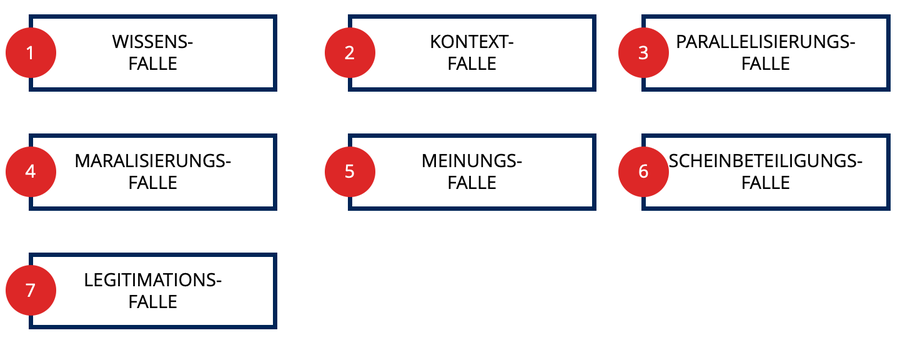
Knowledge trap:
If civic education primarily accumulates individual pieces of information without embedding them in a context, there is a risk of depoliticization (cf. Henkenborg 2008, pp. 66-77).
Context trap:
The political, economic or social decision-making issue disappears behind a flood of individual information (cf. Grammes 1998, pp. 513-539).
Parallelization trap:
Analogies between private life situations and structures in the political system are often used to explain complex social issues. "The state is a big family, the class council is our parliament". However, the limits of these analogies are often not revealed.
Moralization trap:
By making a hasty distinction between good and evil, certain contexts and interpretations are marked as desirable, objective and true, thus immunizing them against criticism and sceptical questions. For examples, see Grammes (1998, pp. 17-55).
Opinion trap:
All opinions and attitudes expressed in the educational situation are
are recognized as equally valid and justified by the addressees' right to freedom of expression. This can lead to a relativism without criteria that leaves young people alone with their orientation needs. Examples in Behrens (2014, p. 70 ff.).
Pseudo-participation trap:
The holding of elections and votes alone is no guarantee of genuine participation by participants. There must also be something to decide. In this sense, the selection of the band for the summer party at the youth center would not be proof of a democratic culture at the facility (see Besand 2019).
Legitimization trap:
Particularly in times when liberal democracy is facing challenges, political education often quickly finds itself on the defensive and becomes bogged down in the legitimization of existing structures and procedures. However, legitimization is not the task of political education. It must therefore never remain stuck in the status quo, but must always be open to facing new social challenges (value-based) and searching for new solutions.
By reversing the traps presented here and summarizing them, it becomes clear that civic education is good when it seriously engages with its addressees and searches for answers to pressing questions together in risky situations. It is aimed at the future competent and self-confident co-determination of its addressees and, for this reason, must already actively redeem this in the educational process. In this context, taking participants seriously as political subjects does not mean accepting their political judgments, attitudes and opinions indiscriminately. Rather, taking them seriously means taking a serious, critical look at these opinions and looking for ways and means in which democratic understanding and recognition is and remains possible.
ADAPTED TEXT EXCERPT FROM:
Behrens, Rico/ Besand, Anja/ Breuer, Stefan (2021): Political education in reactionary times. Plea for a steadfast school, Frankfurt/ M.: Wochenschau, pp. 55-57.
Literature:
Autorengruppe Fachdidaktik (2016): What is good political education, Schwalbach/Ts.
Achour, Sabine (2013): Citizens of the Muslim faith. Political education in the context of migration, integration and Islam, Schwalbach/Ts.: Wochenschau.
Behrens, Rico (2014): As long as they behave decently in the classroom. Politics teachers and how they deal with right-wing extremist youth culture at school, Schwalbach/Ts.: Wochenschau.
Besand, Anja (2019): What is good political education at school?, in: Bildung und Erziehung 3/2019, pp. 262-276.
Besand, Anja (2019): Hoffnung und ihre Losigkeit - Politische Bildung im Zeitalter der Illusionskrise, in: This/Overwien, Bernd/Zorn, Peter (eds.): Politische Bildung mit Gefühl, Bonn: Bundeszentrale für politische Bildung, pp. 173-187.
Henkenborg, Peter/Krieger, Anett/Pinseler, Jan/Behrens, Rico (2008): Political education in East Germany. Demokratie-Lernen zwischen Anspruch und Wirklichkeit, Wiesbaden: VS Verlag für Sozialwissenschaften.
Eis, Andreas/ Salomon, David (2014): Partizipationskulturen und gesellschaftliche Lernprozesse in der "Postdemokratie", in: Lange, Dirk/ Öftering, Tonio (eds.): Politische Bildung als lebenslanges Lernen, Schwalbach/Ts.: Wochenschau, pp. 44-54.
Grammes, Tilman (1998): Communicative subject didactics. Politics - History - Law - Economics, Opladen: Leske + Budrich.
Gessner, Susann (2014): Political education as a space of possibility. Perspectives on school-based political education for young people with a migration background, Schwalbach/Ts.: Wochenschau.
Klafki, Wolfgang (2005): Allgemeinbildung in der Grundschule als Bildungsauftrag des Sach- unterrichts, available online here [05.09.2019].
Massing, Peter/ Weißeno, Georg (1995): Politics as the core of civic education, Opladen: Leske + Budrich.
Negt, Oskar (2000): Umbrüche und Veränderungen, lecture at the DGB-Bildungswerk NRW (manuscript reproduced).
Petrik, Andreas (2013): On the difficulties of becoming a political person. Konzept und Praxis einer genetischen Politikdidaktik, 2nd, erw. u. aktual. Studien zur Bildungsgangforschung, Opladen: Budrich.
Sander, Wolfgang (2013): Politik entdecken - Freiheit leben: didaktische Grundlagen politischer Bildung, Schwalbach/Ts.: Wochenschau.
Schelle, Carla (1995): Pupils' discourses on society: "If you were a foreigner". Investigation into the reorientation of school political education processes, Schwalbach/Ts.: Wochenschau.
Schelle, Carla (2003): Politisch-historischer Unterricht hermeneutisch rekonstruiert: von den Ansprüchen Jugendlicher, sich selbst und die Welt zu verstehen, Bad Heilbrunn/Obb.: Klinkhardt.
Szukala, Andrea (2013): Der Zusammenhang zwischen epistemologischen Überzeugungen und Lehr-Lernüberzeugungen in der sozialwissenschaftlichen Domäne, in: Besand, Anja (ed.): Schülerforschung und Lehrerforschung in der politischen Bildung, Schwalbach/Ts.: Wochenschau, pp. 33-54.