
The Week of the Italian Language in the World
Italian Language Week in the World takes place every year during the third week of October. It is organized by the diplomatic and consular network and the Italian Cultural Institutes in collaboration with our key partners in the field of language promotion (MiC, MIM, MUR, CePeLL, the Government of the Swiss Confederation, the Accademia della Crusca, the CGIE, the Comunità Radiotelevisiva Italofona, the Istituto dell’Enciclopedia Italiana Treccani, RAI Italia, and the Società Dante Alighieri), and has evolved over time into the world’s most significant event dedicated to our language. Since its inception in 2001, this event has been held annually under the patronage of the President of the Republic.
Each week is dedicated to a different theme, which serves as the central thread for a rich program of lectures, exhibitions, and meetings.

The 26th Week of the Italian Language in the World has the theme “Lingua geniale: ideare, progettare, creare con l’italiano.” This year’s edition celebrates the Italian language’s ability to foster creativity, innovation, and knowledge across a wide range of fields—from technology, science, and engineering to design, fashion, and gastronomy, as well as literature and art. The initiative aims to highlight the connection between culture and economic growth and to convey a dynamic, innovative, and forward-looking image of Italy.
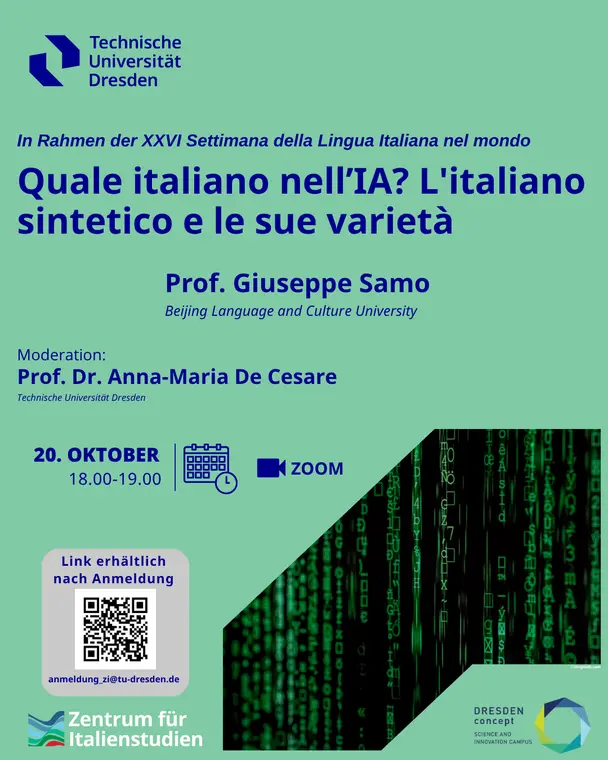
On the occasion of Settimana della Lingua Italiana nel Mondo , the Center for Italian Studies organized a conference with Prof. Samo ( Beijing Language and Culture University) on the topic «Quale italiano nell’IA? L’italiano sintetico e le sue varietà».
Abstract: The increasing prevalence of largelanguage models(LLMs) raises new questions about the relationship between language and artificial intelligence. The issue is not only whether these models can understand Italian and generate texts in Italian, but also what variety of Italian is actually represented in them and to what extent the various linguistic varieties are taken into account. This question is particularly significant in the case of predominantly multilingual models that have been trained on data of varying volumes, origins, and types.
The full recording of the conference is available on our YouTube channel: https://www.youtube.com/watch?v=tvDIK5clS3s.
Podcast “L’italiano oltre i confini: la presenza dell’italiano nella Firenze sull’Elba”
On the occasion of the 25th Settimana della Lingua Italiana nel Mondo, dedicated to the theme “Italofonia: “lingua oltre i confini,” Michela Gargiulo and Tom Weidensdorfer from the Faculty of Linguistics, Literature and Cultural Studies at TU Dresden provide insight into the presence and visibility of Italian in the urban space of Dresden.
The corpus collected and analyzed in the podcast can be viewed via the following link: https://zenodo.org/records/15830728.
In Bearbeitung
The podcast for the 25th Week of the Italian Language in the World is now also available on YouTube!
Listen now, subscribe, and discover the diversity of the Italian language: https://youtu.be/DCgVAh_QmJk
The 23rd Week of the Italian Language in the World is themed “L’italiano e la sostenibilità.” The goal is to use the Italian language to promote a culture of sustainability worldwide and to showcase the image of a country that plays a pioneering role in environmental issues.
To mark the Week of the Italian Language in the World , the Center for Italian Studies produced two podcasts on the topic "Riflessioni attorno alla tutela e documentazione linguistica".
The first podcast, curated by Prof. Anna-Maria De Cesare, features an interview with two colleagues from the University of Palermo, both of whom work at the Center for Sicilian Philological and Linguistic Studies. In the first part of the podcast, Prof. Luisa Amenta presents a talk titled “L’Atlante Linguistico della Sicilia: moduli, approcci, prospettive.” In the second part, Prof. Marina Castiglione discusses about "La documentazione dei toponimi orali (DATOS), tra conoscenza e salvaguardia".
In Bearbeitung.
The second podcast, moderated by Dr. Stefan Koch ( TU Dresden), is titled „Italienische Dialekte als Beitrag zur Nachhaltigkeit“.
In Bearbeitung.