
Nov 17, 2026
New Publication in the Journal “Advanced Materials”
Publication Advanced Materials
A research team at the TUD Dresden University of Technology has made new discoveries in the field of nanoelectronics and has now published its findings in the prestigious journal *Advanced Materials*.
Area-switching memristors (resistors that can assume different values in a controlled manner) are extremely attractive for analog computing and analog model weights, particularly for innovative neuromorphic networks and AI applications —but parasitic charge storage typically leads to drift and unreliability, as well as the occurrence of undesirable hysteresis effects. But how thin must an oxide be for memristors to finally switch the way we need them to for analog in-memory computing? The answer: about 5 nanometers.
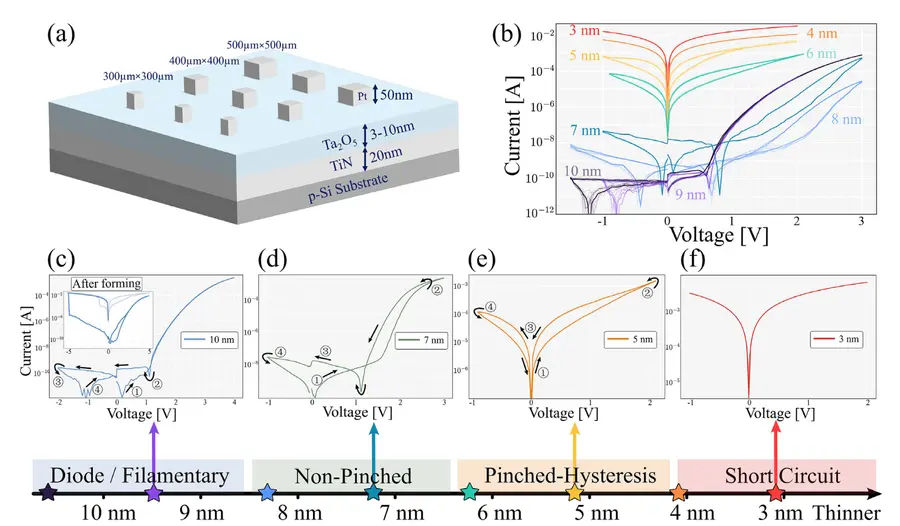
In a new study, researchers from the Chair of Nanoelectronics at TU Dresden demonstrate how a simple design rule—scaling the thickness—can achieve nearly ideal area-like switching. They fabricated TiN/Ta₂O₅/Pt memristors with oxide thicknesses ranging from 3 to 10 nm and investigated four different transport regimes—from nearly short-circuit-like behavior to filamentary switching. Through precise electrical characterization, the researchers investigated the switching kinetics and macroscopic behavior of the device and analyzed the underlying transport mechanisms. At a thickness of 5–6 nm, unwanted shifts in the measured values are prevented, while controlled analog switching between the different resistance values is maintained. This results in a nearly polarity-symmetric current-voltage curve and defined readout behavior, clear area scaling, and continuous, nearly linear conductivity modulation. A physics-based compact model of the 5-nm device was developed and published as Verilog-A code. These results underscore that ultra-thin scaling is not merely a step toward miniaturization—it is a regime-defining design rule for robust multistate memristors.
The research was conducted as part of the NeuroMCross research project (DFG Priority Program 2262 MemrisTec) as well as within the SFB/TRR 404 TRR Active-3D and the REC2 Cluster of Excellence.
Autoren: Cuo Wu / Junjie Zhao / Richard Schroedter / Jason Vincent / Hampus Hoffman / Leif Riemenschneider / Abdallh Herbawe / Hao Shen / Ronald Tetzlaff / Stefan Slesazeck / Gianaurelio Cuniberti / Thomas Mikolajick / Benjamin Max
Publication available at: