
Research
Overview of All Current Projects
DFG Approves Joint Research Project on Second-Generation Quantum Technology at TU Dresden and TU Darmstadt

Quantum technology revolutionizes biomedical diagnostics through novel entangled holography
For the first time, the German Research Foundation (DFG) is funding a groundbreaking project on the use of entangled photons for biomedical 3D imaging and holography with a total budget of approximately 800,000 euros. The joint project “3D Quantum Imaging with Non-Detected Light and Wavefront Control,” which is being carried out in close cooperation between TU Dresden and TU Darmstadt, marks a significant step in the application of second-generation quantum technology. The project is led by Prof. Markus Graefe (TU Darmstadt) as well as Prof. Juergen Czarske and Dr. Lars Büttner from the BIOLAS Competence Center (TU Dresden). The project will begin on January 1, 2025, and run for three years.
The project focuses on the development and application of quantum imaging techniques based on spatially correlated photons. This makes it possible to spectrally separate the light sources of the illuminating and detected light, which represents a paradigm shift in biomedical diagnostics. In particular, new methods for examining cancerous tissue will be developed that enable marker-free, chemically selective, and gentle 3D imaging, thereby offering a promising alternative to traditional fluorescence labeling. By matching the illumination light to the absorption lines of certain biomolecules in the infrared spectral range, a natural contrast is created that makes the molecular structure of tissues and cells more visible, while correlated “partner light” in the visible spectral range is detected by a camera.
The physical basis for this research stems from the work of Nobel Prize winner Prof. Anton Zeilinger, among others. Researchers at TU Dresden and TU Darmstadt are pursuing the vision of using entangled photons and the principle of “spooky action at a distance” to transfer image information from the illuminating light (infrared) to the detected light (visible). The envisioned 3D image reconstruction is also a novelty. These innovative approaches could lead to significant progress in cancer diagnostics and, at the same time, sustainably expand the fundamentals of second-generation quantum technology.
The project opens up new possibilities for enhancing established imaging methods in the life sciences with entangled photons and enabling a gentler yet more precise diagnosis of cancer.
Contact:
Prof. Jürgen Czarske
TU Dresden
Chair of Measurement and Sensor System Technology
Phone: +49 (351) 463-34803
Email: juergen.czarske@tu-dresden.de
SMART FIBER COMMUNICATION WITH A PARADIGM SHIFT IN SECURITY USING DEEP LEARNING AND DIGITAL HOLOGRAPHY
Juergen Czarske, Qian Zhang, Dennis Pohle
In the era of Big Data, an increasing amount of sensitive data is being transmitted over the Internet. To meet the growing demand for data transmission and, in particular, to ensure data security, improving transmission capacity and guaranteeing data security have become central issues in the field of communications. Quantum Key Distribution (QKD) is a quantum communication protocol developed to distribute secure public keys among remote parties; it is a technology that can effectively address communication security challenges. The paradigm shift involves leveraging the physical layer for data security rather than relying on electronic coding (RSA). Measurement technology plays a key role, as it exploits the scattering of light in multimode fibers to generate a physical key for the legitimate recipient. The more accurate the measurement, the higher the data security of multimode fibers. At the Czarske Lab/Chair MST at TU Dresden, we are working on these advancements using innovative approaches in digital holography and deep learning.
Single-mode fibers (SMF) are typically used as the medium for classical communication. Through technologies such as time-division multiplexing, wavelength-division multiplexing, and polarization multiplexing, SMF has approached its physical transmission limits. Compared to SMF networks, networks using space-division multiplexing (SDM) or mode-division multiplexing could be several orders of magnitude more efficient. Multimode fibers (MMF) are expected to play an important role in future data networks; however, mode conversion remains a significant hurdle.
The Chair MST/Czarske Lab is dedicated to classical and quantum communications using MMF based on smart laser metrology. We have demonstrated the feasibility of enhancing information security using physical-layer security in MMF, which can be applied in high-capacity SDM networks of the future. We are exploring the deployment of MMF in QKD systems by leveraging various technologies—such as wavefront shaping, holography, and artificial intelligence—to improve the key transmission rate and establish a MIMO (Multiple Input Multiple Output) key distribution system.
The team members have won several awards, including: Juergen Czarske (2022 SPIE Chandra S. Vikram Award, San Diego, U.S.; inaugural 2020 IEEE Laser Instrumentation Award), Stefan Rothe (2023 PhD Prize from the Gisela and Erwin Sick Foundation, 3,000 euros), Qian Zhang (2021 Prize for the Best Master’s Thesis, Gisela and Erwin Sick Foundation, Freiburg), Dennis Pohle (2022 Prize for Applied Optics, DGaO—The German Branch of the European Optical Society, Pforzheim), Anna-Lena Geppert (2022 Theodore Maiman Scholarship for Best Bachelor’s Thesis, WLT—Scientific Society for Laser Technique, 2,000 euros), David Krause (2023 Master’s Thesis Prize), etc.
- Several positions are currently open.
Please apply for paid Bachelor’s, Master’s, Ph.D., and postdoctoral positions. Send your application via email
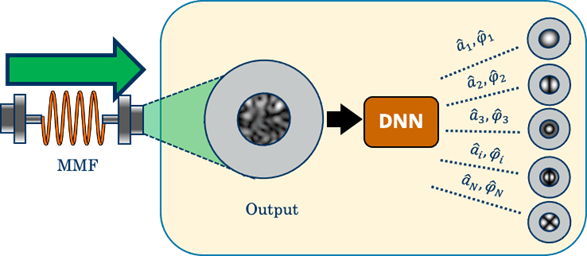
Mode Decomposition of MIMO Fiber Systems Using Deep Neural Networks (DNN)
Source: Qian Zhang, …, Juergen Czarske; Learning the matrix of few-mode fibers for high-fidelity spatial mode transmission. APL Photonics, June 1, 2022; 7 (6): 066104. https://doi.org/10.1063/5.0088605
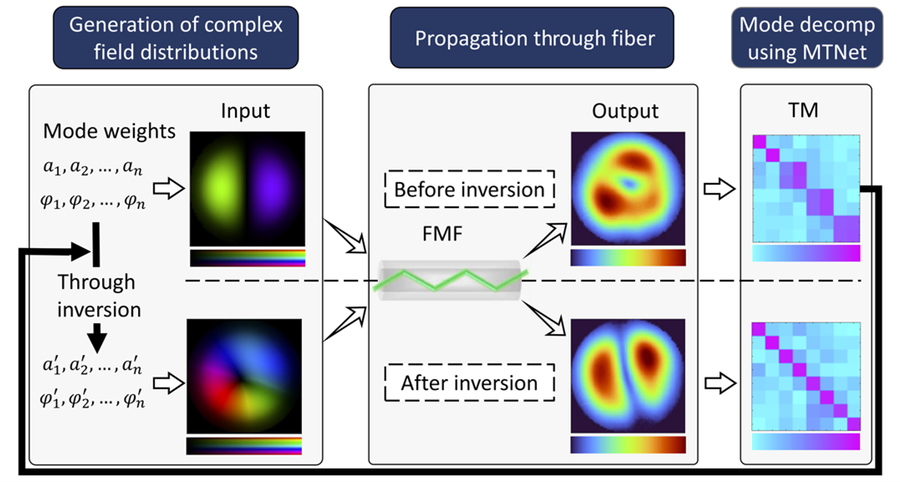
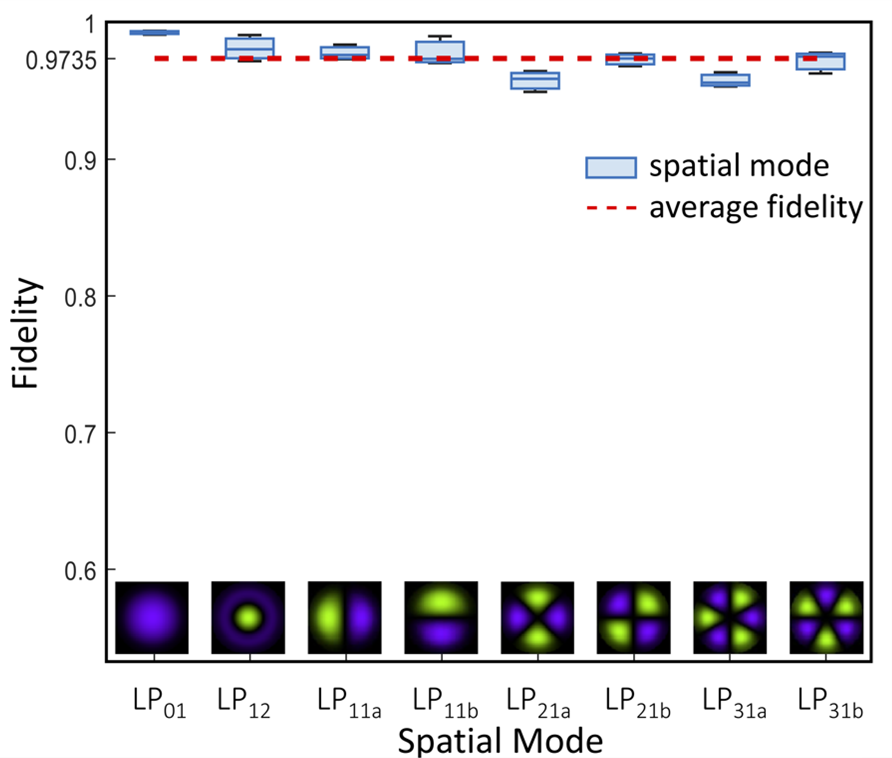
Source: Deep learning-based space division multiplexing in multimode fibers (MIMO)
Qian Zhang, …, Jürgen Czarske; Learning the matrix of few-mode fibers for high-fidelity spatial mode transmission. APL Photonics, June 1, 2022; 7 (6): 066104. https://doi.org/10.1063/5.0088605
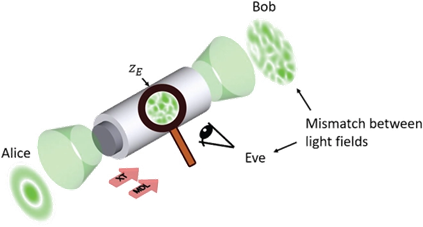
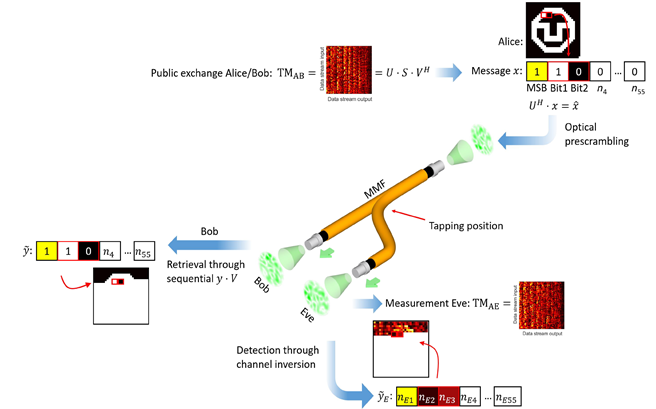
Physical Layer Security in MIMO Fibers toward Post-Quantum Crypto
Source: Securing Data in Multimode Fibers by Exploiting Mode-Dependent Light Propagation Effects
S. Rothe, …, Eduard Jorswieck, Jürgen W. Czarske, Research 6, 2023
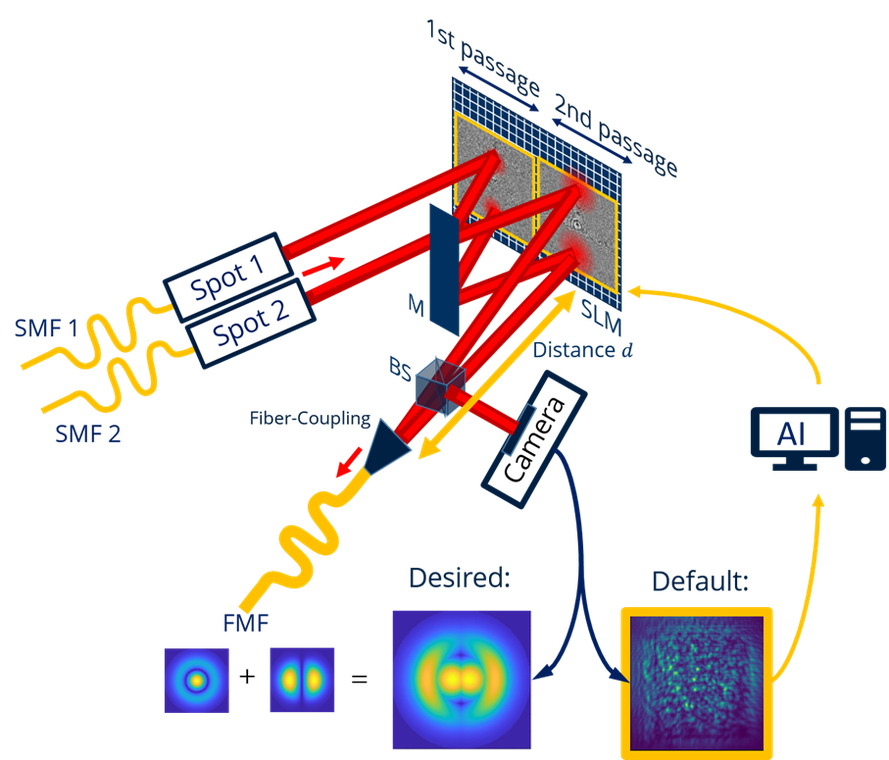
Multiplane light conversion: Two spatially separated Gaussian input spots are incident on the Spatial Light Modulator (SLM). After two reflection passes between the SLM and mirror (M), the output beams are imaged by a 4f telescope onto a camera, where intensity images are captured. The few-mode fiber (FMF) facet and the camera are in conjugate planes. A smart calibration based on artificial intelligence (AI) is implemented to generate appropriate SLM phase masks in order to shape the desired output modes.
Source: Dennis Pohle, Fabio A. Barbosa, Filipe M. Ferreira, Juergen Czarske, and Stefan Rothe, “Intelligent self-calibration tool for adaptive few-mode fiber multiplexers using multiplane light conversion,” JEOS:RP, 2023
Projects include:
- DFG Physical Layer Security of Multimode Optical Fiber Transmission Systems:
Brief introduction + website
Partners: Technical University of Braunschweig - BMBF 6G-life:
Brief introduction + website https://6g-life.de/
Partners: Technical University of Munich and University College London - BMBF QUIET:
Brief introduction from the BMBF + website https://www.forschung-it-sicherheit-kommunikationssysteme.de/projekte/quiet
Partners: Deutsche Telekom AG, IFW Dresden, TUD Dresden University of Technology
Projects include:
Securing Data in Multimode Fibers by Exploiting Mode-Dependent Light Propagation Effects https://spj.science.org/doi/full/10.34133/research.0065
Physical-layer security in multimode fiber-optic networks https://www.nature.com/articles/s41598-020-59625-9
Learning the matrix of few-mode fibers for high-fidelity spatial mode transmission https://aip.scitation.org/doi/full/10.1063/5.0088605
Surveillance of few-mode fiber communication channels using a single-hidden-layer neural network https://opg.optica.org/ol/fulltext.cfm?uri=ol-47-5-1275&id=469958
Contact:
- Prof. Juergen Czarske
Head of the Laboratory of Measurement and Sensor System Technology
Director of the Institute of Circuits and Systems
Director of the Competence Center for Biomedical Computational Laser Systems (BIOLAS) TUD Dresden University of Technology / TU Dresden
Faculty of Electrical and Computer Engineering / Faculty of Electrical and
Computer Engineering
Institute of Circuits and Systems / Institute of Fundamentals of Electrical Engineering and Electronics
Chair of Measurement and Sensor System Technique / Chair of Measurement and
Sensor System Technology
Co-opted Professor of Physics, Institute of Applied Physics, TU Dresden - 01062 Dresden, Germany
Phone: +49 (351) 463-34803 - Fax: +49 (351) 463-37716
Email: juergen.czarske@tu-dresden.de
Fellow of OPTICA (The Optical Society, Washington, DC, USA)
Fellow of SPIE (The International Society for Optics and Photonics, Bellingham, WA, USA) Fellow of EOS (European Optical Society, Joensuu, Finland)
Fellow of the IET (Institution of Engineering and Technology, formerly the IEE, London, UK)
Fellow IOP - FInstP (Institute of Physics, London, UK)
Date: May 6, 2023
