
Dec 01, 2025
Four sets of measures for Spremberg: TUD's ‘2050 Zukunftswerkstatt Lausitz’ (Lusatia 2050 Future Workshop) develops ideas for local energy transition and urban development
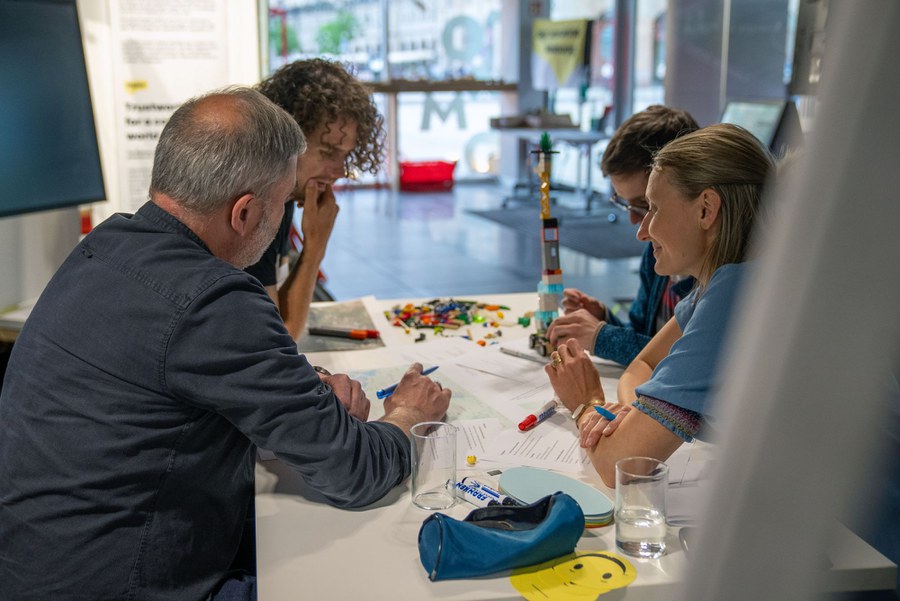
Participants in the Lausitz 2050 Future Workshop
Following successful participation initiatives in Dresden and Spremberg, the closing event of the “2050 Zukunftswerkstatt Lausitz – Energy takes center stage” took place on November 25, 2025. Participants from science, business, politics, and civil society presented their jointly developed visions for the future and measures for both the energy transition and urban development. The results were officially handed over to the Spremberg city administration and discussed with local stakeholders. The Future Workshop was initiated and scientifically supported by researchers from TUD Dresden University of Technology.
A bridge between research and society
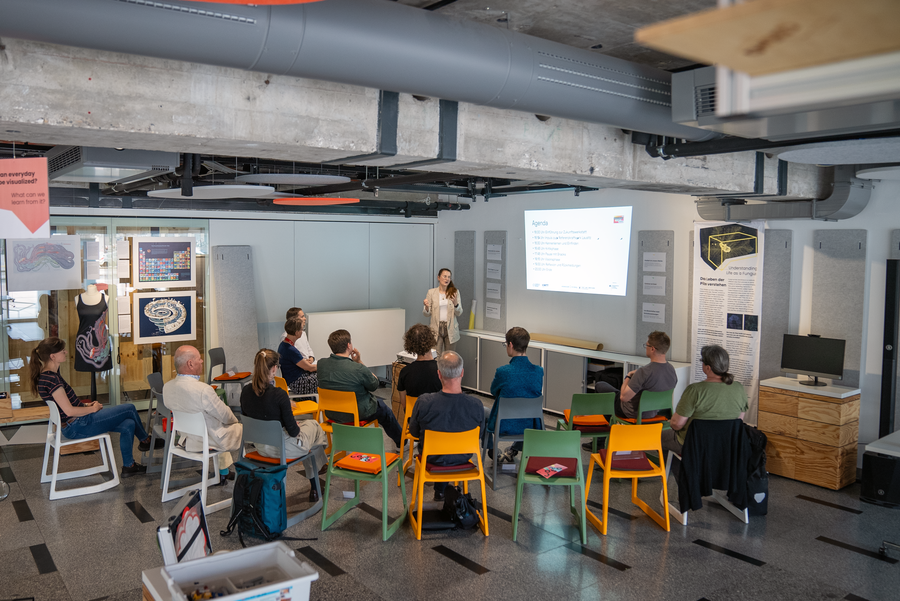
Workshop as part of the Lausitz 2050 Future Workshop
The “2050 Zukunftswerkstatt Lausitz – Energy takes center stage” is a prime example of how participatory events can bridge the gap between research and society and build trust: moving away from one-sided knowledge transfer and toward mutual learning and shared visions.
“The energy transition is not merely a question of technology, but rather of cooperation,” says project manager Katharina Hunger, who is researching the exchange between scientific and non-scientific stakeholders in the structural change of Lusatia. “Our visions show Spremberg in 2050 as a livable city based on the principles of community, education and participation.”
The creative exchange within the Future Workshop took place in three phases and resulted in a shared understanding of the problems associated with the energy transition, visualized images of the future for 2050, and implementation-oriented measures for the four areas of “social cohesion and culture of dialogue,” “climate-neutral Spremberg 2050,” “future prospects for young people,” and “securing skilled workers.”
For example, workshop participants proposed moderated “debate spaces” and created a concrete timeline for their implementation. They discussed how the Paris Climate Goals could be achieved locally in Spremberg through a local energy and heating transition, and the workshops also addressed future prospects for young people in the region. The latter could be improved, for example, by strengthening the youth parliament or establishing youth limited liability companies. Skilled workers are to be retained through cooperation with regional research institutions.
Dialogue on equal footing — and the importance of listening

Participants in the Lausitz 2050 Future Workshop
Workshops with eight to ten participants showed that dialogue on equal footing between science and practice leads to more than purely technological negotiations. In a protected environment that acknowledges individual expertise, the ability to listen becomes central: insights emerge especially when practical knowledge is included.
The jointly developed approaches from different roles and responsibilities are intended to strengthen long-term acceptance and innovation in the Lusatia region. A key insight: The visions for the future and the measures place the community at the center of the energy transition.
Shaping the future through dialogue
Particularly striking were the contrasts between the perspectives of the Dresden group, which focused on technical solutions, and the experiences of the Spremberg participants, who are directly experiencing social change in Lusatia. Through digital networking, the groups maintained continuous dialogue, making regional differences visible while strengthening shared solutions.
Background
At the 2050 Zukunftswerkstatt Lausitz - Energy takes center stage , researchers, citizens and entrepreneurs engage in discussions that address challenges of Lusatia as a region undergoing structural change. Katharina Hunger, Research Associate at the CIMTT Center of Production Engineering and Management at TU Dresden, initiated and led the project. It was funded with EUR 10,000 by the Federal Ministry of Research. Technology and Space (BMFTR) and Wissenschaft im Dialog (German Science in Dialogue Association WiD) as part of the university competition for the 2025 Science Year – Future Energy.
The project results report is available here: https://datashare.tu-dresden.de/s/bBL3N7X3spyFq9P
Contact:
Katharina Hunger
CIMTT – CIMTT Center of Production Engineering and Management
TUD Dresden University of Technology
+49 351 463-33597