
Feb 18, 2026
Interview: Prof. Dr. Thorsten Schmidt on his goals as the new dean
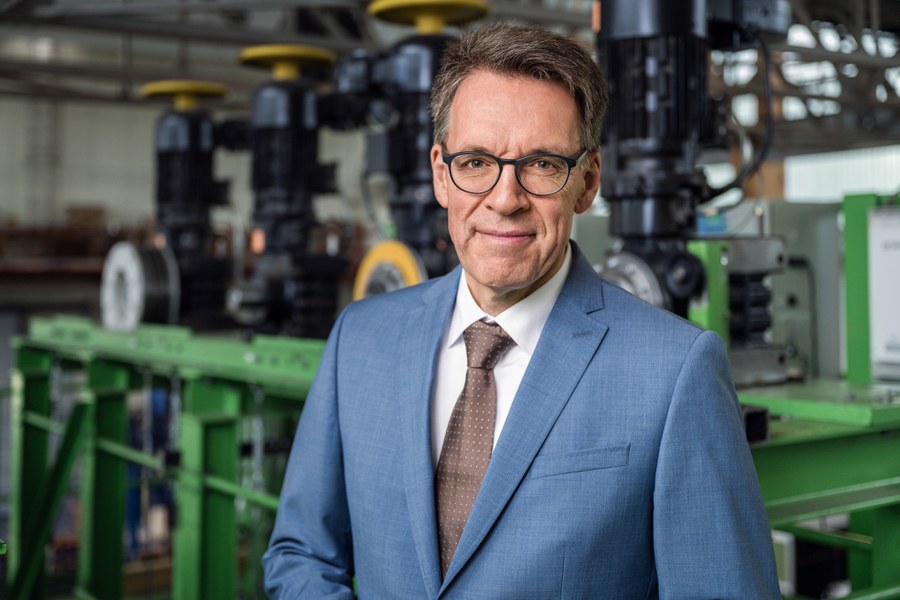
Since January 22, 2026, the Faculty of Mechanical Science and Engineering has been under new leadership: Prof. Dr. Thorsten Schmidt has taken over as Dean. In this interview, the new Dean provides insights into his motivation, looks back on the work of his predecessor Prof. Beckmann and outlines which topics and goals are particularly important to him for the next three years.
Personal introduction
Prof. Schmidt, what motivated you to take on the position of Dean?
Involvement in the tasks of self-administration has always been a matter of course for me. On the one hand, this is due to a sense of responsibility, but also because I enjoy shaping things.
What should people know about you that is not on your CV?
Not only am I a native of Dortmund, I also think I have all the characteristics of a native Westphalian. According to the relevant opinion, these might be down-to-earthness, a certain directness, a little taciturnity and, above all, friendliness.
Retrospect and transition
Your predecessor Prof. Beckmann shaped the Faculty of Mechanical Science and Engineering for several years. What developments from this time do you consider to be particularly important for the current state of the faculty?
When he took office, Prof. Beckmann had to deal primarily with maneuvering the faculty through the outbreak of the coronavirus pandemic. However, this period has also brought amazingly positive things for our day-to-day work and for teaching, which we should continue to develop.
Strategically, however, it has above all initiated a process for the future development of the Faculty, which has resulted in a concept for the differentiated orientation of vacant Chairs. The task now is to bring this concept to life in the coming years.
Goals and plans for the next three years
Where do you currently see the greatest challenges for the faculty - particularly with regard to teaching, financial resources and structural development?
Currently, the teaching workload and the Faculty's financial resources are the main challenges we face.
In teaching, we must therefore strive more than ever to score points with attractive courses. Mechanical engineering in particular provides answers to the major challenges of our time, but we need to communicate these even better, it seems. At the same time, the current AI hype is bringing about major upheavals that are having an impact on degree courses. The faculty is quite unanimous in seeing this development not as a problem, but as an opportunity. In short, those who have sufficient knowledge and skills to correctly assess and evaluate the results of LLM queries will benefit. Basic knowledge therefore remains important, while methodologically new concepts need to be developed and introduced into teaching.
On the other hand, the funding situation forces us to handle the limited resources very carefully. My aim is to find fair and equally effective ways of doing this. In order to leverage synergies, we will have to make do with shared resources. However, this also requires restructuring of the Institutes, which in turn requires new spatial possibilities.
However, networking with other TUD partners, i.e. interdisciplinary cooperation, is not entirely independent of this. On the one hand, this creates solutions for complex challenges; on the other hand, it enables us to strengthen our impact and participate in corresponding programs.
Looking ahead
What are your hopes for your term of office - for the Faculty of Mechanical Science and Engineering and for the people who work and study here?
We can do little about the external conditions at the moment. It is therefore all the more important for me to see the drivers as an incentive for the joint further development of the faculty. My most important wish is therefore to stick together in challenging times.