
Doctorates 2025
This page provides an overview of the dissertations completed at the Institute for Lightweight Engineering and Polymer Technology (ILK) at TU Dresden in 2025. The research projects combine interdisciplinary research with collaboration with partners from academia and industry. Further information on the individual research projects is available via the respective dissertation titles.
Doctoral Student: Tino Wollmann
Supervising Professor: Prof. Dr.-Ing. habil. Maik Gude
Composite materials are characterised by high specific stiffness and strength, direction-dependent material properties and adjustable gradual damage behaviour, making them particularly well suited for the use in modern high-performance rotors. The combination of thermomechanical loading and damage under real operating conditions represents a key challenge in the structural design of rotating composite structures. This thesis therefore investigates the damage-dependent vibration behaviour of rotating composite structures. An analytical method for stress and deformation analysis and a numerical approach for considering crack opening and closing are developed. For an improved experimental characterisation of the vibration behaviour, a co-rotating vibration excitation system and methods for deformation, vibration and damage analysis of rotating structures are designed and applied for the first time. To validate the developed methods, an experimental investigation of different rotor geometries (Fig. 1 and 2) is carried out.
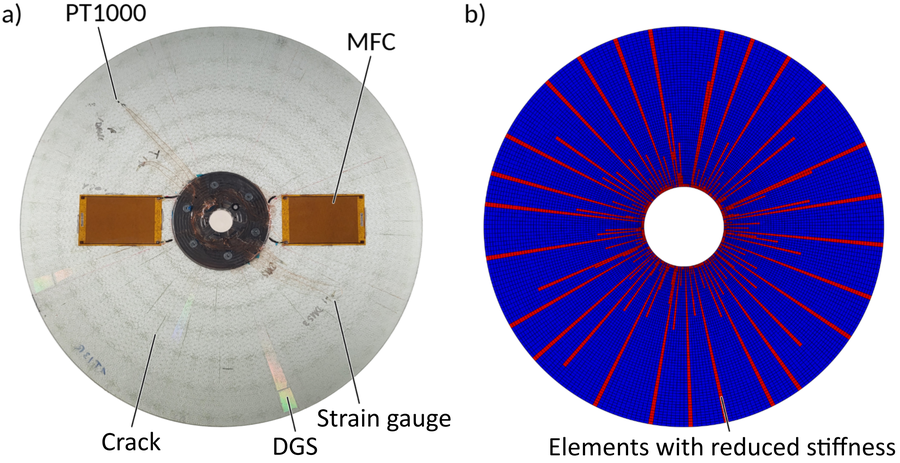
GFRP disc rotor (a) and numerically predicted damage progression (b) after reaching a maximum rotational speed of 7 500 rpm.
The work thus contributes to an improved understanding of the vibration behaviour of rotating composite structures as a function of thermomechanical loading and damage state, as well as to the design and validation of high-performance rotors made of composite materials.
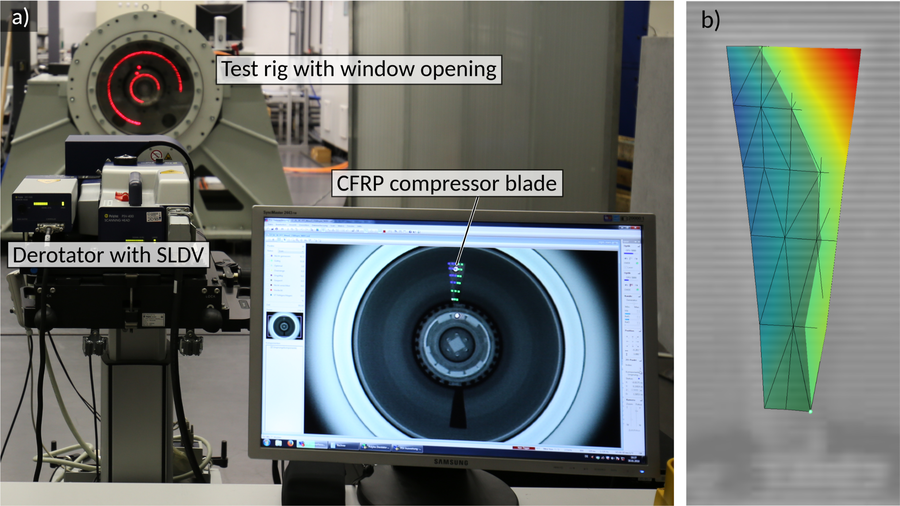
Experimental set-up for the SLDV measurements using an optical derotator during the measurement of a CFRP compressor blade at 1 500 rpm (a) and the identified first torsional mode shape (b).
Doctoral Student: Tom Ehrig
Supervising Professor: Prof. Dr.-Ing. Niels Modler
Consistent lightweight design often leads to an increased vibration susceptibility due to the primarily stiffness- and strength-oriented design approach, particularly in the case of thin-walled components. This susceptibility can result in secondary effects such as noise pollution, reduced performance, or component failure. In order to prevent environmental and health issues, as well as functional impairments or damage-relevant vibrations, passive or active vibration damping measures are often implemented. However, these measures frequently prove to be incompatible with the principles of lightweight design.
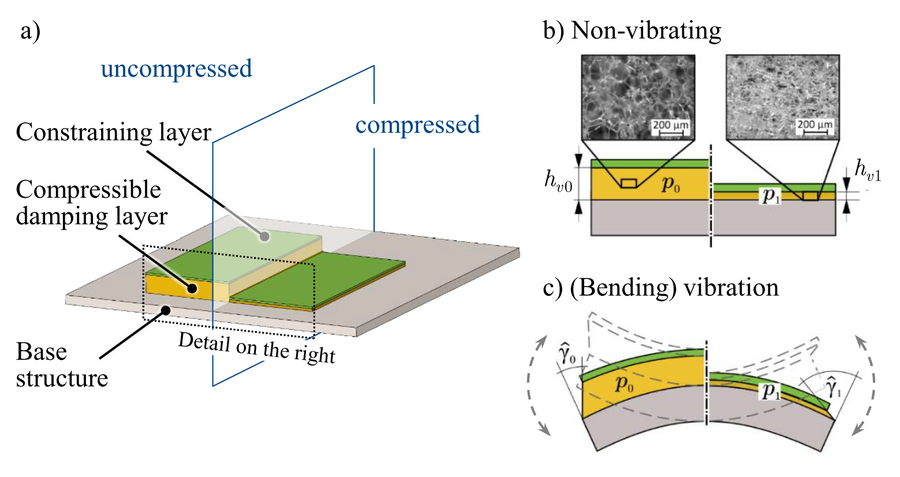
Fig. 01: b) a) Basic design of the CCLD in the uncompressed (left) and compressed state (right); b) cross-section of the structure at rest (no vibration) and c) under (bending) vibration.
In this thesis, a novel semi-active damping method, termed Compressible Constrained Layer Damping (CCLD), is proposed. This method combines the attractive properties of passive constrained layer damping, such as low additional mass and high reliability, with the advantages of active control. After introducing the concept, the work provides a comprehensive description of CCLD, covering material selection and characterization, numerical modeling of the system, and practical demonstration. The proof-of-concept conducted on a generic lightweight structure demonstrates that CCLD is a simple yet efficient method for reducing vibration amplitudes in lightweight structures under variable excitation frequencies. Together with design guidelines derived from extensive parameter studies, this work provides a practical framework for the development of innovative lightweight structures featuring Compressible Constrained Layer Damping.
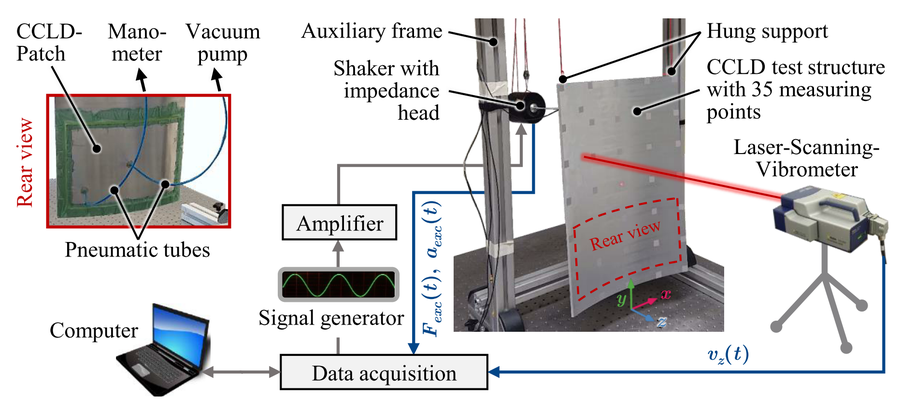
Test setup for the experimental proof-of-concept and validation of the numerical model.
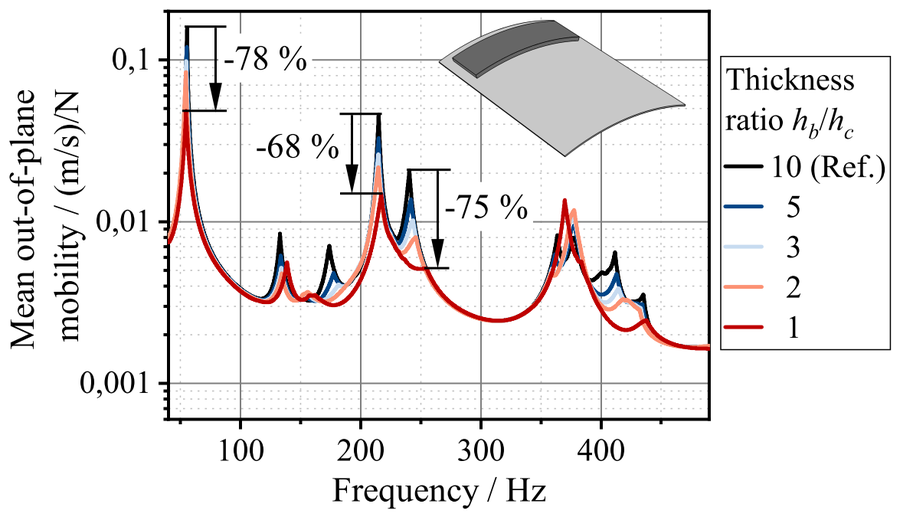
Parameter study to investigate the influence of the thickness ratio (base structure to constraining layer) on the vibration amplitude upon optimal adaptation of the CCLD patch.
Doctoral Student: Dr.-Ing. Magdalena Heibeck
Supervising Professor: Prof. Dr.-Ing. habil. Maik Gude
Recycling is essential for sustainable development and the transition to a circular economy. One of the key challenges in mechanical recycling is the effective liberation of materials from multi-material structures during shredding.
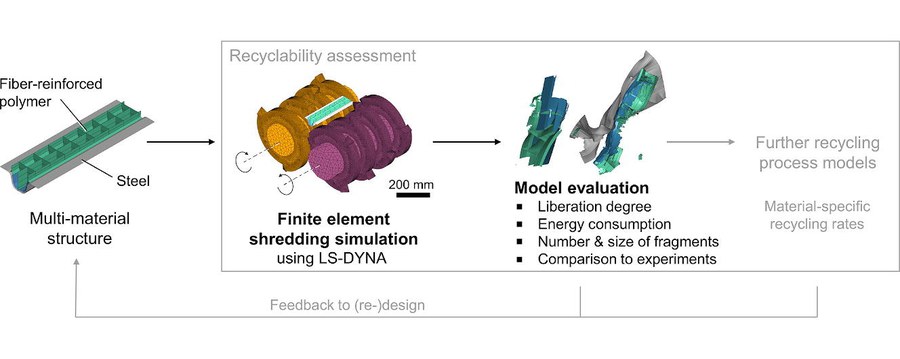
This thesis addresses this previously underexplored aspect by applying the finite element method (FEM) to simulate the shredding process in a rotary shredder. The aim was to develop a simulation-based methodology for predicting shredding performance with respect to the metrics liberation degree, specific mechanical energy consumption, and fragment size distribution.
A numerical model for shredding in a rotary shredder was developed based on experimental trials, using single-specimen tests with hybrid profiles and plates composed of steel and glass fiberreinforced polymers, primarily joined by adhesion. The simulations successfully replicate the complex loading conditions as well as the material-specific fracture and deformation behavior. In addition, an automated post-processing method was developed to efficiently characterize simulated fragments and quantify mechanical energy consumption.
The results demonstrate that FEM-based shredding simulations are a promising tool for predicting shredding performance and represent a novel contribution to the recyclability assessment of multi-material structures.
Further links:
- Dissertation and animation video
https://doi.org/10.1016/j.matdes.2023.112167