
H₂ retrofit propulsion system for general aviation and commuter aircraft, using the Cessna C172 as an example
Project description
Against the backdrop of climate change, solutions must be developed that enable a drastic reduction in greenhouse gas emissions. The aviation sector must also make a significant contribution to this. In addition to the further development of conventional propulsion technologies, new propulsion concepts and alternative fuels are therefore being investigated in particular.
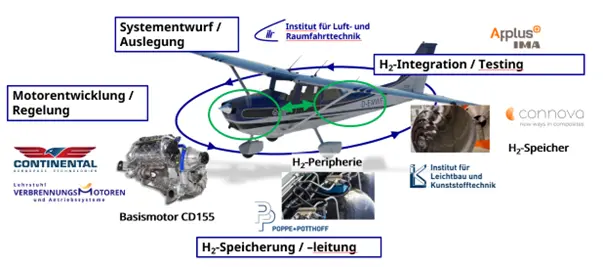
Key areas of work and project partners
One promising option, particularly in the general aviation sector, is the use of hydrogen as an alternative to the fossil-based aviation fuels commonly used today, such as aviation petrol or kerosene. Whilst the use of hydrogen offers potential benefits in terms of its impact on the climate, it also presents the aviation industry with considerable technical challenges. For instance, the storage of gaseous hydrogen in aircraft requires high pressures of more than 300 bar. This necessitates new fuel tank concepts and architectures, which must be optimised in terms of safety, weight and space requirements. Furthermore, the entire fuel system and the engine must be adapted to the specific physical and chemical properties of hydrogen.
In order to develop and test solutions to these challenges in practice, TU Dresden, together with its project partners, is investigating the conversion of a small aircraft to hydrogen propulsion as part of the H2-Ces project. To this end, a research aircraft belonging to TU Dresden – a Cessna 172 – is being converted accordingly. The existing powertrain is to be completely replaced by a system suitable for hydrogen operation. This includes, in particular, the hydrogen tank, the fuel lines and the engine. The aim is to investigate the technical feasibility of such a propulsion system and to gain insights into the future use of hydrogen in general aviation.
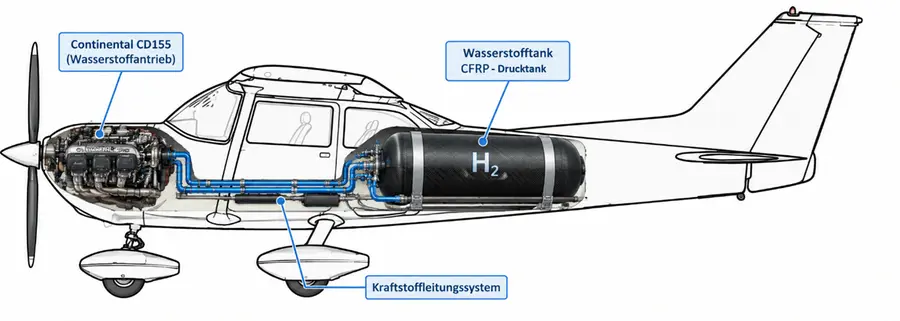
Schematic diagram showing the integration of the hydrogen propulsion system
Project focus
Analysis of requirements and constraints
- This includes, amongst other things, identifying the relevant requirements and clauses of the certification regulations, defining the flight performance requirements to be met, and taking into account the installation spaces and interfaces specified by the Cessna 172.
Development of a Basic System Architecture
- Based on the requirements, a system architecture for the hydrogen storage system, piping system and engine is developed and translated into a virtual system model. This serves to analyse, evaluate and optimise the overall system.
Design and Optimisation of the Hydrogen Internal Combustion Engine
- The individual components of the hydrogen internal combustion engine are designed and optimised in terms of their performance and operational behaviour. The development is supported by extensive experimental investigations on various engine test benches.
Development of a high-pressure hydrogen storage tank using fibre-reinforced composite construction
- The focus here is on achieving high storage capacity and gravimetric storage density, whilst taking into account the constraints of installation space, safety requirements and structural integrity.
System integration and development of the hydrogen piping and safety system
- The tank and engine are combined to form an integrated propulsion system. In addition, the hydrogen piping system and the necessary safety and monitoring systems are designed. The functionality and performance of the individual components are verified through tests and experimental investigations.
Testing of the complete hydrogen system in the TU Dresden aircraft Cessna 172
- The integrated hydrogen propulsion system is being installed in the TU Dresden research aircraft and tested in stages. In particular, the functionality, performance and operational safety of the entire system are being investigated.
Development of a certification concept for the hydrogen propulsion system
- Based on the findings, a certification concept for the hydrogen propulsion system will be developed. This will involve examining the necessary verification procedures, tests and certification requirements for the individual components and the system as a whole.
Partners & Funding
The H2Ces project is a joint venture that brings together experts from research and industry.
Project partners:
- Continental Aerospace Technologies GmbH
- Connova Deutschland GmbH
- Poppe + Potthoff GmbH
- IMA Materialforschung und Anwendungstechnik GmbH
Project data
| Verbundprojekt | H2Ces |
| Projektkoordinator | Continental Aerospace Technologies GmbH |
| Projektpartner |
Connova Deutschland GmbH Poppe + Potthoff GmbH IMA Materialforschung und Anwendungstechnik GmbH TU-Dresden (ILR, ILK, VMA) |
| Projektlaufzeit | 06/2026 - 06/2030 |
| Förderprogramm | Luftfahrtforschungsprogramm (LuFo) VII-1 KTF |
| Förderkennzeichen | 20M2415E |
| Fördergeber | Bundesministerium für Wirtschaft und Energie (BMWE) Gefördert aufgrund eines Beschlusses des Deutschen Bundestages |

Federal Ministry of Economic Affairs and Energy
Kontakt

Kontakt Forschung
Send encrypted email via the SecureMail portal (for TUD external users only).
Certificate of DFN-PKI for encrypted email communication.