
Concluded projects
ACTiVE

Investigation of secondary injection with a linear aerospike nozzle at DLR Lampoldshausen

Nozzle mount with 6-axis force measurement and integrated linear aerospike nozzle
In the project "AerodynamiC Thrust VEctoring" (ACTiVE), funded by the state of Saxony, aerospike engines with aerodynamic thrust vector control were investigated. This was achieved both by numerical simulations and by means of numerous cold gas experiments. Aerospike engines with aerodynamic thrust vector control are an innovative engine design with high application potential for a variety of spacecraft. Examples include the use in upper stages of launch vehicles and in satellites for orbit and attitude control. The Space Transportation research group is investigating this innovative engine technology in order to understand the wider applicability in the space industry. The advantages of aerospike nozzles over conventional bell nozzles lie in increased performance potential due to continuous adaptation to the ambient pressure, thus improved propellant utilization, a compact and highly integrated design, and system mass savings due to simplified integration. The aerospike nozzle concept with aerodynamic thrust vector control was investigated in various cold gas test setups in order to characterize the parameters influencing the generation of thrust and steering forces. For this purpose, a cold gas nozzle test rig was set up at TU Dresden to measure the force generation of a large number of additively manufactured nozzle variants. In further experiments, the pressure distribution on the nozzle surface was measured on a larger test rig in cooperation with the DLR Institute of Space Propulsion in Lampoldshausen. Based on these investigations, engineering models were then developed to describe the nozzle flows, and promising applications were tested for their feasibility. The project was unique in Europe and was able to open up new fields of research and application for Saxony's industrial and research landscape. As a result, three follow-up projects were launched at the beginning of 2020 and, building on the ACTiVE project, a 500 N aerospike engine was additively manufactured by the Fraunhofer Institute for Material and Beam Technology (IWS). This engine was investigated in 2019 as part of a hot fire test campaign by the Space Transportation research group.

Hot fire test of the aerospike engine manufactured in cooperation with the Fraunhofer IWS
ASCenSIon

ASCenSIon was an Innovative Training Network funded by the European Commission in the frame of Horizon 2020, whose goal was to contribute to a sustainable and independent space access for Europe. To achieve this, a consortium of 24 partners ensured that 15 doctoral students were trained to become outstanding specialists in their field and gained a comprehensive understanding of the complexity, multidisciplinarity and internationality of launch vehicle development. The acronym stands for “Advancing Space Access Capabilities – Reusability and Multiple Satellite Injection” and it well describes the focus of the project to research several areas of space access. The three main research areas of the project were propulsion technologies and their reusability, Guidance, Navigation and Control (GNC), and aero-thermo-dynamics of re-entry and safe disposal. The core of the project were the 15 Early Stage Researchers (ESRs), talented PhD students of different disciplines, nationalities and ages who were enrolled in different countries across Europe and employed within the project for maximum 36 months. The ASCenSIon consortium was coordinated by the Technische Universität Dresden and the project culminated in a dedicated conference in Dresden in 2023.

ASPIRER
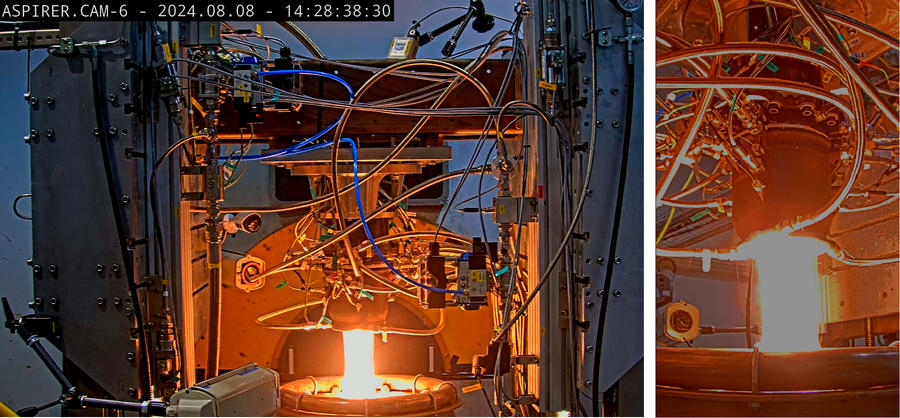
Within the framework of the ESA funded project "AeorSPIke Rocket Engine Realisation" (ASPIRER), an additively manufactured aerospike breadboard thrust chamber using kerosene and hydrogen peroxide as propellants was developed and tested. The engine is designed for 6 kN thrust at 2.0 MPa chamber pressure and was manufactured from nickel-based superalloy INCONEL® 718 powder using the laser powder bed fusion process (LPBF). A staged-bipropellant concept was applied, where hydrogen peroxide was decomposed by a catalyst and combustion was initiated by kerosene autoignition. The overall objective of the activity was a verified bread board engine, which was experimentally tested in a final hot-fire test campaign in 2024. The project is part of the overall effort at TU Dresden to overcome the low Technology Readiness Level (TRL) and the resulting uncertainties associated with aerospike engines and was carried out in cooperation with Fraunhofer Institute for Material and Beam Technology (IWS), the Łukasiewicz Institute of Aviation and ArianeGroup.
CFDµSAT

Engine components during manufacturing via LPBF
Within the CFDµSAT project, the additive manufacturing of metallic components for rocket engines was investigated as part of the Agent3D program (funded by the German Federal Ministry of Education and Research within the innovation campaign Zwanzig20). The focus was on injector heads and cooling channels for novel engine concepts. The overall process chain considered in the project for the manufacturing of complex fluidic components comprised the design, additive manufacturing using laser powder bed fusion (LPBF), post-processing of functional surfaces, quality assurance and testing. The use of simulations and experimental investigation of individual structures supported the design of the final components. Structures manufactured by LPBF have relatively high surface roughness and shape and position tolerances, which initially do not meet the requirements of many fluid technology applications. For this reason, the post-processing methods of abrasive flow machining (AFM) and laser drilling were investigated in order to refine internal channels on the one hand and to introduce fine holes in a defined manner on the other. At the end of the project, based on the knowledge gained, an aerospike engine was additively manufactured using LPBF, together with the cooperation partners of the Fraunhofer Institute for Material and Beam Technology (IWS) and the Institute of Materials Science (IfWW) of the TU Dresden, which will be used for future test campaigns.

Additively manufactured engine components
LUNAR ISLANDS

Interaction between cold gas jet and glass spheres in cold gas investigations
In the LUNAR In-Situ LANDing Structures (LUNAR ISLANDS) project funded by the European Space Agency (ESA), an international consortium led by TU Dresden investigated the effectiveness of in-situ manufactured structures for containing high-speed particles. These particles are created by the interaction between the engine exhaust of landers and the lunar surface and pose a significant risk to lunar missions.
The project involved the manufacturing and characterization of samples made from lunar regolith replica, experimental investigations using cold and hot gas tests, and numerical simulations of the interaction between engine exhaust and lunar regolith.
For the experimental work, the Technical University of Berlin produced sintered test specimens from regolith replica, while laser-melted structural test specimens were produced at the Technical University of Clausthal. These samples were subjected to both cold and hot gas tests in an extensive test campaign. At the University of Glasgow, the interaction between a small-scale cold gas nozzle, the test specimens, and regolith replica as well as glass balls with reduced density was investigated in a vacuum chamber to simulate the reduced lunar gravity. ONERA conducted additional tests on the influence of a hot rocket exhaust jet (hybrid engine) on the test specimens.

Hot gas investigation to examine the erosion behavior of laser-melted test specimens
A method developed at TU Dresden enabled detailed insights into erosion processes to be gained using 3D scans taken before and after the hot gas experiments. The test specimens and source material were characterized at TU Braunschweig.
Parallel to the experimental work, numerical models were developed and validated using the test data. Three numerical methods were combined: Computational Fluid Dynamics (CFD) simulations for the continuum region of the flow, Direct-Simulation Monte-Carlo (DSMC) simulations for the rarefied gas flow, and Discrete Element Method (DEM )simulations for particle interaction. The coupling of CFD and DSMC was implemented at TU Dresden, while the coupling of CFD and DEM was carried out at TU Braunschweig.

Laser-melted test specimens (left); camera image of the test specimen during testing (center); analysis of erosion (right)
MACARONIS

ceramic aerospike nozzle
As part of the project "MAnufactured Ceramic AeROspike Nozzle In Space" (MACARONIS), which was funded by the state of Saxony with ERDF funds, additively manufactured ceramic aerospike engines were investigated for use in cold gas propulsion systems for satellite applications. This was done by numerical simulations as well as by numerous experiments and a propulsion system demonstrator. The use of additive manufacturing opens up completely new application forms and fields for many materials, as well as new potentials for increasing performance and reducing mass. Among other domains, this is absolutely essential for the technology driver aerospace technology. The great interest of aerospace technology in additively manufacturable ceramics is due to a large number of advantageous material properties such as low density, high heat resistance and high strength. In this joint research project between TU Dresden and the Fraunhofer Institute for Ceramic Technologies and Systems (IKTS), these advantageous characteristics of additively manufactured ceramic components were transferred to a propulsion concept for satellites. Within the project, a cold gas satellite propulsion system with a ceramic nozzle was developed, which can be experimentally explored in future space missions. This development was implemented in the form of a propulsion demonstrator using nitrogen as the working gas. Aerospike engines researched at the ILR served as the basis for the developed propulsion system.

Demonstrator for the cold gas propulsion system with ceramic, additively manufactured aerospike nozzle
RDRS
POLARIS is developing reusable multi-role spacecraft based on initial concepts developed by the German Aerospace Center (DLR e. V.) in 2015-2018. Specific features include aircraft-like takeoff and landing on conventional runways and the ability to autonomously change mission bases. Reusability and airplane-like operations lead to potential cost reductions compared to conventional missiles and enable greater responsiveness, flexibility, and safety for launch systems. The horizontal launch spacecraft under development at POLARIS offer a multi-mission capability that covers various commercial and defense mission scenarios, including satellite launches, orbital cargo transport, and future manned spaceflight. Within the project "Rapid Deployable Reconnaissance System" (RDRS), a concept study for POLARIS was conducted within the Space Transportation Systems Research Group to investigate the suitability of aerospike engines for such multi-mission spacecraft. Aerospike engines appear to be of particular interest for such vehicles with a diverse altitude profile due to their continuous adaptation to changing ambient pressures.
SMART-Rockets

Based on the funding program STudentische Experimental-RaketeN (STERN) of the German Aerospace Center (DLR), a number of students from different semesters developed a small sounding rocket as part of their studies at the TU Dresden. Notably, is has been the only project within STERN that dared to develop a rocket with liquid propellants. In this project, called SMART-Rockets, a wide range of students were familiarized with the topic of small rockets and all their subsystems, which in turn are closely resembling those of large launch vehicles. This gave them a complete system-wide overview of a complex technological system, from design to quality control. In the course of the project, a transportable test stand for a combustion chamber with a thrust of 500 N was designed, manufactured and validated. On this test bench, the students learned how to handle the fluids liquid oxygen (LOX), liquid nitrogen (LN2) and ethanol and developed and qualified a new type of injector with an associated combustion chamber. Although the launch of the planned MIRA rocket could not be realized within the project, the entire propulsion system and a variety of other components were finalized as part of SMART Rockets.

In-house developments within SMART-Rockets: pyrotechnic valve (left), propellant tanks for LOX (center), thrust chamber made of graphite and ceramic materials (right)
SR Dorado
As part of the STERN III (STudentische ExperimentalRaketeN) funding program of the German Aerospace Center (DLR), TU Dresden launched a new development project called SR Dorado in 2022. As a follow-up project to SMART Rockets, the Institute of Aerospace Engineering (ILR) developed a new, larger, and more powerful sounding rocket in cooperation with the student group STAR Dresden. The focus of this development project was on the practical training of students in the field of rocket development. The aim was to promote both subject-specific training as a supplement to university courses and working in project structures and the development of social skills.

Part of the Flightmaster 2000 on-board computer developed in the project
The work carried out in the project included the development of numerous key components for the planned sounding rocket and the commissioning of a mobile test bench for investigating liquid propulsion systems. Other highlights include the development of pyro valves for helium, ethanol, and liquid oxygen, a circuit board-based, modular flight computer, and fuel tanks for helium and ethanol. In addition, several engine iterations were designed and experimentally tested by the students involved in the project in extensive cold and hot gas campaigns. The project formally ended in mid-2025., The goal of a successful launch continues to be pursued and is currently being driven forward by the student university group STAR Dresden with the support of staff from the Chair of Space Systems.

Hot fire test of the second engine iteration for the SR Dorado project at the M11 test facility at DLR Lampoldshausen